Lines & Angles
In mathematics when we talk about a line, we are always talking about a straight line. If it isn’t straight then we call it a curve.
When two lines meet each other (e.g. intersect), where they meet is called a point.
We usually use capital letters to name points.
In mathematics, a line “goes on forever” in both directions. If it only “goes on forever” in one direction, we call it a ray.
If we have two rays (or lines) going in different directions, we can measure the difference between those directions as an angle. We also sometimes call the space between the point where they meet and angle.
If lines (or rays) never meet, we say that they are parallel.
Exercise 1

Labelling
If a line doesn’t “go on forever” in any direction, we call it a line segment.
If a line segment goes from point A to point B, we will often call it AB.
If there are two line segments, one going from point A to point B and the other going from point A to point C, we call the angle between them BAC (notice that the middle letter is the point where the angle is).
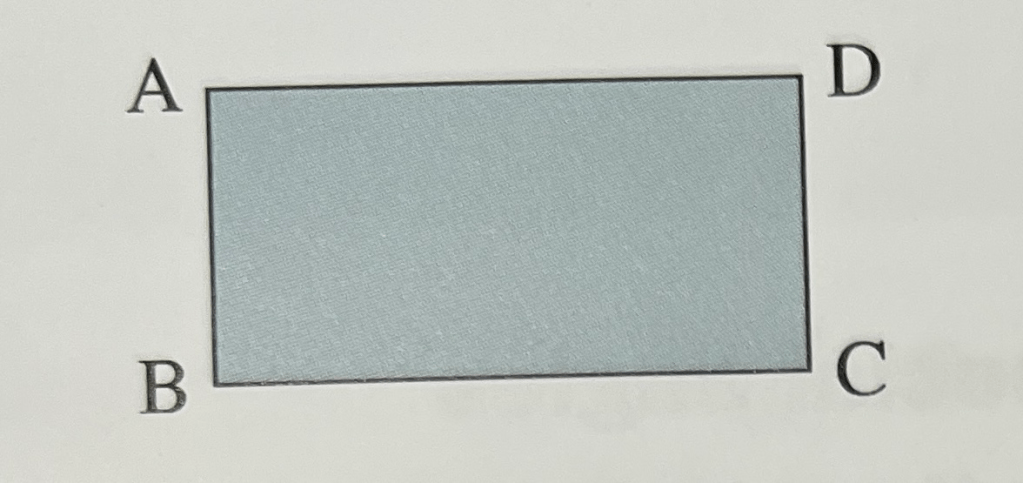
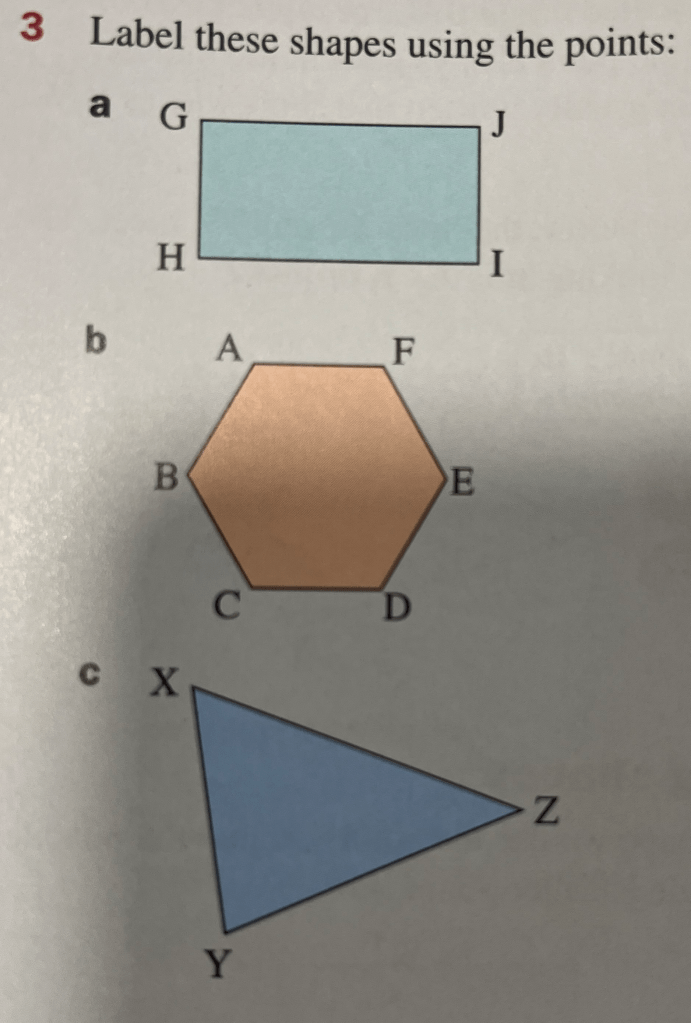
To refer to a shape, we list out the points around it. So the below rectangle would be called ABCD (you could also call it ADCB if you really must):
Exercise 2

Measuring Angles
- We need to be able to:
- Estimate the size of an angle, which means look at it and have a sense of its approximate size; and
- Accurately measure angles using a protractor.
The largest angle we will look at is 360º, which is a complete turn. Half a turn, or the angle on a straight line is 180º. A quarter turn, which we call a right angle is 90º. What do you think a three quarter turn would be?
Worked Example
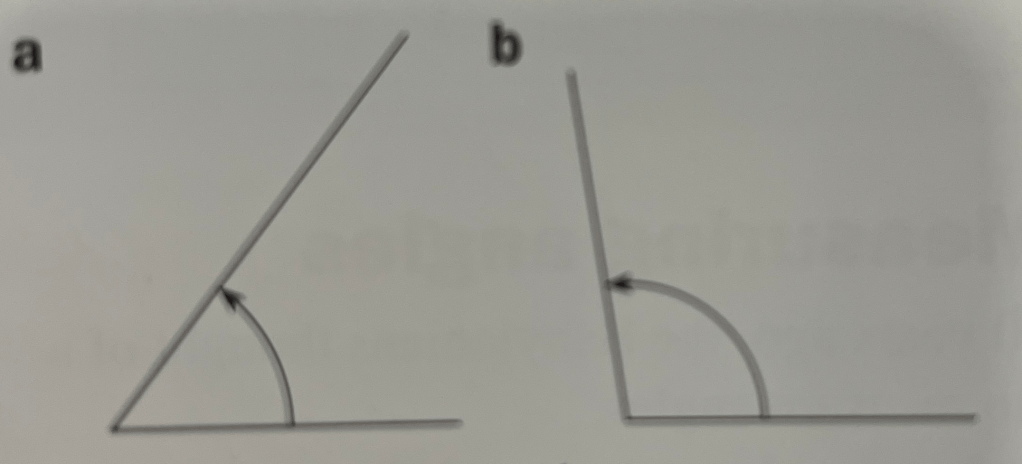
1.) Let’s try to estimate the size of these two angles:
2.) Draw five different angles in your book, measure them and make a private note of their measurement, then ask your friend to measure them and check to see how accurate she is.
Angles larger than 360º
With angles larger than 360º, which we call reflex angles, it is normally easier to measure the “other part” of the angle and subtract that from 360º.
Angles which are less than 90º are called acute angles and angles between 90º and 180º are called obtuse angles.
Exercise 3
In this exercise, any angles that you are asked to measure, please do a rough copy of the diagram in your book and then measure the angle that you have drawn.


Drawing Angles
As well as being able to use our protractor to measure angles, we also need to be able to use it to draw angles.
Worked Example
Draw the angle PQR = 55º
Draw the angle ABC = 235º
Exercise 4
As in the last exercise, if you are asked to measure something, make a rough copy of it in your book and then measure that.
1.) Draw a line segment in your book and label it XY
2.) Use a protractor to draw the 55º angle ZXY on your line.
3.) For each of the following angles, do the following three things (i.) Decide is is acute, obtuse or reflex, (ii.) Draw what you think it should look like, using only your ruler and pencil, (iii) Draw it properly, using a protractor. How good were your guesses?
(3a.) 60º, (3b.) 78º, (3c.) 335º, (3d.) 90º, (3e.) 120º, (3f.) 244º
4.) Do the same as in question 3, but for the following angles:
(4a.) 177º, (4b.) 10º, (4c.) 212º, (4d.) 136º, (4e.) 94º, (4f.) 300º
5.) Draw five different smallish line segments in your book and measure each one to the nearest millimeter. Ask the person next to you to do the same and see if you get the same answer.
6.) Without using a ruler, put two points in your book that you think are 5cm apart. Now measure them. How close were you? Try this with a few different measurements to see if you get closer.
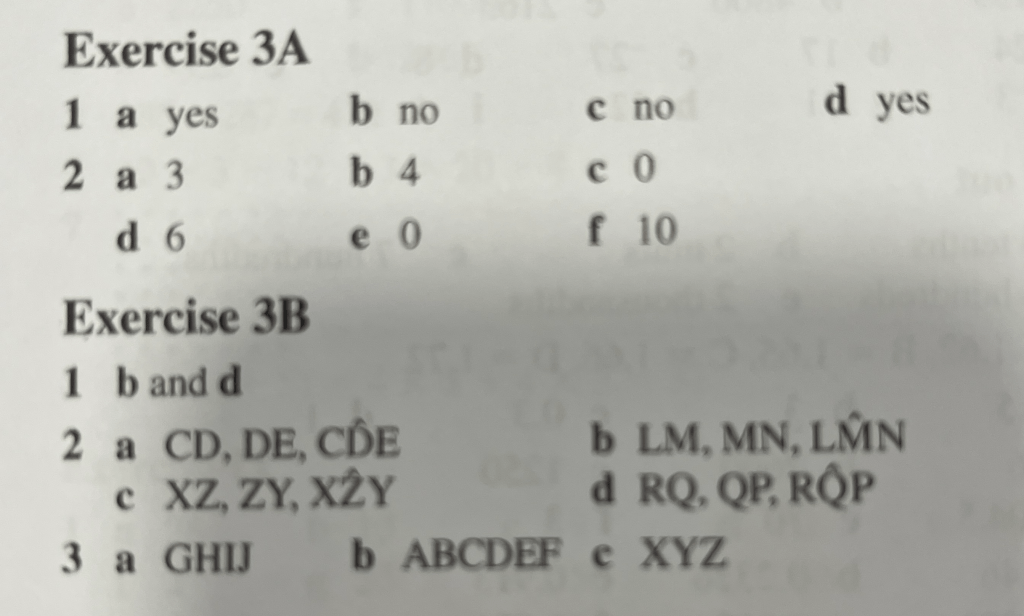
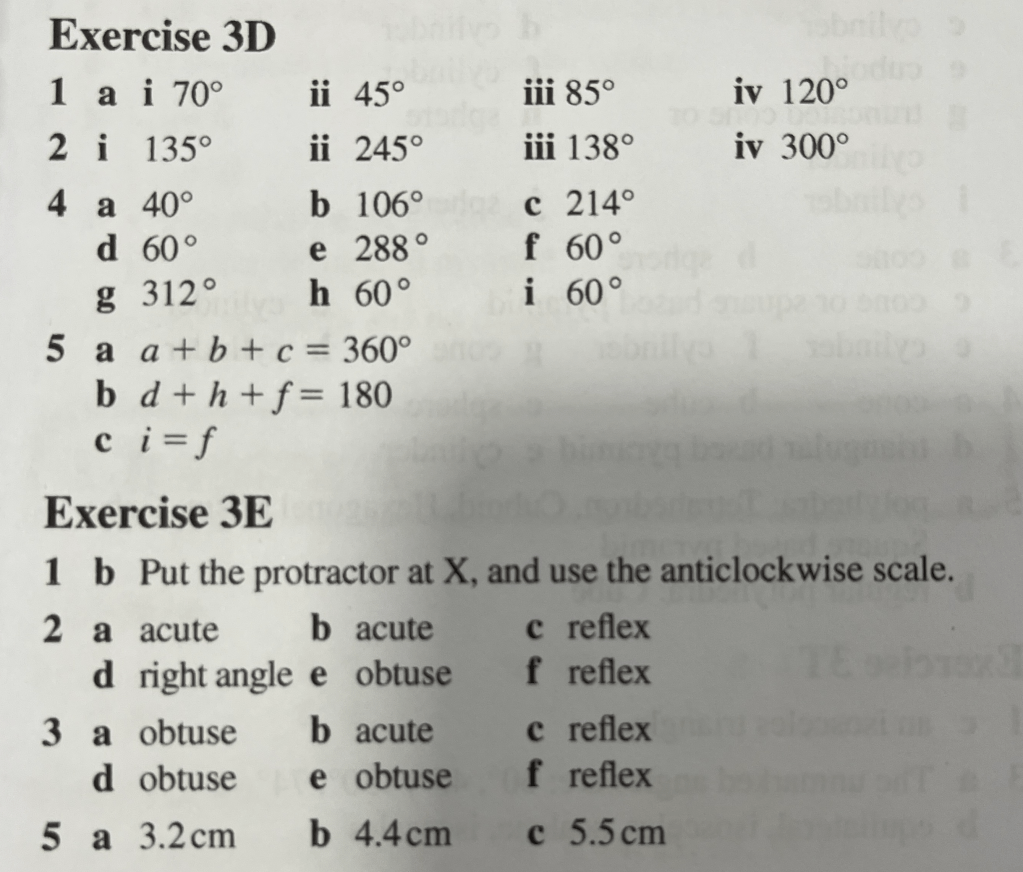
Answers to all four exercises
 Maths with David