We often think of fractions as being less than one, because they are parts of a whole. But if we have many, many quarters of a pizza, we end up having more than one pizza. This is why fractions can be greater than one.
There are two different ways to write fractions that are larger than one.
Improper fractions. An improper fraction has the numerator larger than the denominator, e.g. 9/4. This form is quite useful for calculating with, especially with multiplications or divisions.
Mixed numbers. A mixed number has a whole number part and a fraction part which is less than one, e.g. 2 1/4. This form is useful for giving a final answer, as it is easier for people to understand the quantity by comparing it with whole numbers.
Exercise 1


Converting between improper fractions and mixed numbers
To convert from an improper fraction to a mixed number, we divide the numerator by the denominator. This gives us the whole number part and the remainder gives us the numerator of the fractional part.
To convert from a mixed number to an improper fraction, we multiply the whole number part by the denominator and add this to the numerator to get our new numerator.
Worked Example
- Convert these improper fractions into mixed numbers:
- 8/5
- 18/7
- Convert these mixed numbers into improper fractions:
- 1 5/7
- 3 1/4
Exercise 2
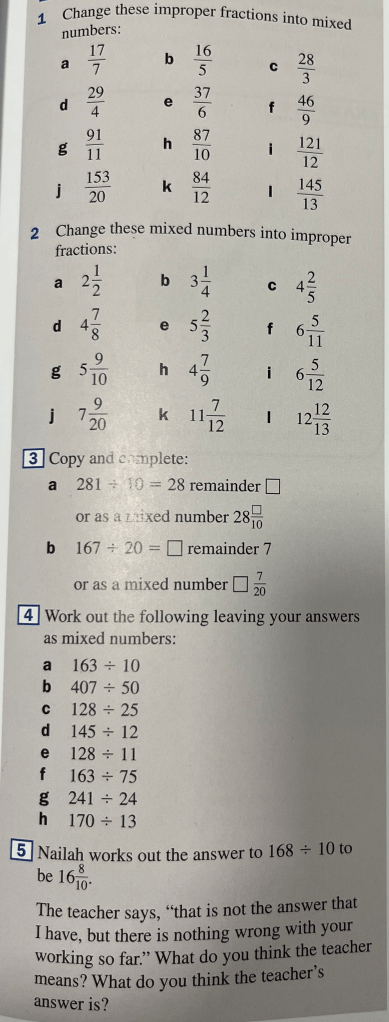
Answers to both exercises


 Maths with David