The standard unit of length is the metre.
Other units of length are defined in relation to the metre based on their prefix:
- 1000 nanometres = 1 micrometre
- 1000 micrometres = 1 millimetre
- 10 millimetres = 1 centimetre;
- 100 centimetres = 1 metre;
- 1000 metres = 1 kilometre,
Area, because it is 2 dimensional, has different units, and is measured in “millimetres squared”, “centimetres squared”, “metres squared” and “kilometres squared”. The conversion is a little bit different -> if we draw a square centimetre and break it up into millimetres, we will see why:
- 100mm2 = 1 cm2;
- 10,000cm2=1m2;
- 1,000,000m2=1km2.
We can convert by any of these by multiplying by the large number if we want the number to get bigger (e.g. going from m2 to cm2) and dividing by the large number if we want the number to get smaller (e.g. going from cm2 to m2).
We should also be aware of a unit called hectare, which is equal to 10,000m2. To convert from metres to hectares, we divide by 10,000 and to convert from kilometres to hectares, we multiply by 100.
Exercise
Let’s complete exercises 5B and 5C on pages 73 to 75 of the textbook:
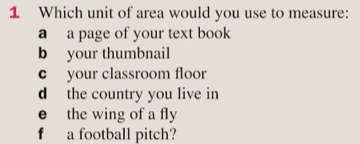

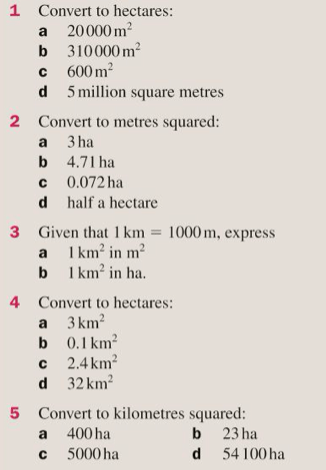

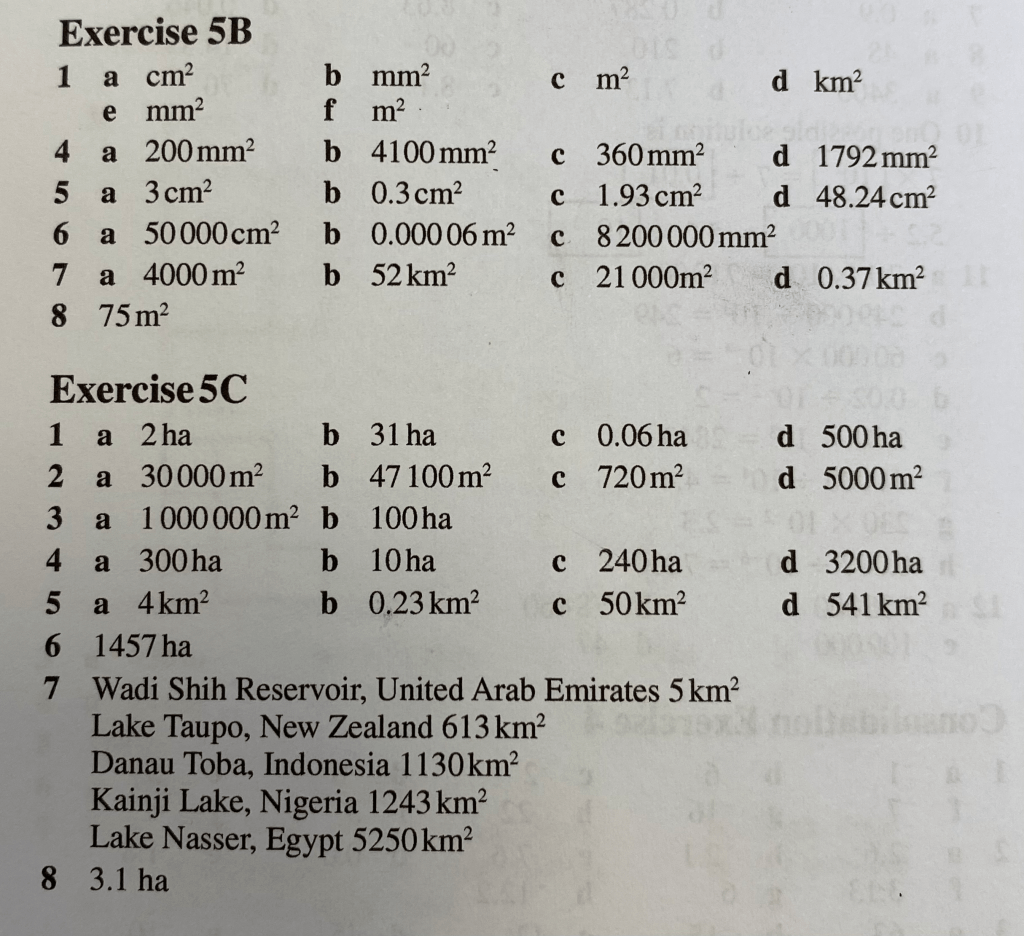
The answers are below:
 Maths with David