If we have a number like 3.2814893140784325973845703457, we normally don’t want to write it out in all its detail (sometimes the number goes on forever, so we couldn’t even if we wanted to.
Because of this we typically write numbers in rounded form, where we round them either to a certain number of decimal places, or to a certain number of significant figures. For very large and very small numbers we also have a special way of writing a number which is called standard form.
Rounding to a number of decimal places
Let’s try with the teacher rounding numbers to different numbers of decimal places. The number lines below may help us.


Exercise
Let’s complete exercise 7A from pages 98 and 99 of the textbook:

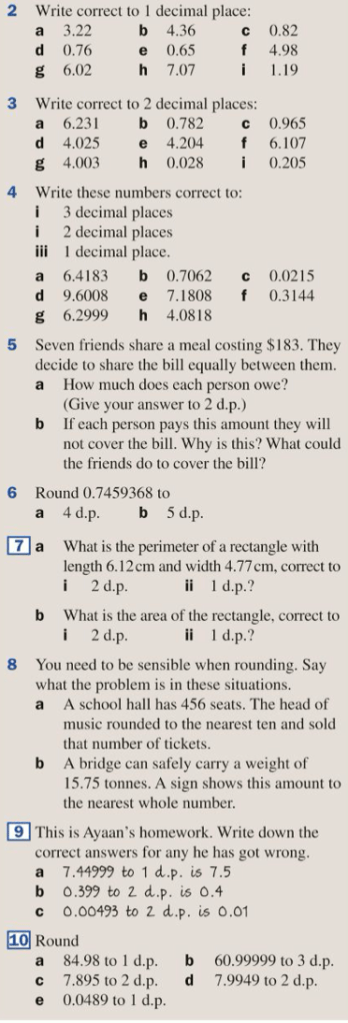
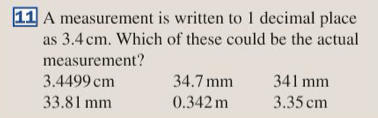
The answers are below:
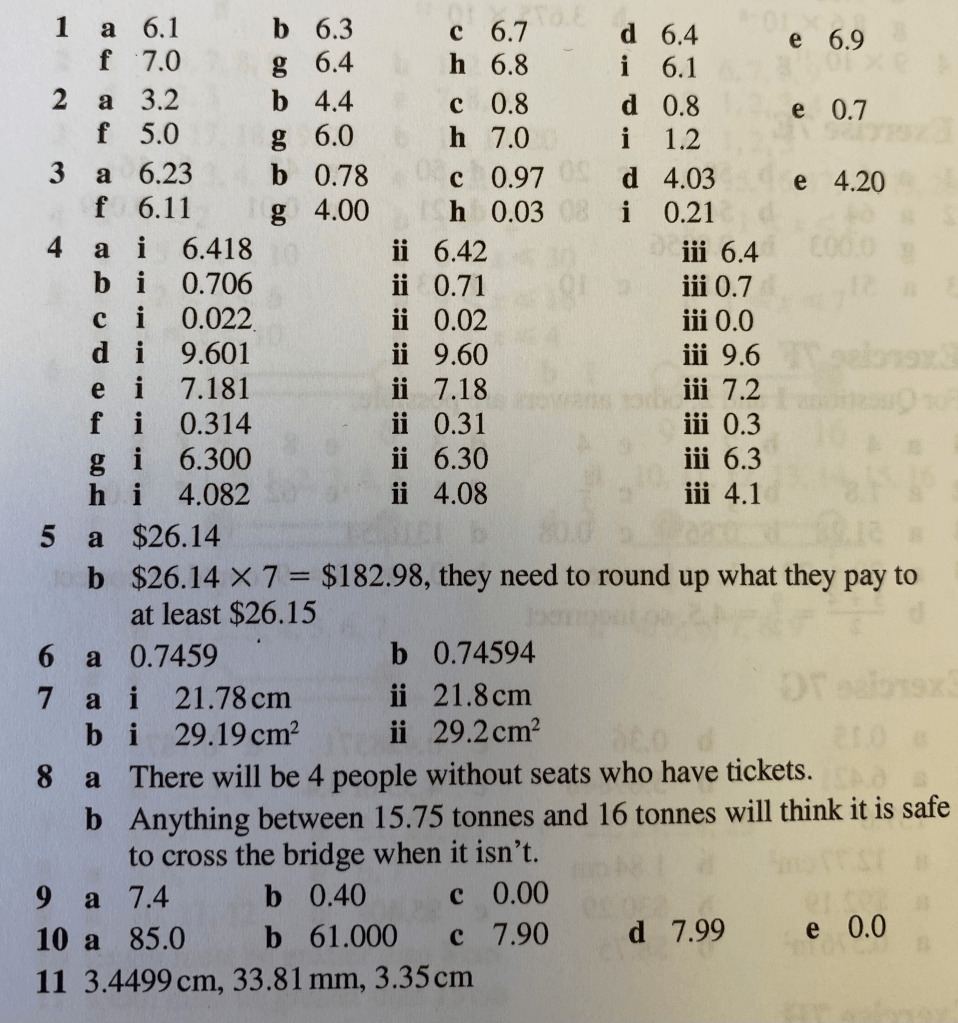
Rounding to a number of significant figures
When we are asked to round to a number of significant figures, we count that number of digits from the number’s first digit (or in the case of very small numbers, from the number’s first non-zero digit). We follow the same rules that we follow when rounding to a number of decimal places, in that we need to consider the following digit always to decide whether to round up or down.
Example
- Round 67,346 to:
- 4 significant figures;
- 3 significant figures;
- 2 significant figures; and
- 1 significant figure.
- Round 0.03286 to:
- 4 significant figures;
- 3 significant figures;
- 2 significant figures; and
- 1 significant figure.
Exercise
Let’s complete exercise 7B from pages 99 and 100 of the textbook:
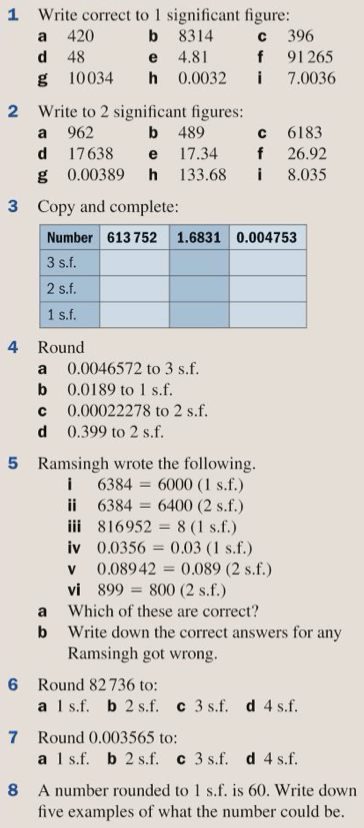
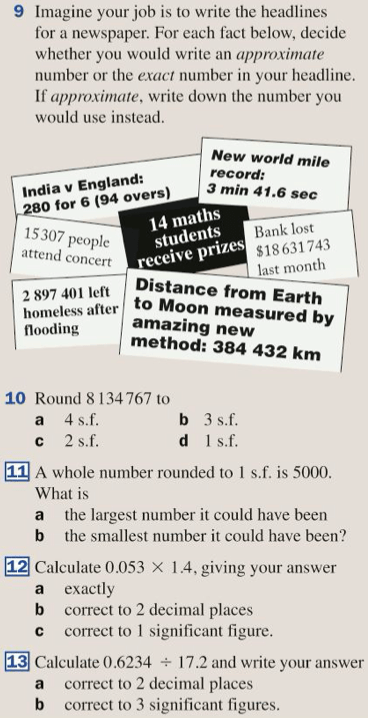
The answers are below:

Standard Form
Very large and very small numbers can be written in a special way called standard form, so that we don’t waste time writing lots of zeroes. The rule below for writing a number in standard form should be copied into your textbook
To write a number in standard form, we rewrite it is as a number between 1 and 10 multiplied by 10 to an appropriate power.
Examples
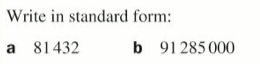
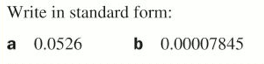
Exercise
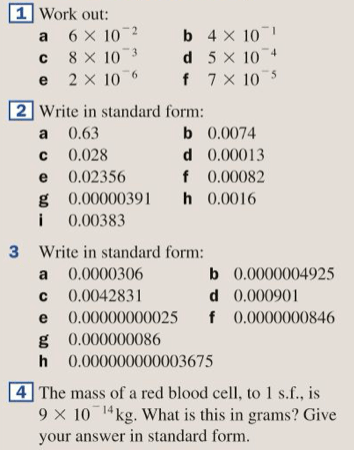
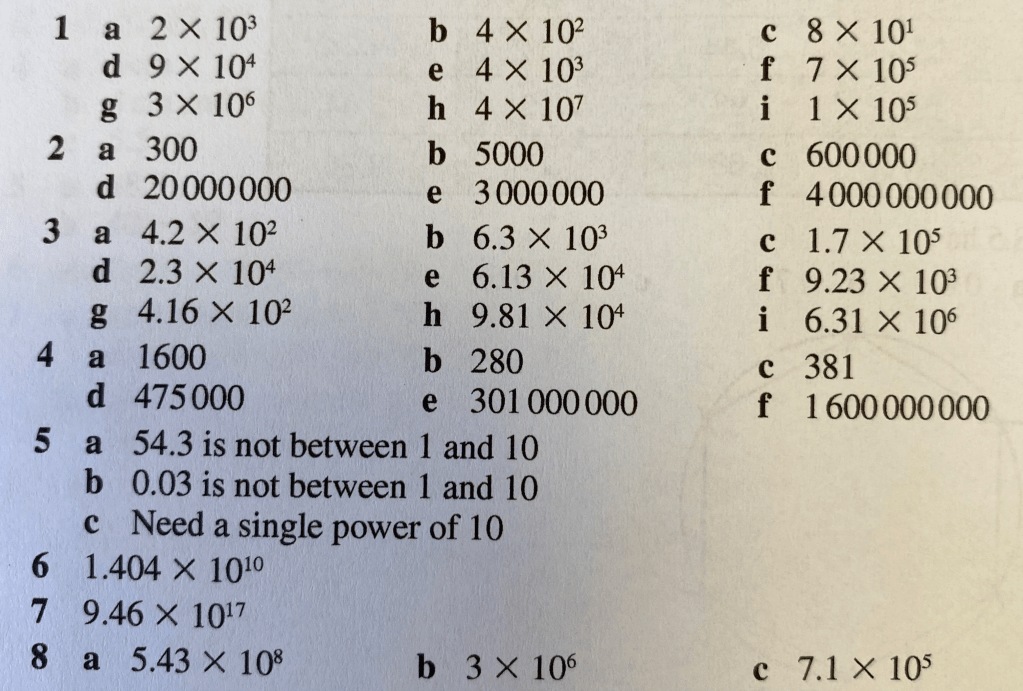
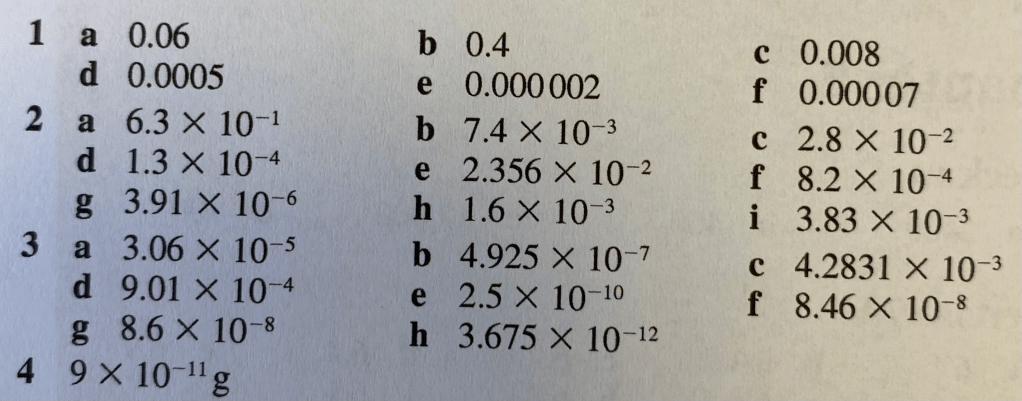
Let’s complete exercises 7C and 7D from pages 100 to 102 of the textbook:

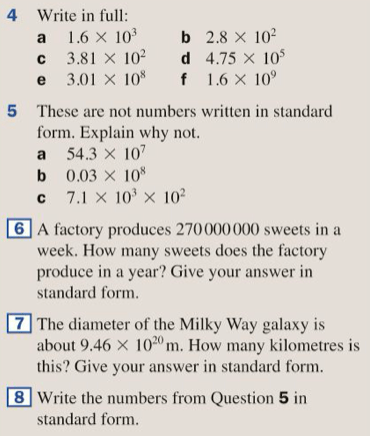
The answers are below:
 Maths with David