A random variable (“RV“) is an unknown quantity whose value can differ over a set of values, each with different probabilities, e.g.
- Result when two coins are tossed;
- Sum of two dice thrown.
A probability distribution is a list of all the possible values an RV can take alongside their corresponding probabilities
N.B. With probability distributions, it is useful not to simplify fractions unless explicitly required.

Worked Examples
Three coins example
Three coins are tossed:
- List all the possible outcomes when the three coins are tossed.
- A random variable, X, is defined as the number of heads when the three coins are tossed. Write the probability distribution of X.
Spinner example
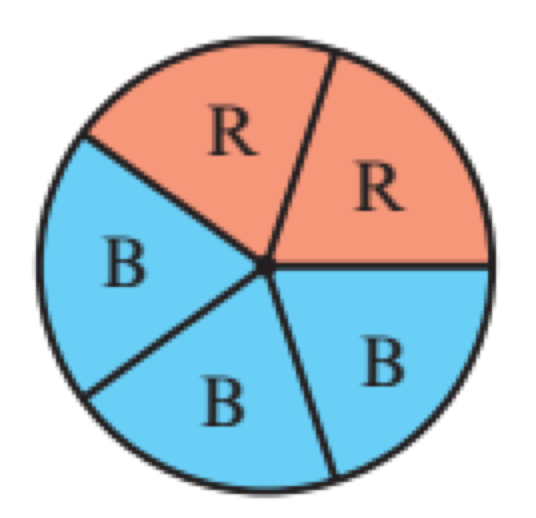
This spinner is spun until it lands on red or has been spun a total of four times. Find the probability distribution of the random variable S, the number of times the spinner is spun.
Table Worked Example
The following table shows the probability distribution for the random variable V. Find the value of the constant c and find P(V>4).
| v | 2 | 3 | 4 | 5 | 6 |
| P(V=v) | 0.05 | c2 | c+0.1 | 2c+0.05 | 0.16 |
Exercise 1

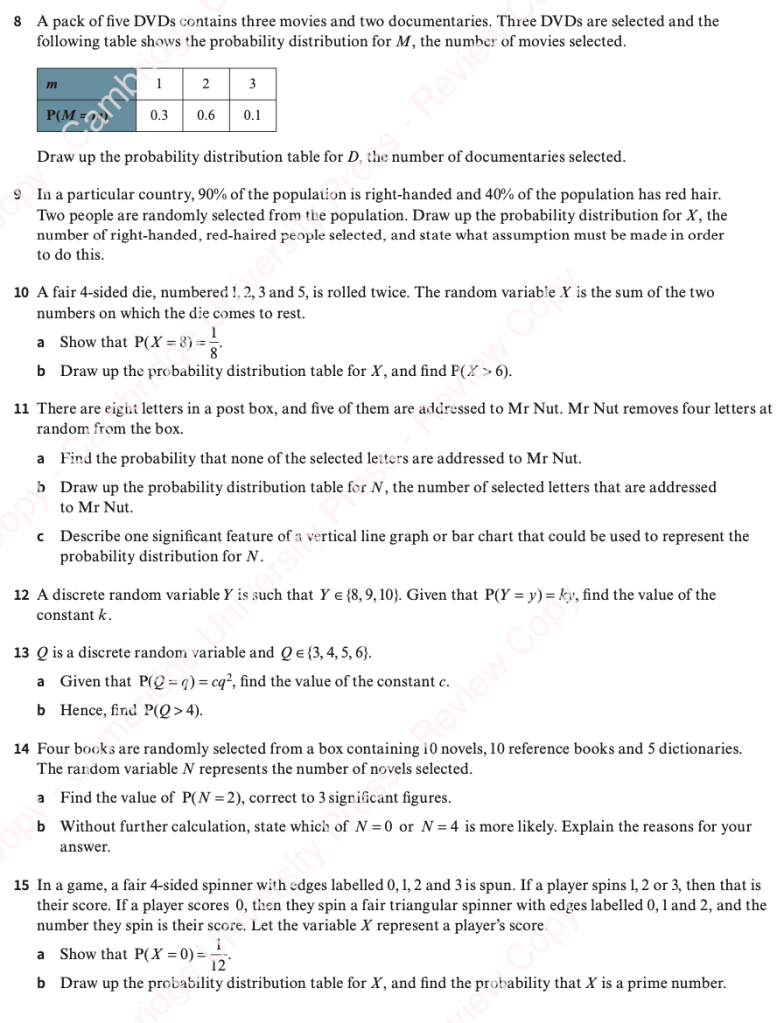
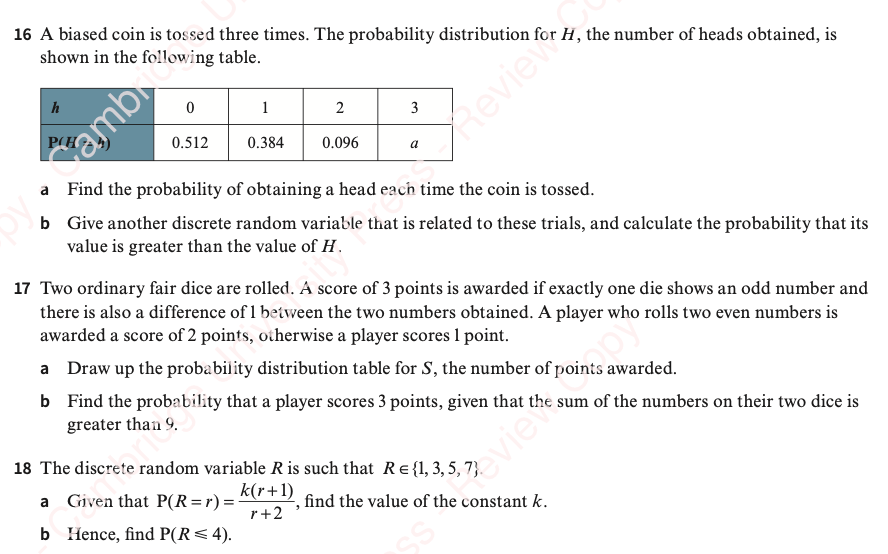
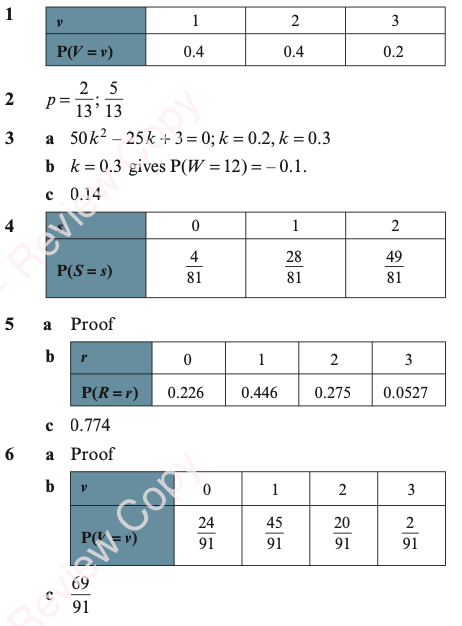
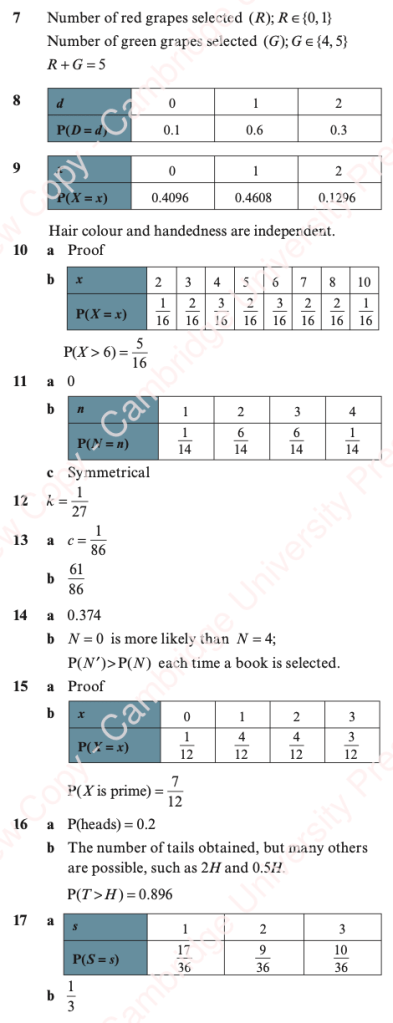
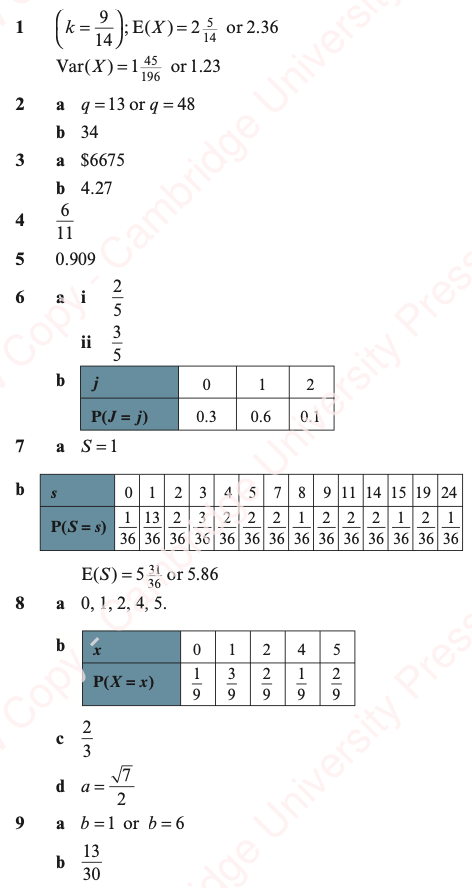
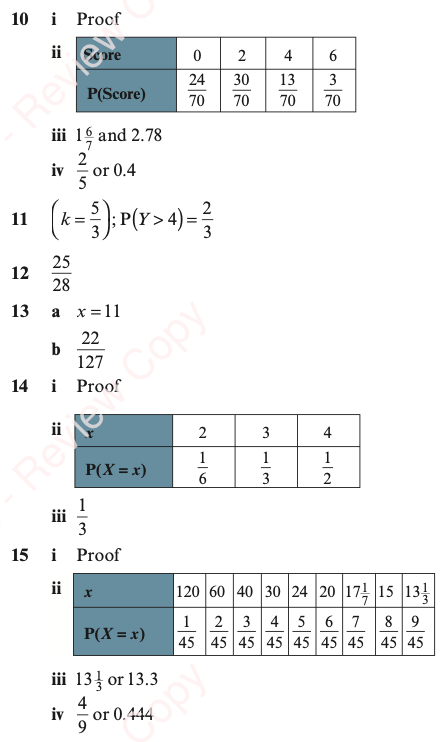
Answers

Expectation and Variance of Discrete Random Variable
Expected Value
The probabilities effectively give a “weighting” for the likelihood of their value occurring. When a number of trials happen, we can calculate the expected value of the random variable, E(X).
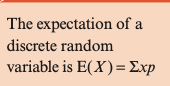
If there are 1000 trials, say, and we wanted to know the expected total value, we would simply multiply E(X) by 1000.
Variance
We can calculate the variance of a random variable using the following formula, which we often remember as “the mean of the squares minus the square of the means”.

As always, standard deviation is simply the positive square root of the variance.
Worked Example
The following table shows the probability distribution for X. Find its expectation, variance and standard deviation:
| x | 0 | 5 | 15 | 20 |
| P(X=x) | 1/12 | 3/12 | 5/12 | 3/12 |
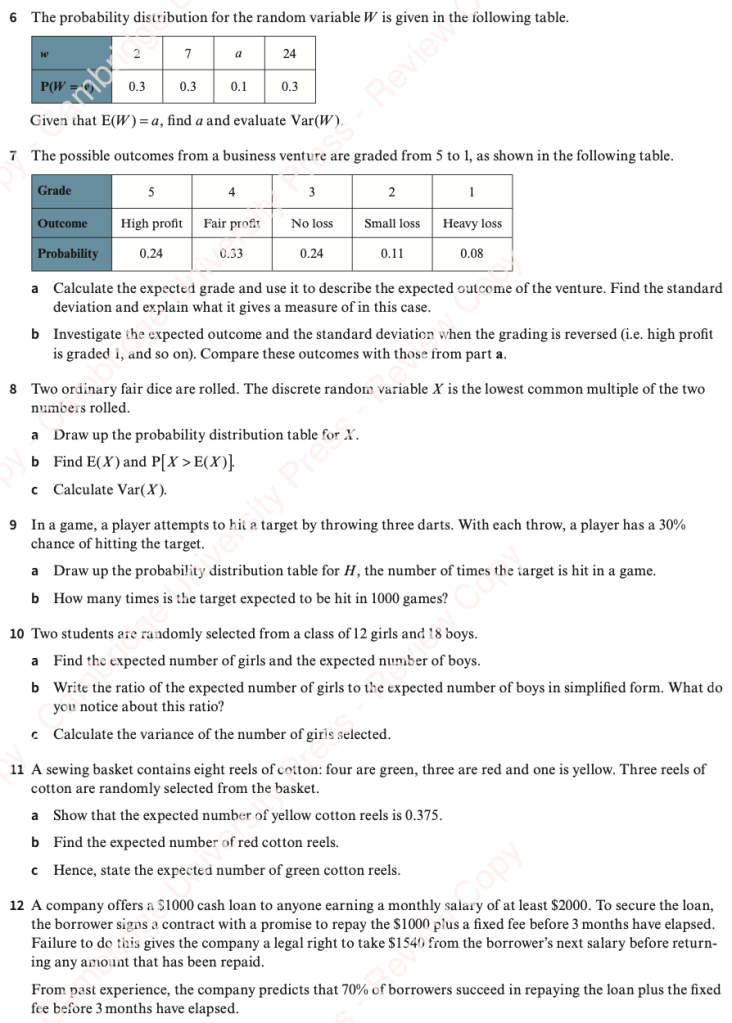
Exercise 2

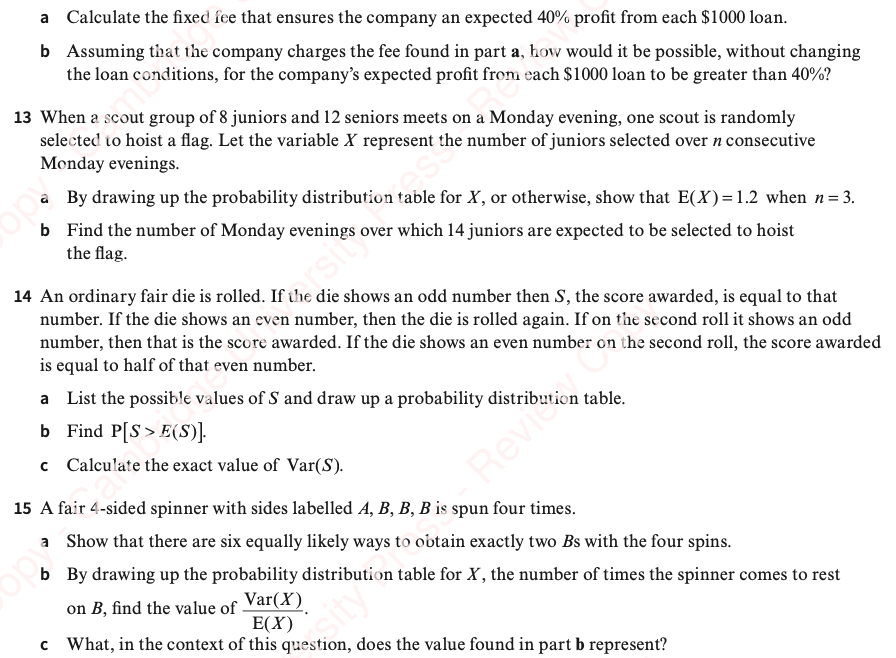
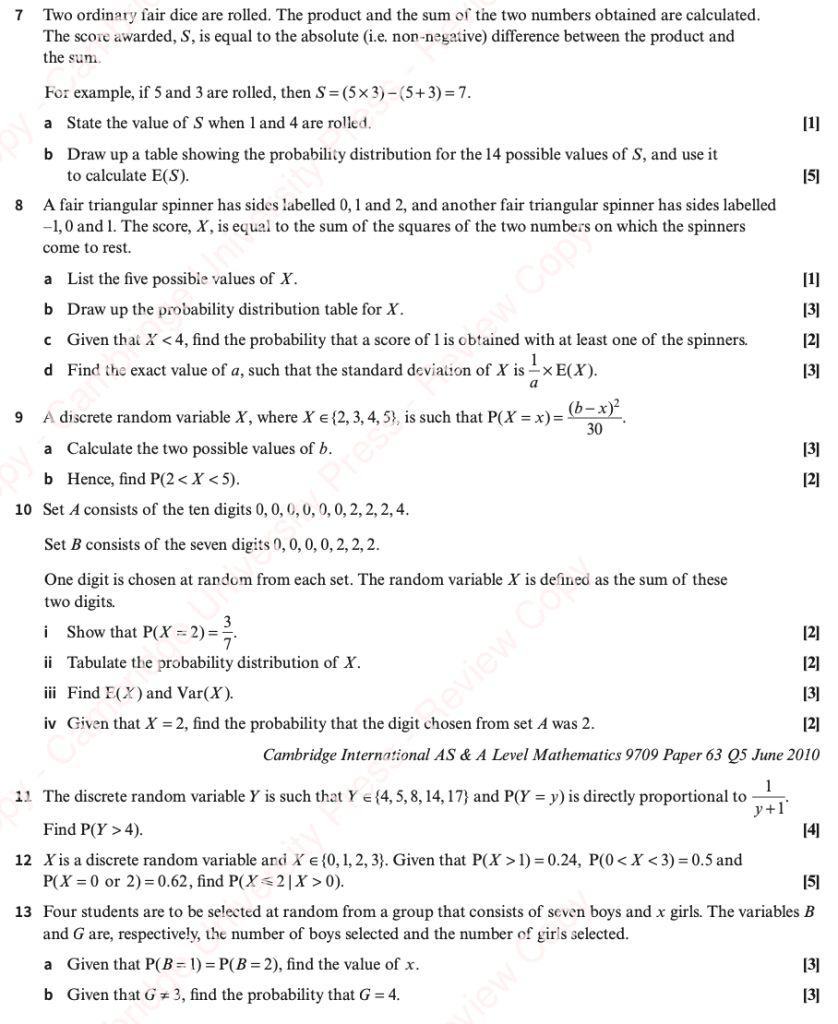
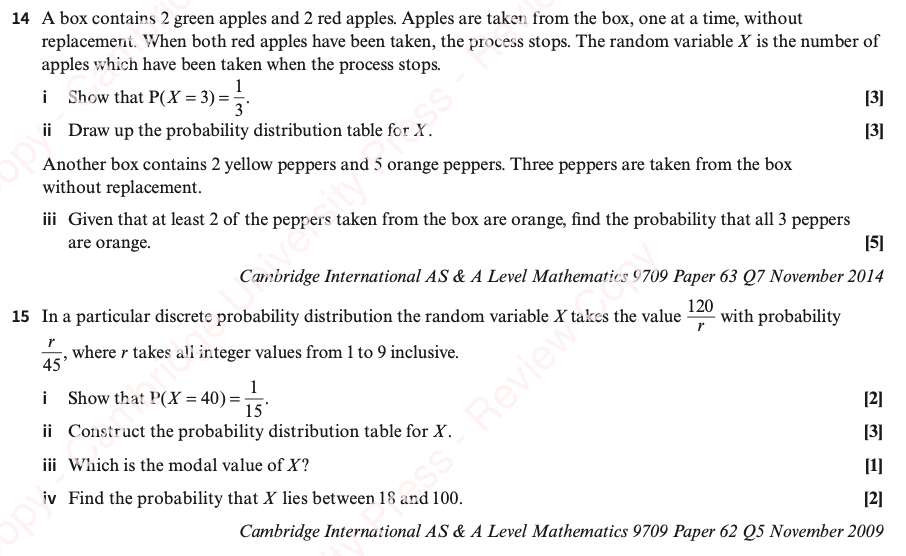
Mixed Exercise

Answers
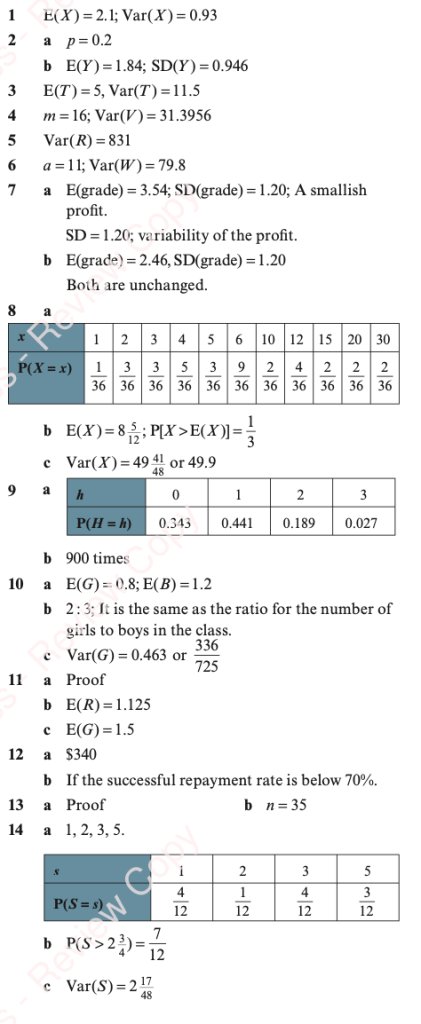
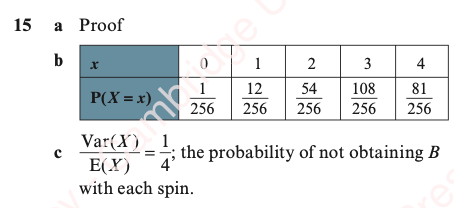
Answers to Mixed Questions
 Maths with David