Proportion questions are related to ratio questions, but a little different. We can split questions up into direct proportion questions and inverse proportion questions.
In direct proportion questions, two quantities increase at the same rate. Let’s try solving the following related examples:
1.) If 11 litres of petrol costs $20.46, how much does 27 litres cost.
2.) If a foreign exchange rate is $2.5:£1, how many pounds (£) will I get in exchange for $300?
3.) If it takes me 40 minutes to run twice around Lisi lake, how long will it take me to run 15 times around it?
In inverse proportion questions, on quantity increases as the other quantity decreases. Let’s try solving the following related examples:
1.) A farmer has enough hay to feed 5 horses for 6 days. How long would the hay last for three horses?
2.) If I travel at 60km/h, it will take me 6 hours to get to Batumi. How long would it take me if I travelled at 100km/h?
3.) If I share my pizzas with 7 friends, I will end up with 5 slices. How many slices will I end up with if I share it with 15 friends?
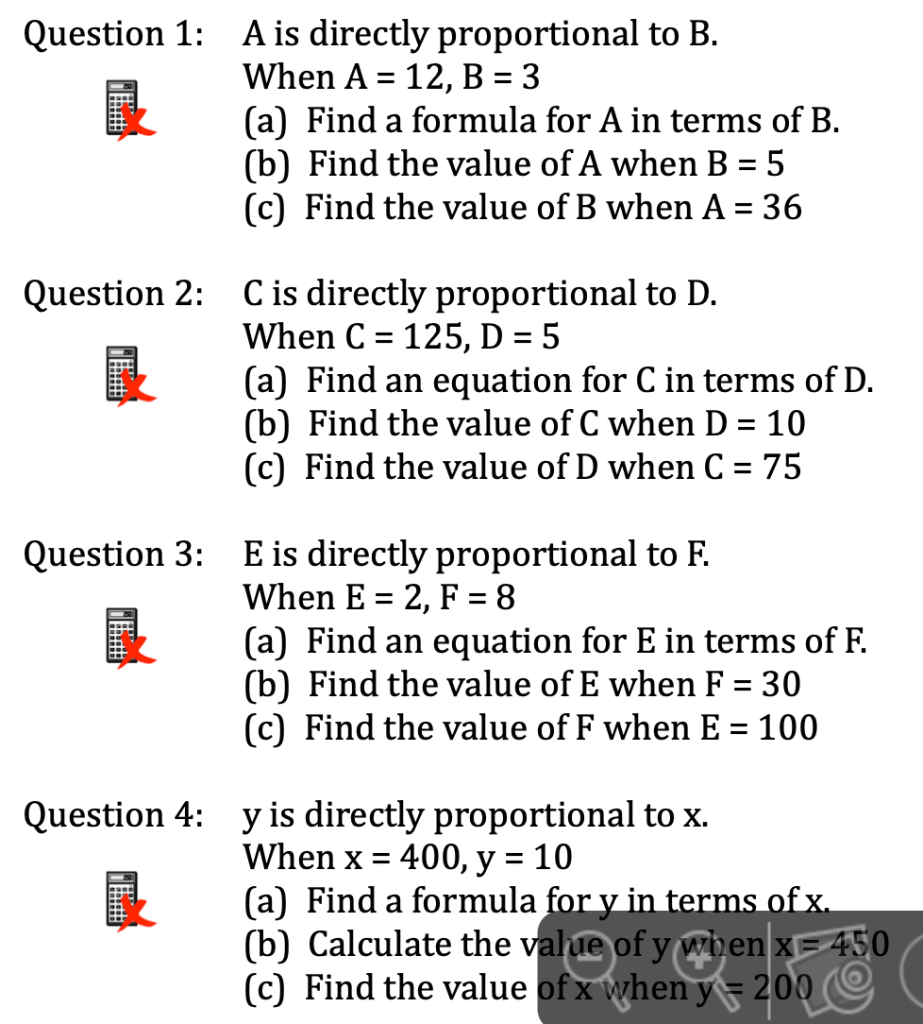
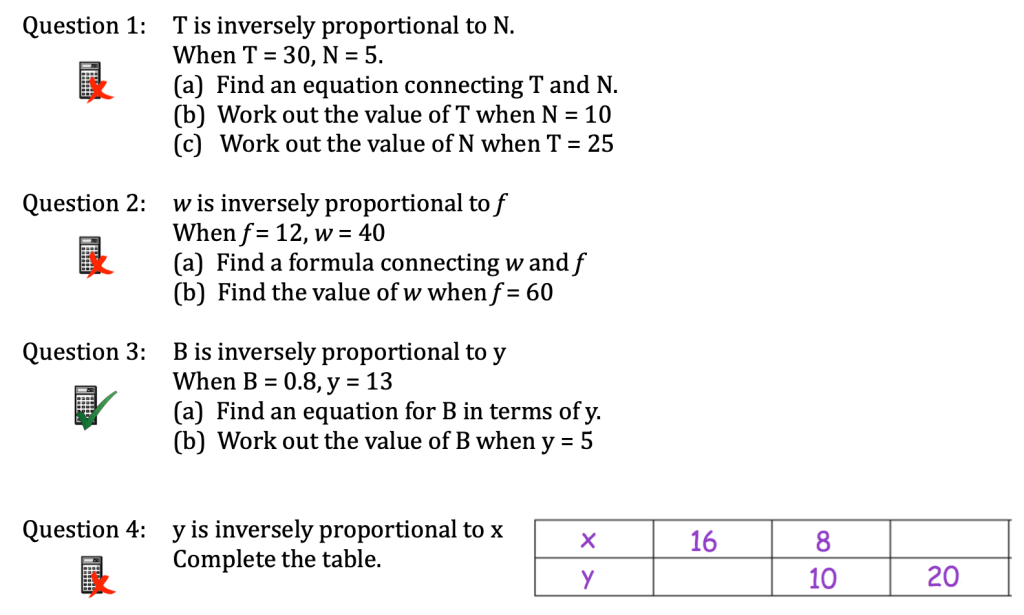
Below are some examples that give us a formal algebraic method that is useful to represent two variables that are directly or inversely proportional.
Examples
Exercise
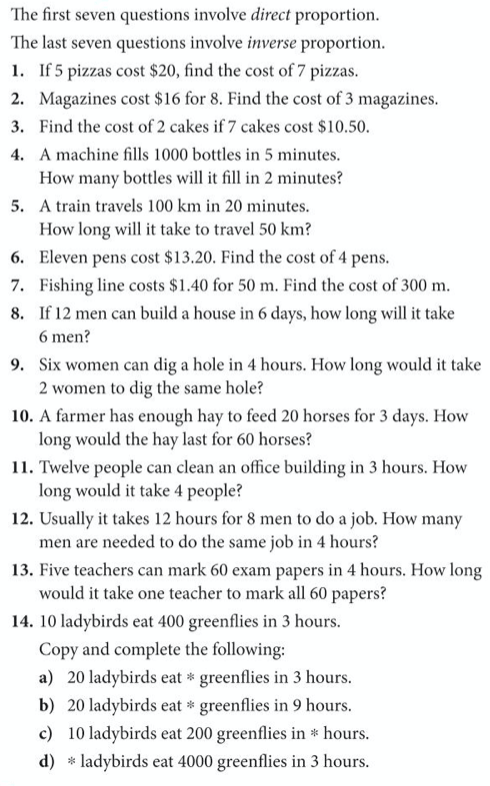
Let’s complete exercise 36 and 37 from pages 112 to 114 of the textbook:
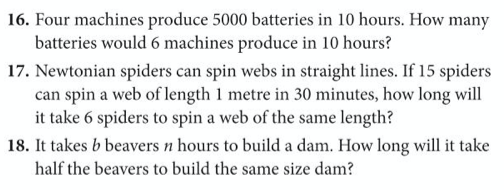
The answers are below:

Foreign Exchange
When we are changing money from one foreign currency to another, we should always have an expectation as to whether the new number should be larger or smaller than the number we have. This will help us to decide whether to divide or multiply by the foreign exchange rate.
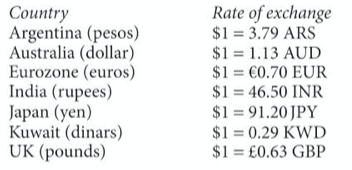
Let’s thing about whether we should multiply or divide for exchanges of some of the currencies above.
Exercise
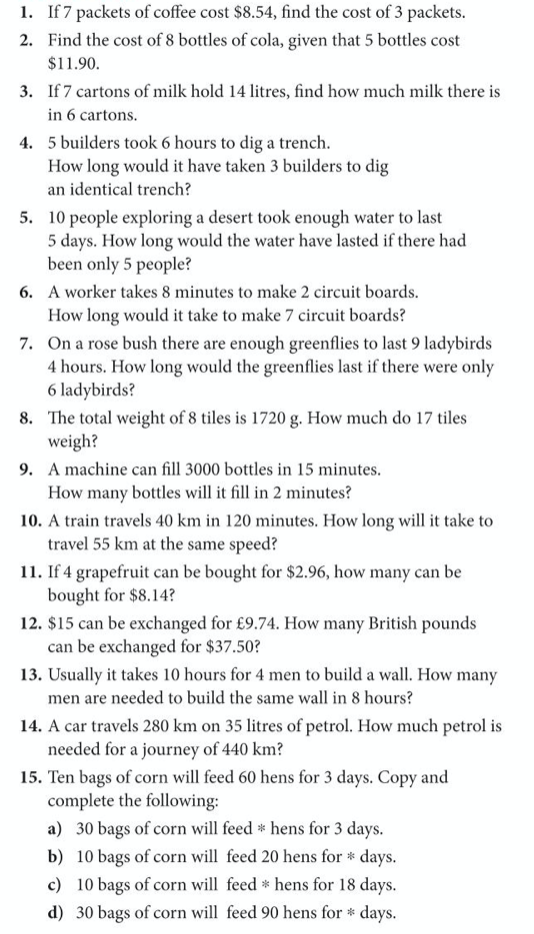
Let’s complete exercise 38 on pages 114 to 115 of the core textbook:
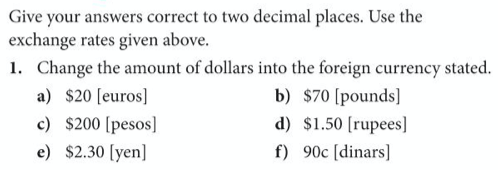

The answers are below:

 Maths with David