
Changing the subject of a formula is like a game where our aim is to rewrite an equation in our preferred way.
So, for instance, we might have the formula 
So, how would we do it? Well there is only one rule. We can do any arithmetical operations we want to, but we must always do exactly the same to both sides of the equation. Let’s do it now to make u the subject of the equation.
Making t the subject of the equation is a little bit more difficult. Let’s try it!
Worked Examples
Make x the subject of the following formulae:

First set of exercises
Let’s complete exercises 13, 14 and 15 from the textbook:
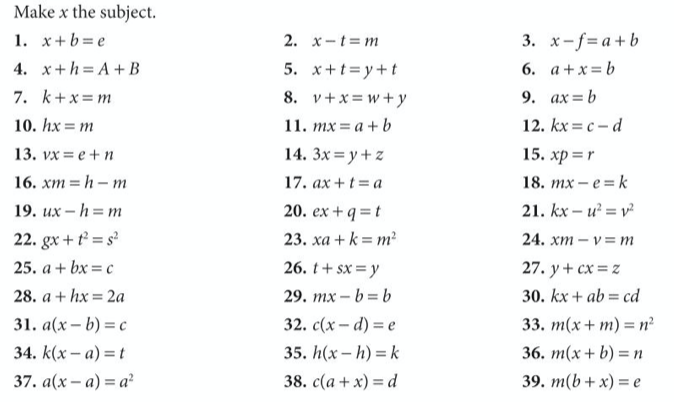
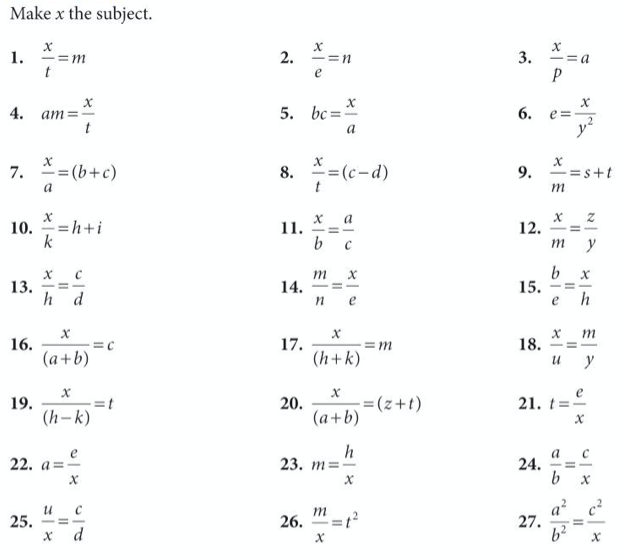


The answers are below:
(1.) x = e-b, (2.) x = m+t, (3.) x = a+b+f, (4.) x = A + B – h, (5.) x = y
(6.) x = b-1, (7.) x = m-k, (8.) x = w+y-v, (9.) x = b/a, (10.) x = m/h
(11.) 


(14.) 


(17.) 


(20.) 


(23.) 


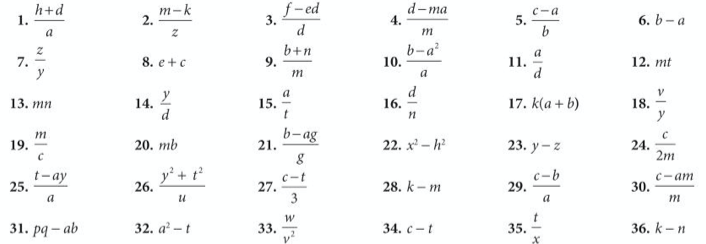
Further, progressively more advanced exercises
 Maths with David