Any set of numbers in a specific order is a sequence.
We can classify sequences according to those that display certain properties. The first two we want to consider are arithmetic sequences and geometric sequences. Do you know what these are? Once you know what they are can you think of some examples of them.
With many sequences we are interested in identifying the term-to-term rule. This is what is “done” to a term to get the following term. Can we identify the term-to-term rule in some sequences?
Exercise
Let’s complete exercise 14K on page 235 of the textbook:
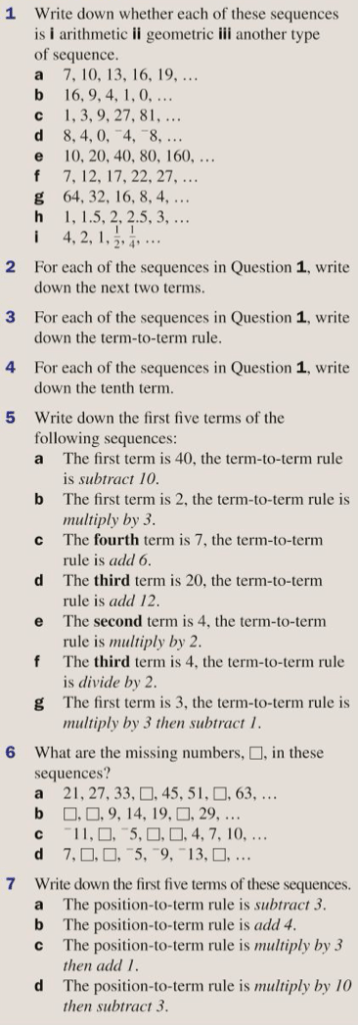
The answers are below:

As well as the term-to-term rule, a very important thing we often want to identify in a sequence is the n-th term rule. This is a rule which turns the number representing the position of the term into the number displayed at that position.
So if the n-th term rule is 2n+4, then the 10th term will be 24. Do you see why?
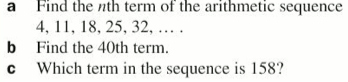
With arithmetic sequences, the n-th term is always of the form a+(n-1)d, where a is the first term and d is the amount by which the terms increase each time.
Examples

Exercise
Let’s complete exercise 14L on page 236 of the textbook:

The answers are below:

 Maths with David