What units of measurement do you know? What are they used to measure?
Which of them relate to length? Which to mass? Are they all metric units?
Exercise
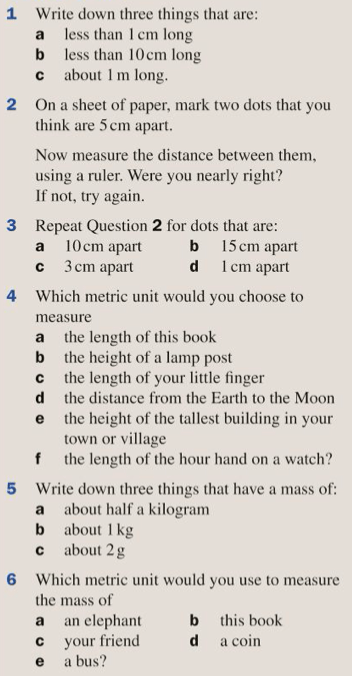
Let’s complete exercise 4A on page 61:
The answers are below:

Converting
We often need to convert between larger and smaller units. Because it sounds pretty silly that you went for a 5,000,000mm run.
Examples


Exercise
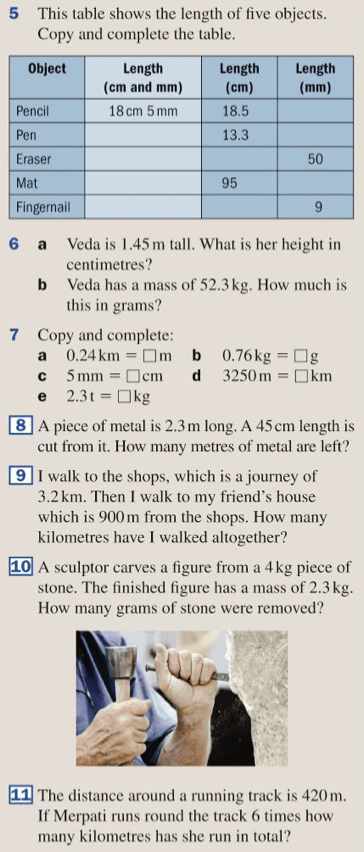
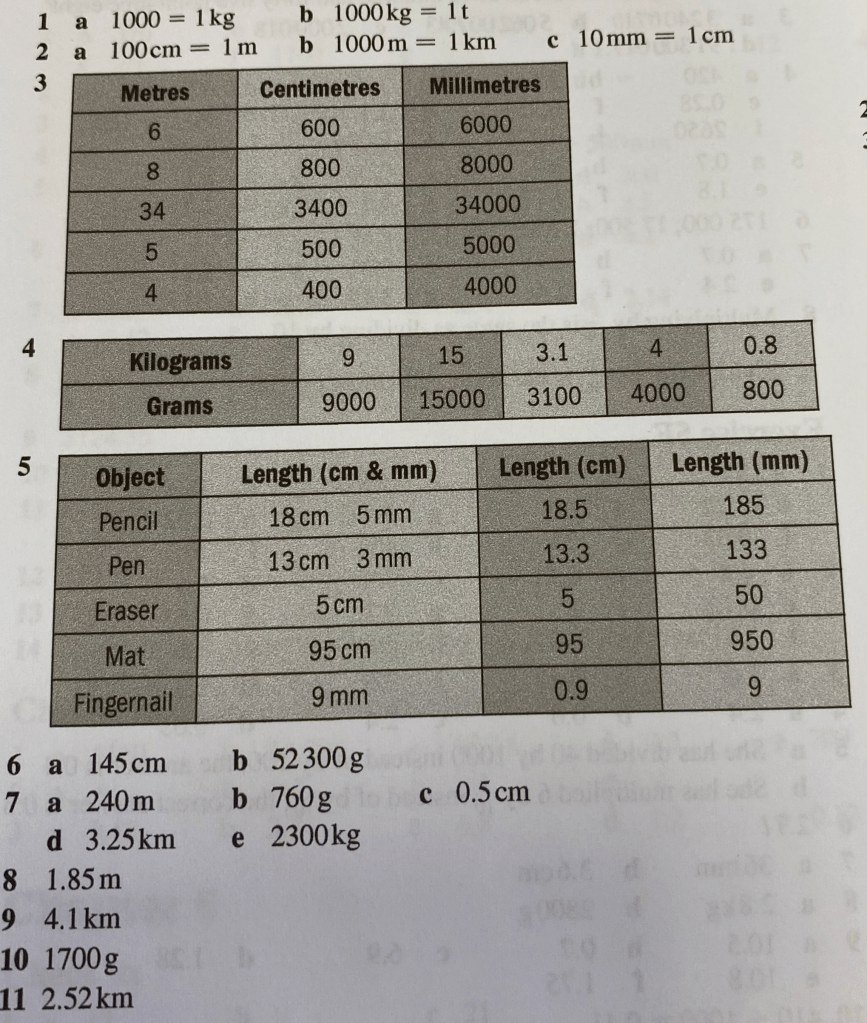
Let’s complete exercise 4B from page 62 of the textbook:

The answers are below:
Other units
We’ve talked about length and mass. Let’s think now about area, volume and capacity.
Which units do we know for these? Let’s list them out and try some conversions with the teacher. It is important to remember that the conversions with area and volume are significantly different from those with length.
What’s the difference between volume and capacity?
It is worth memorising that 1ml is equal to 1cm3, because all of the others you can work out based on their names.
Exercise
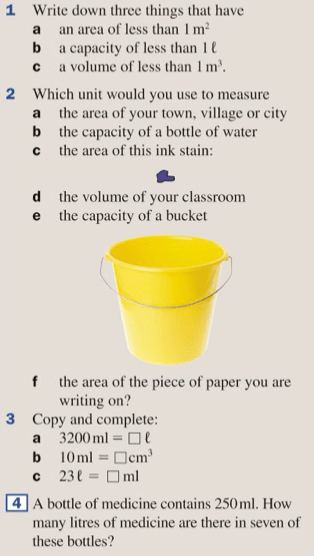
Let’s complete exercise 4C on pages 63 and 64:
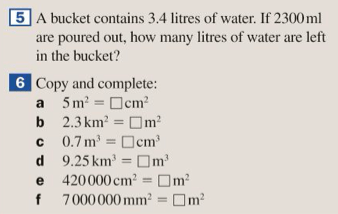
The answers are below:

Estimation
People often think of mathematics as being a subject which is all about accuracy and of course, accuracy is really important when doing calculations. But there are often restrictions that make it impossible to be completely accurate and so we need to estimate. Also, it helps develop our insight if we practice estimating things and then comparing our estimates with the real values.
Let’s try estimating some lengths, some areas and some volumes of things in the classroom.
Exercise
Let’s complete exercise 4D on page 64 of the textbook:
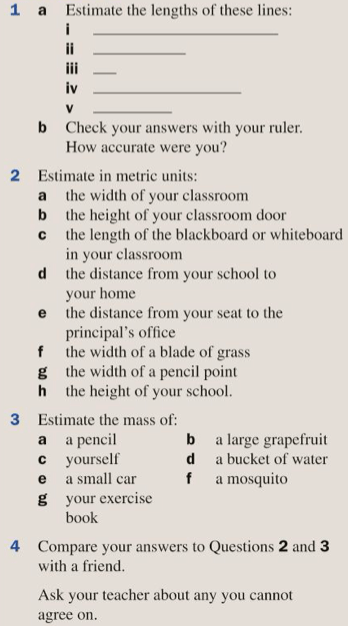
The answers are below:

Let’s think some more about estimation. Do you know what the dial below measures? What is the most accurate value that you could measure with it?
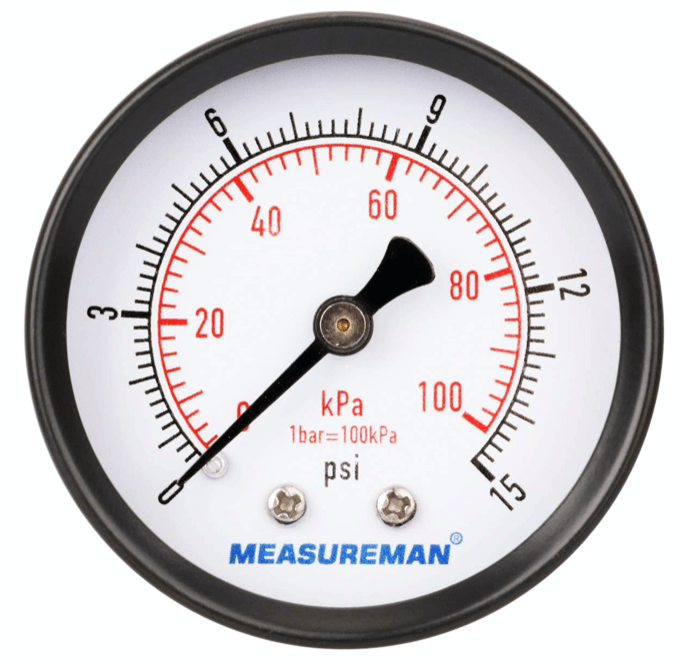
Do you know what the ≈ is for? Do you know what the sign is to say that two amounts are not equal?
Exercise
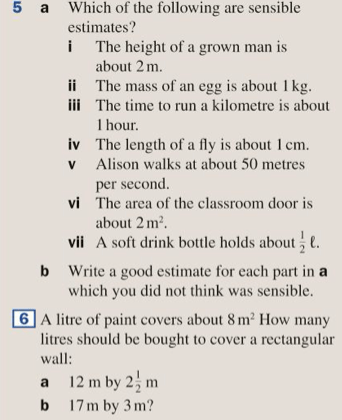
Now let’s complete exercises 4E and 4F from pages 65 and 66:

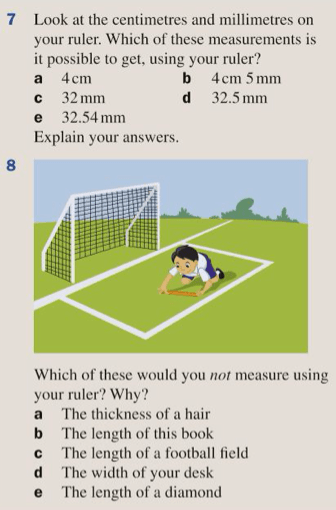

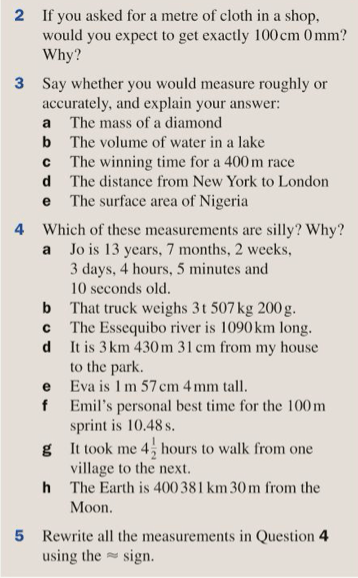
The answers are below:

Imperial Units
These days we use metric units all the time, because they are much easier to calculate (even though Napoleon lost the war). Some countries, such as Britain and the US, however, still make some use of old “Imperial” measurements though, such as miles (other countries had different systems as well, but most of them have become obsolete now.
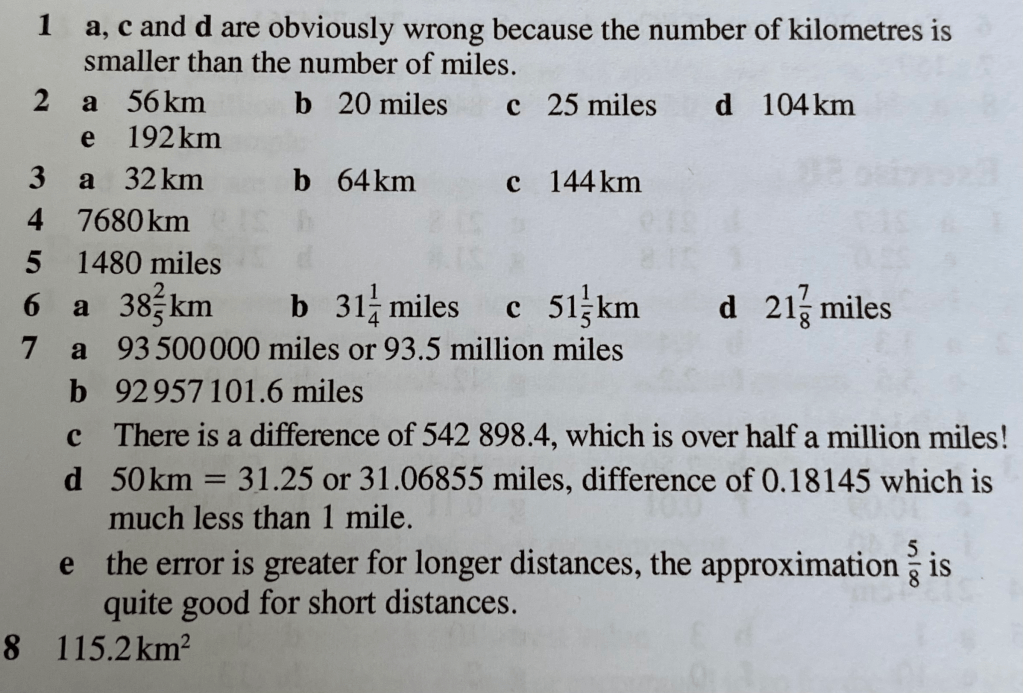
Converting between miles and kilometres is easy enough. We just have to remember that 1km is 5/8 of a mile. Another way to say this is to say that 5 miles = 8km. Let’s try converting some distances.
Exercise
Let’s complete exercise 4G on page 67:
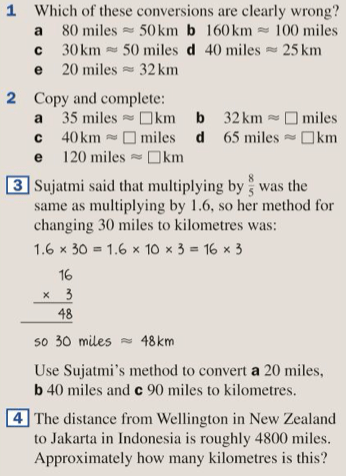
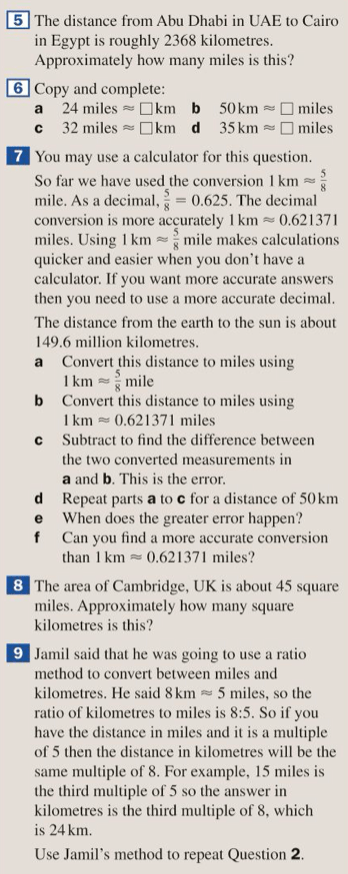
The answers are below:
 Maths with David