The word integers means all of our whole numbers, both the positive ones that we use to count and the negative ones, that we get if we subtract a larger number from a smaller number (e.g. 2-5 = -3, which is a negative number).
We need to be able to add and subtract them. The best way to do this is not to remember any special rules (two negatives makes a positive, etc.), but to get used to using a number line (either written out or imagined in your mind).

It’s also important that we always think of an arithmetic operation as relating to the number after it. So if we see 3 – 5, we understand that we are subtracting 5. If we see -3 + 6 we understand that we are adding 6.
Let’s try some examples together on the number line.
We should also know that with addition it doesn’t matter which way round we do it, so 5+3 = 3+5. (This is officially known as commutativity of addition. Subtraction, however, is not commutative (5-3 ≠ 3-5).
Exercise
Let’s complete exercise 1A from page 9 of the textbook. The little horizontal lines towards the top of a number are the textbook’s way of indicating negative numbers.
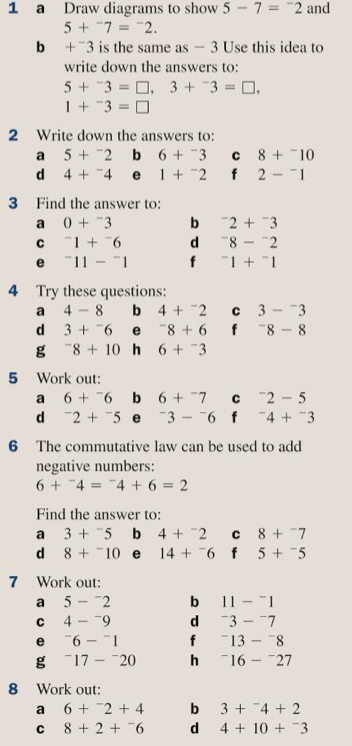

The answers are below:

 Maths with David