Sequences is one of the most fascinating topics of mathematics. It certainly fascinated English mathematician Isaac Newton, whose careful study of sequences was one of the main things that led him to develop the theory of calculus, which allowed Physics to become an exact science and paved the way for technological development such as flight and space travel.
The idea behind a sequence is that a set of numbers follows a specific rule, for instance, each number may be the double of the last one, or may be 5 greater from the last one. In general, we say in mathematics that any ordered set of numbers is a sequence.
- Using specified rules we can write out a sequence, e.g:
- The first term of a sequence is 7. The term-to-term rule is “multiply by 2 then subtract 3”. Write the first five terms of the sequence;
- Find the first five terms of the sequences with the following postition-to-term rules:
- Multiply by 7;
- add 4;
- multiply by 8 and then subtract 3.
- Also, we can look at sequences that we are given and try to work out the rules that they are following in order to identify the following terms. e.g:
- Write down the next three terms in the following sequences:
- 4, 5, 6, 7, 8, …
- 1, 4, 9, 16, 25, …
- 2, 3, 5, 7, 11, …
- 2, 0, -2, -4, -6, …
- 9, 18, 27, 36, 45, …
- What would you do if you wanted to find the hundredth term of each of these sequences?
- Write down the next three terms in the following sequences:
Note: Sequences that increase (or decrease) by a fixed amount every time are called linear sequences, or arithmetic sequences.
Exercise
Let’s complete exercise 14B on pages 215 and 216 of the textbook:


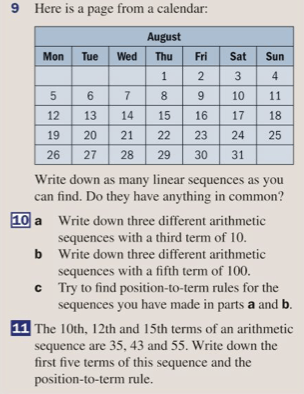
The answers are below:

The n’th term
One of the most important things to identify with a sequence that follows a specific rule is the nth term. This is a formula a rule that will let us find any term of the sequence (e.g. the 52nd term or the 2000th term). So if the sequence was 2,4,6,8,10,… the n’th term would simply be 2n (i.e. two times n).
For linear sequences we have a special method for finding their n’th term. Let’s use it to find the n’th term of some.
Exercise
Now let’s complete exercise 14C from pages 217 and 218 of the textbook:

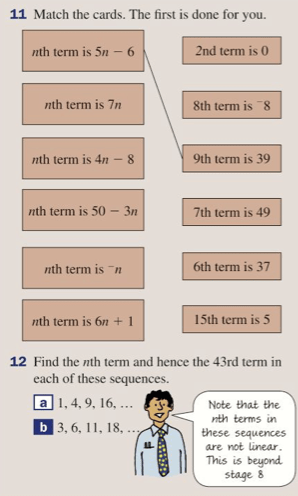
The answers are below:

Sequences from shapes
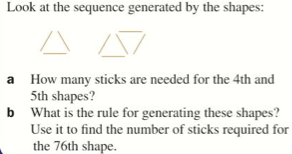
As well as looking at sequences as a list of numbers, we sometimes need to derive a sequence from something else, such as a pattern of shapes.
Example
Exercise
Let’s apply this by completing exercise 14D on pages 219 and 220 of the textbook:


The answers are below:


 Maths with David