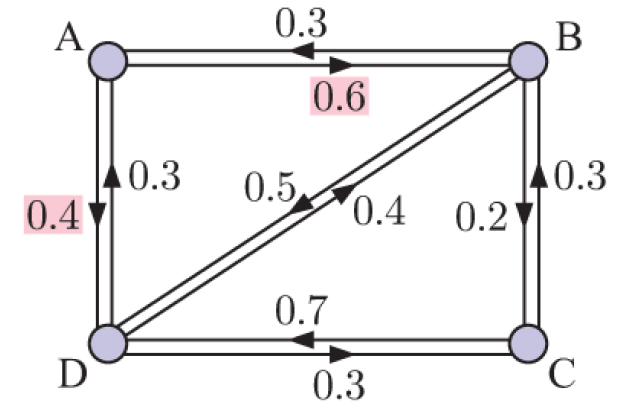
Below is a directed weighted graph showing the movement of buses between cities. The weights of the edges indicate probabilities, e.g. from city A 60% of the buses travel to city B and 40% to city D.
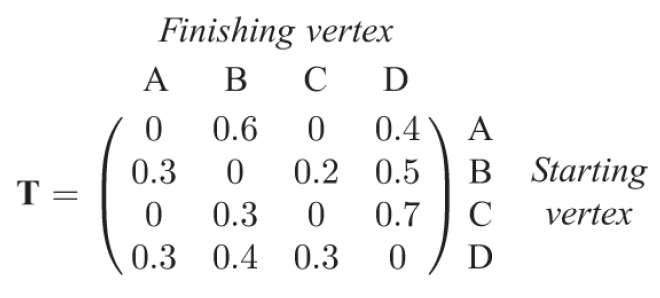
We can construct a transition matrix for this graph, as shown below. As with the adjacency matrices, the rows represent the starting vertices and the columns represent the finishing vertices.
The transition matrix is useful because it allows us to study the movement of the buses in the future. For example, consider T3 below:
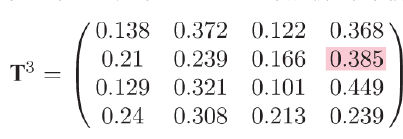
The shaded element tells us that a bus currently at B has probability 0.385 of being at D in three stops’ time.
The initial state matrix s0 must now be written as a row matrix rather than a column matrix and we must premultiply Tn by s0 to find sn. For example, if a bus is initially at B, then s0 = (0 1 0 0) and s1 = s0T = 
Exercise
Answers