Reminder of Perpendicular Bisector
For the Core part of the course, we know that the perpendicular bisector of line segment AB is the line perpendicular to AB which passes through its midpoint.
All points on the perpendicular bisector are equidistant from A and B.
The perpendicular bisector divides the plane into two regions. On one side of the line are points closer to A than B and on the other side are points closer to B than A.
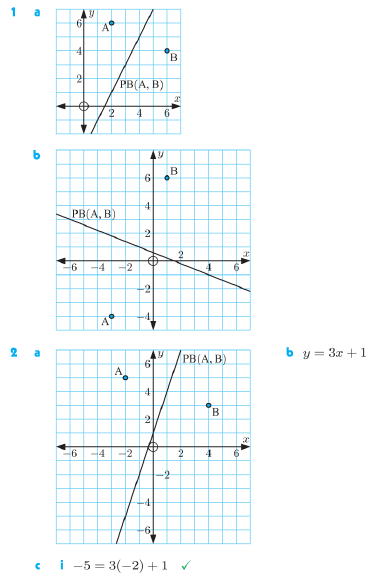
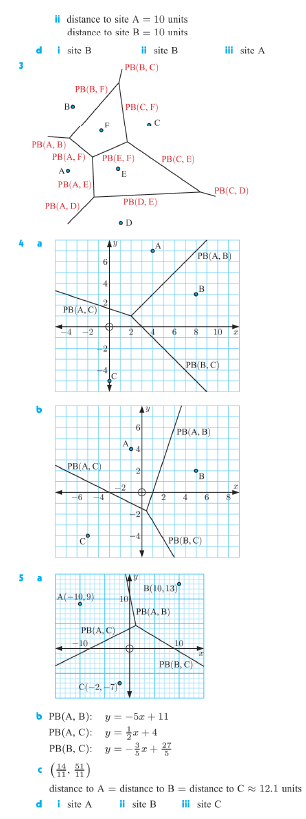
If a plane contains only two sites, A and B, then the Voronoi diagram is simply the two points and their perpendicular bisector (which we will call PB(A,B)).
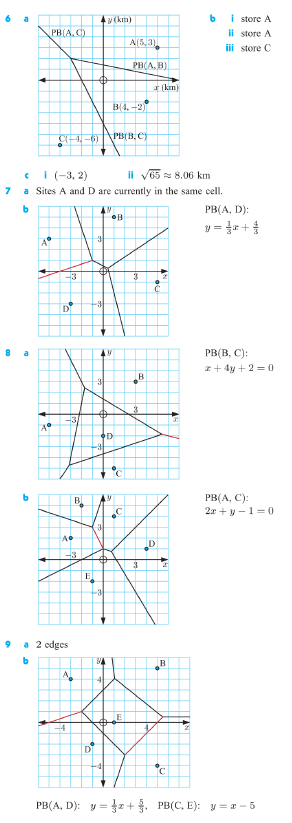
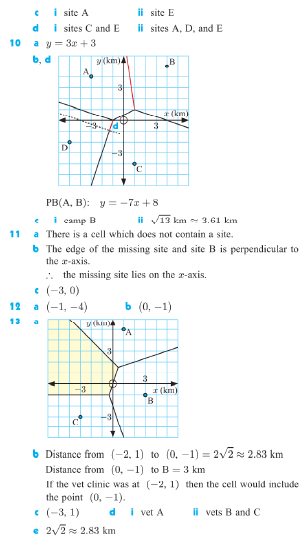
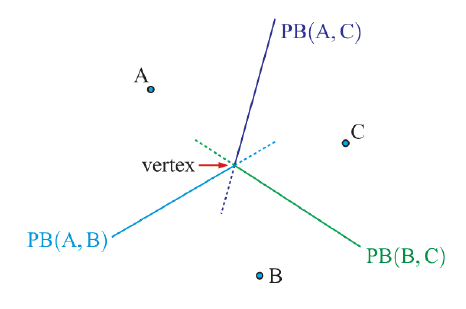
If a plane has three sites, A, B and C, then drawing the perpendicular bisectors between each pair of points we can find the vertex of the Voronoi diagram (where these three lines meet. A section of each of the perpendicular bisectors will be a Voronoi edge (as illustrated below):
Worked Example 1
- Construct a Voronoi diagram for the sites:
- A(-1,-2) and B(5,0)
- A(-5,2), B(3,-4) and C(-3,-2)
Worked Example 2
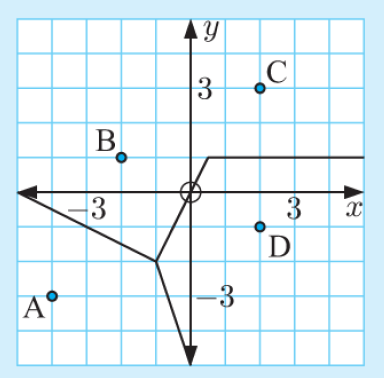
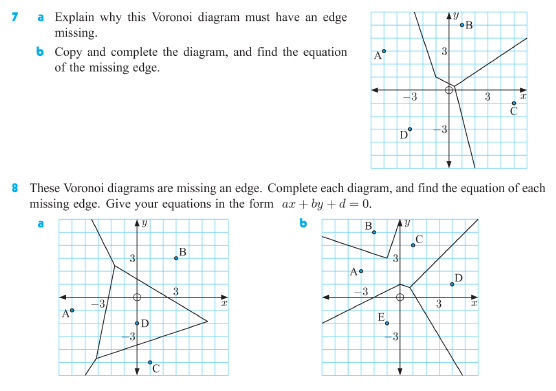
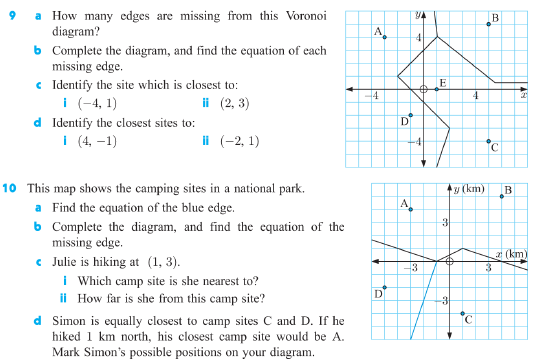
The Voronoi diagram below is missing an edge. Complete the diagram and find the equation of the missing edge:
Worked Example 3
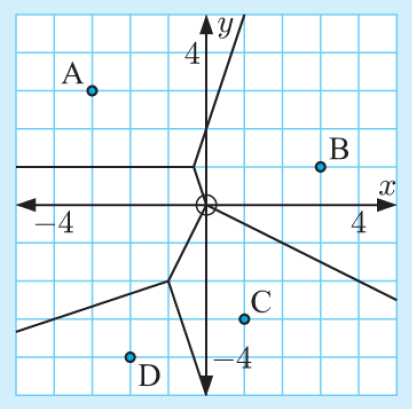
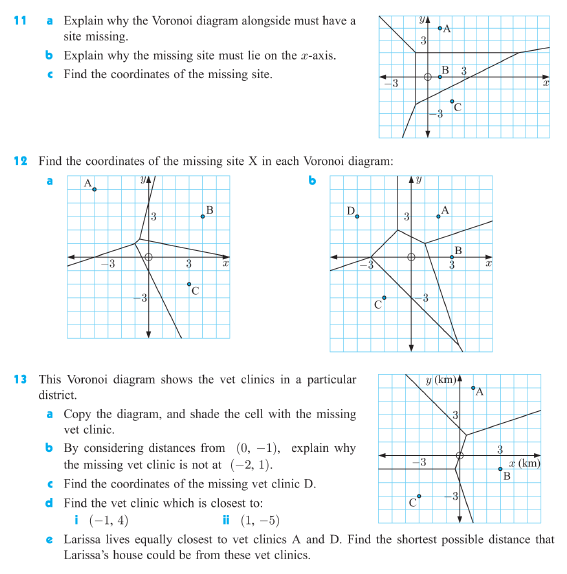
Find the coordinates of the missing site X in the Voronoi diagram below:
Exercise
Answer