When we solve equations, we find a value. However, when we solve differential equations, we find a function, for instance, a solution to 
We can find the general solution or a particular solution of differential equations.
The general solution includes a constant of integration, e.g. 
The particular solution does not include a constant of integration. Further information is required about eg. Initial conditions (i.e. what x or 
Worked Example. Particular Solution of Differential Equation
- Show that
is a solution to the differential equations for any constant c.
- Sketch the solution curves for c = 6, c = 26 and c = 56.
- Given that the initial water temperature was 80ºC, find the particular solution.
A glass of water has temperature TºC. It is placed in the refrigerator and its temperature decreases according to the differential equations 
Exercise
- Verify that
- a.
is a solution to
- b.
is a solution to
- c.
is a solution to
- d.
is a solution to
- e.
is a solution to
- a.


2. Match each differential equations with the correct solution:
a.  | b.  | c.  |
A. ![y = \sqrt[3]{x^2+1}](https://s0.wp.com/latex.php?latex=y+%3D+%5Csqrt%5B3%5D%7Bx%5E2%2B1%7D+&bg=ffffff&fg=000&s=0&c=20201002) | B.  | C.  |
3. Verify that for any constant c:
- a.
is a solution to
- b.
is a solution to
- c.
is a solution to


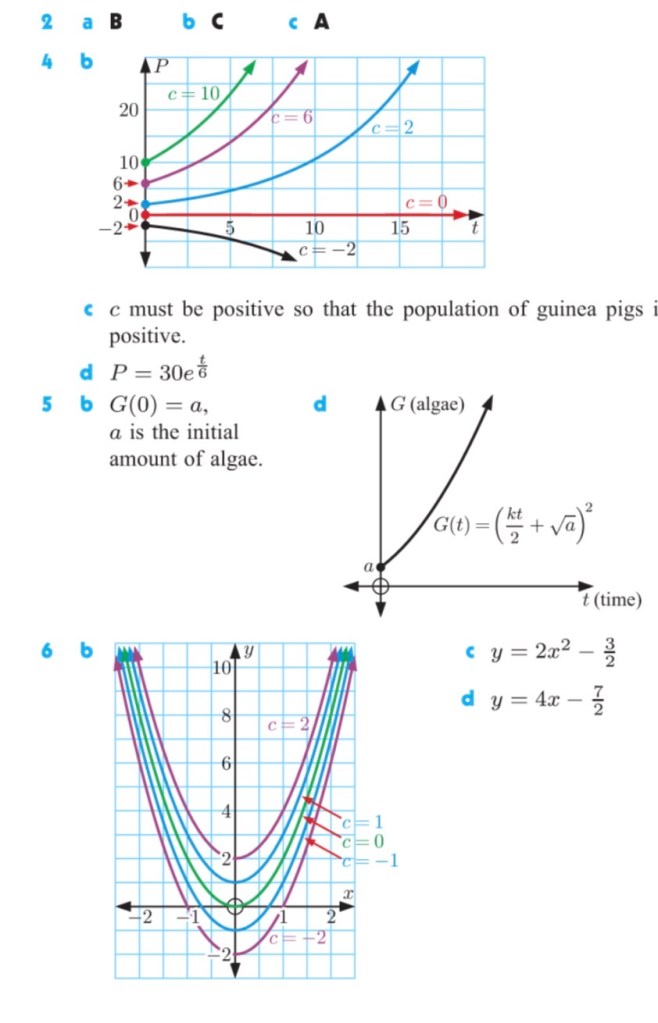
4. The population of guinea pigs P grows according to the model 
- a. Show that
is a solution to the differential equation for any constant c.
- b. Sketch the solution curves for c = -2, c = 0, c = 2, c = 6, and c = 10.
- c. Explain why c must be positive for the model to be realistic.
- d. Given that there were initially 30 guinea pigs in the field, find the particular solution.
5. Consider the algae growth model 
- a. Show that
is a solution for any constant a.
- b. Explain the significance of a by calculating G(0).
- c. Show that G(t) is a quadratic function whose vertex occurs for some t < 0.
- d. Sketch G(t) for t > 0.
6. Consider the differential equation

- a. Show that
is a solution to the differential equation for any constant c.
- b. Sketch the solution curves for c = 0,
,
.
- c. Find the particular solution which passes through (1,5).
- d.Find the equation of the tangent to the particular solution at (1, g).
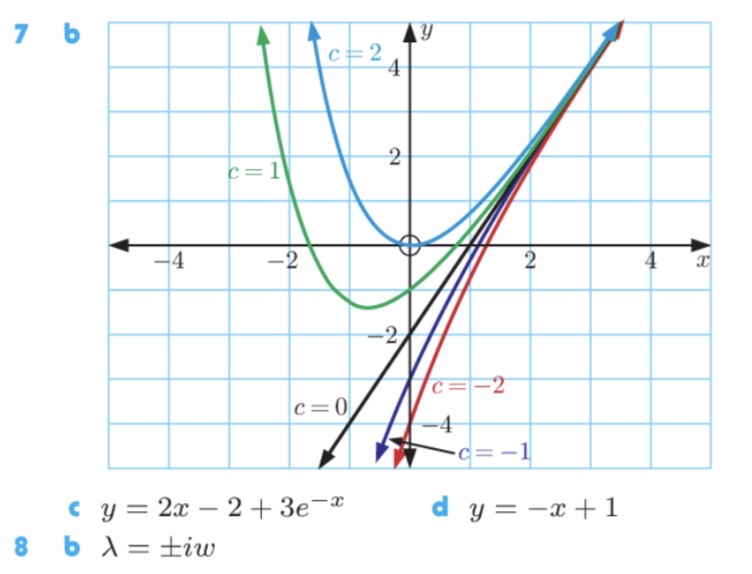
7. Consider the differential equation

- a. Show that
is a solution to the differential equation for any constant c.
- b. Sketch the solution curves for
.
- c. Find the particular solution which passes through (0, 1).
8. For the frictionless mass on a spring described at the start of the previous section, we can write the differential equation as 

- a. Verify that each of the following are solutions to the SHM equation:
- b. Prove that
is a solution to the SHM equation provided
is purely imaginary. Find
- c. Prove that if
and
are both solutions to the SHM equation then
is also a solution.


Answers
 Maths with David