We will consider a method developed by Euler in the 18th century to numerically approximate the solutions curve to a DE in the form

We use an iterative approach, starting with a point (x0,y0) on the solution curve. Each iteration will generate another point on the solution curve.
Considering the diagram below, we let h represent a step size, so that xi = xi-1 + h. Then we consider the two different definitions of the gradient, as follows:

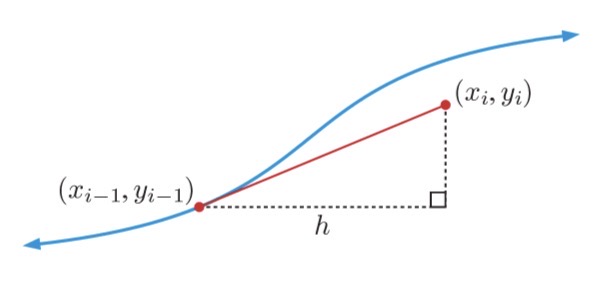
We can rearrange this to give

This gives us our next iteration

As illustrated on the diagram below, this process creates a polygonal approximation to the solution curve, modifying the direction at each point by recalculating the gradient of the tangent to the curve:
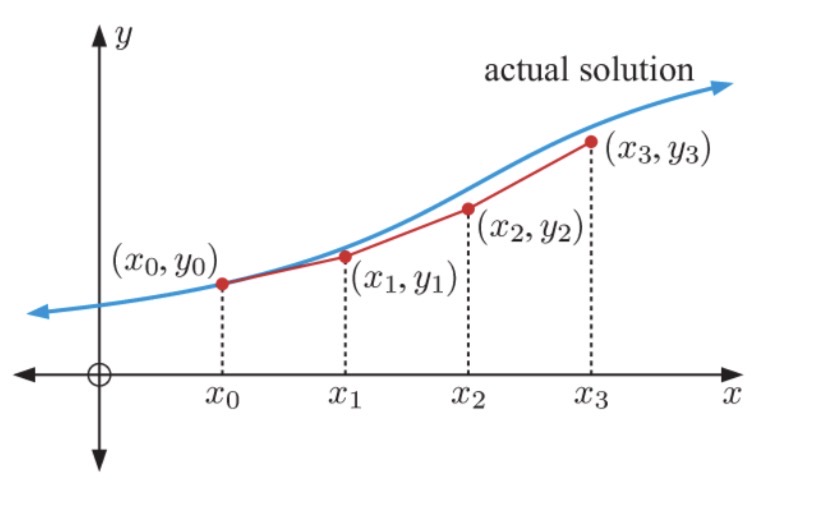
Consider applying Euler’s method for n iterations to reach x=b. Letting n tend to infinity gives infinitely many steps, so the method gives: 
Worked Example
Consider the differential equation 
(a) Estimate y(0.5) by applying Euler’s method with:
- (i) h = 0.25 for two steps;
- (ii) h = 0.1 for five steps.
(b) Find y(0.5) exactly using the Fundamental Theorem of Calculus.
Exercise
1.) Consider the differential equation 
(a) Copy and complete the table below for Euler’s method with step size h=0.1
| Iteration |  |  |  |  |  |
| 1 | 0 | 3 | -1 | 0.1 | 2.9 |
| 2 | 0.1 | 2.9 | |||
| 3 | |||||
| 4 | |||||
| 5 |
(b) Plot the solution curve for

2.) Consider the differential equation 
- (a) Estimate y(0.5) by applying Euler’s method with:
- (i) h = 0.25 for two steps
- (ii) h = 0.1 for five steps
- Find y(0.5) exactly using the Fundamental Theorem of Calculus. Comment on your results.
3.) Use Euler’s method with step size 0.2 to estimate y(1) given 
4.) Consider the differential equation 
- (a) Estimate y(0.5) using Euler’s method with step size 0.1
- (b) Use technology to apply Euler’s method with step size 0.001 for 500 stepts
- (c) Find the exact value of y(0.5). Compare it with your numerical results
5.) Consider the differential equation 
- (a) h = 1
- (b) h = 0.1
- (c) h = 0.01
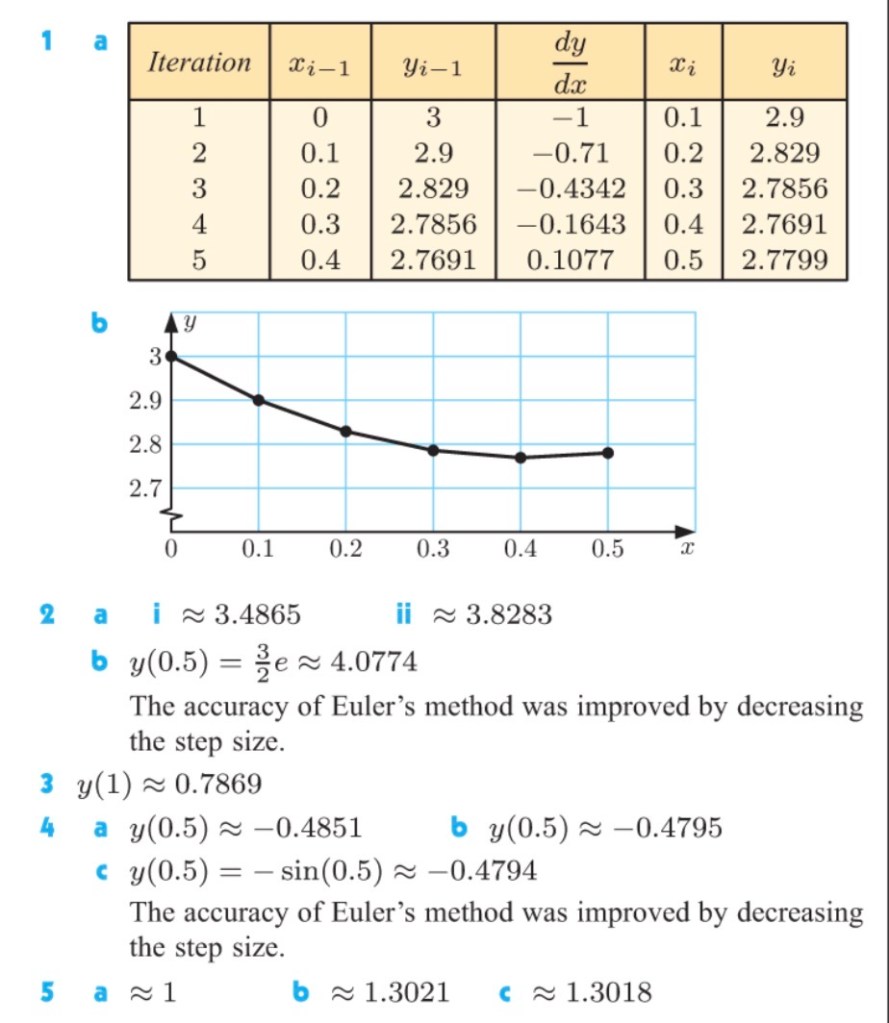
Answers
 Maths with David