Let’s start by considering a spring which is stretched by distance x, as in the image below.
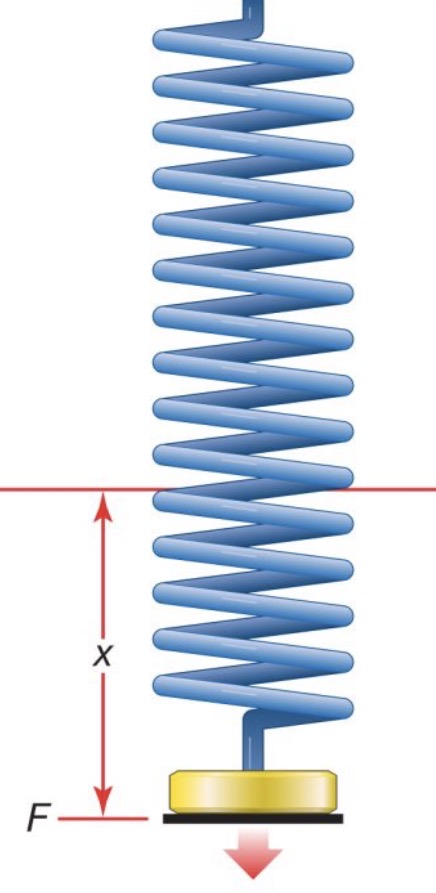
Once released from its stretched position, we can consider x as a function of t, x(t), which states the displacement of the spring from its natural equilibrium position at time, t, after being released.
Consider the following:
- What will happen the moment the spring is released?
- Hooke’s Law states that the force, F, exerted by a spring, is proportional to the distance it has been stretched. Can you explain why Hooke’s Law gives us:
?
- Newton’s Second Law states that the acceleration of an object is proportional to the force acting on it, g iving us
- Based on these two laws, can you see why
?
- The solution to

The above scenario describes a Differential Equation (“DE”) that governs the 1D motion of an extended string (the same DE governs the motion of a swinging pendulum).
Definition: A Differential Equation is an equation whose terms include derivatives of a function
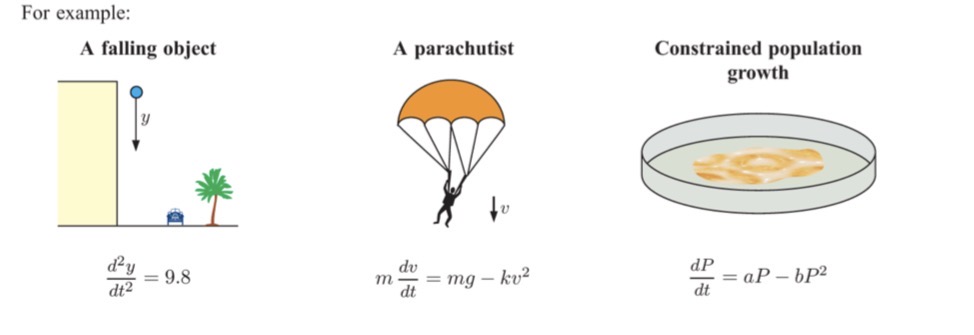
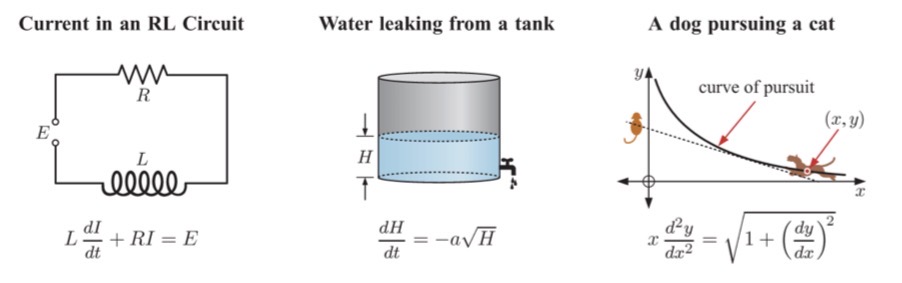
Here are some examples of Differential Equations used outside of Pure Mathematics:
Exercise. Constructing DEs
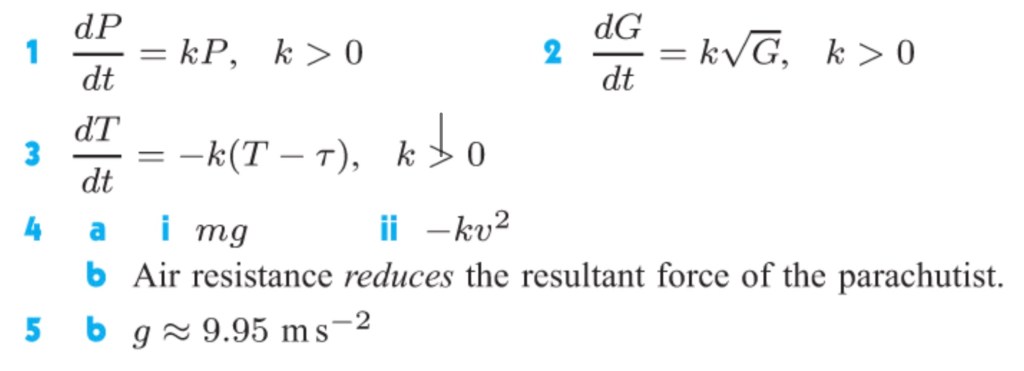
- Given sufficient resources, bacteria reproduce by “splitting” themselves at a constant rate. This means that the population P increases at a rate which is proportional to P. Write this as a differential equation.
- Algae is a kind of plant that grows in water. If G(t) is the amount of algae present in a pond at time t, the rate of algae growth is proportional to
. Write this as a differential equation.
- When a hot cup of coffee cools in a room with temperature 7º, the rate at which its temperature T changes is proportional to the temperature difference with the surrounding room. Write this as a differential equation.
- The equation of motion for a parachutist falling with downwards velocity v, is
, k>0. The term
is the resultant force, as predicted by Newton’s Second.
- Identify the term which models:
- Acceleration due to gravity
- Air resistance.
- Explain the term which has a negative coefficient
- Identify the term which models:
- Newton’s law of universal gravitation states that the force of attraction between two objects with masses m1 and m2 a distance r apart is given by
where
- Consider a small satellite with mass ms which is at altitude x above the Earth’s surface. The Earth has mass
and radius
.
- Use the law of universal gravitation and Newton’s second law to show that the acceleration of the satellite due to gravity is
- Hence estimate g, the acceleration due to gravity for an object at low altitude.
- Use the law of universal gravitation and Newton’s second law to show that the acceleration of the satellite due to gravity is
- Consider a small satellite with mass ms which is at altitude x above the Earth’s surface. The Earth has mass


Answers
 Maths with David