Let’s consider the following specific form of coupled DEs, which are called coupled linear differential equations.


We can rewrite these in matrix form as

In matrix notation we can write this as 

Investigation
This investigation looks at the properties of a system of coupled linear differential equations
1.) State the equilibrium point for any system of coupled linear differential equations

2.) Below is the phase portrait for the system of differential equations 

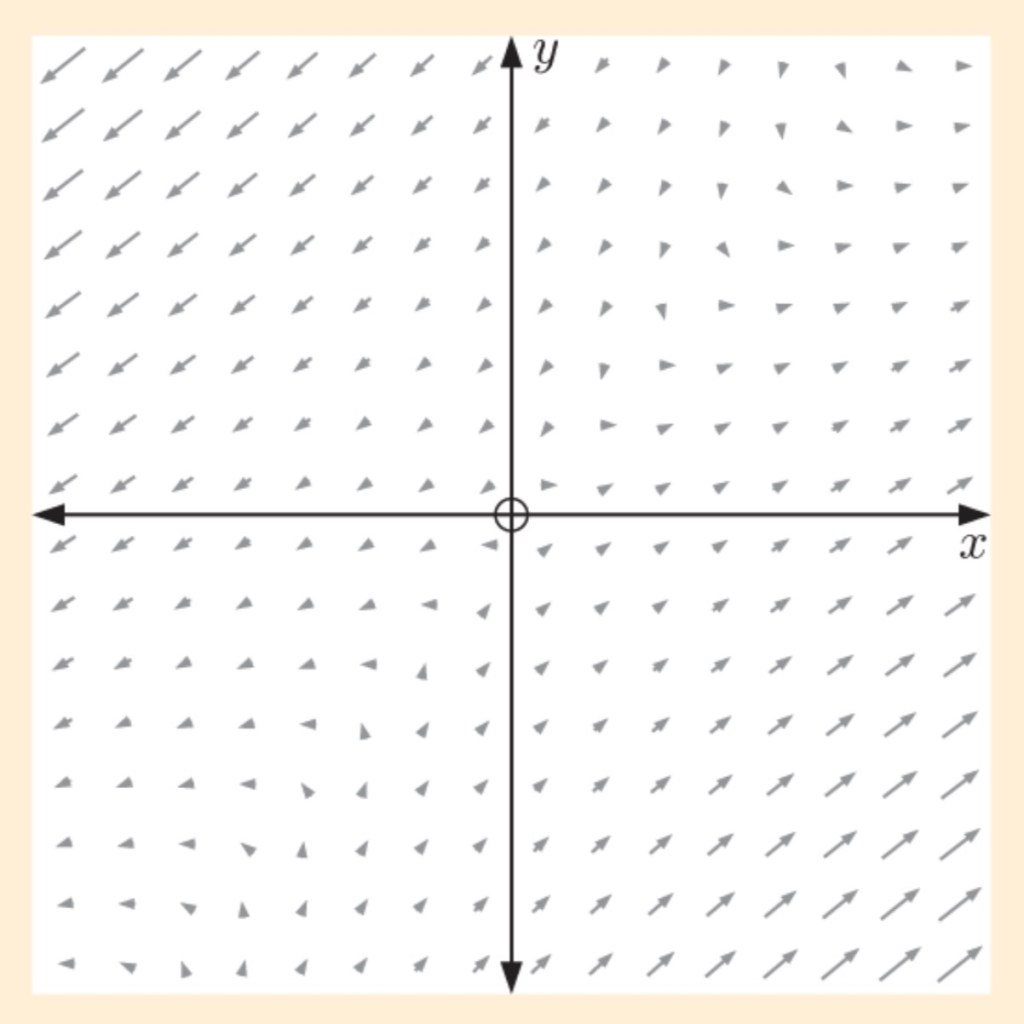
- a.) Rewrite the system in the form
.
- b.) Describe the equilibrium point of the system.
- c.) Show that the matrix A has eigenvalues -1, 2 with corresponding eigenvectors
,
.
- d.) Are there any trajectories which are straight lines? How do these relate to the eigenvectors of A?
3.) The system 

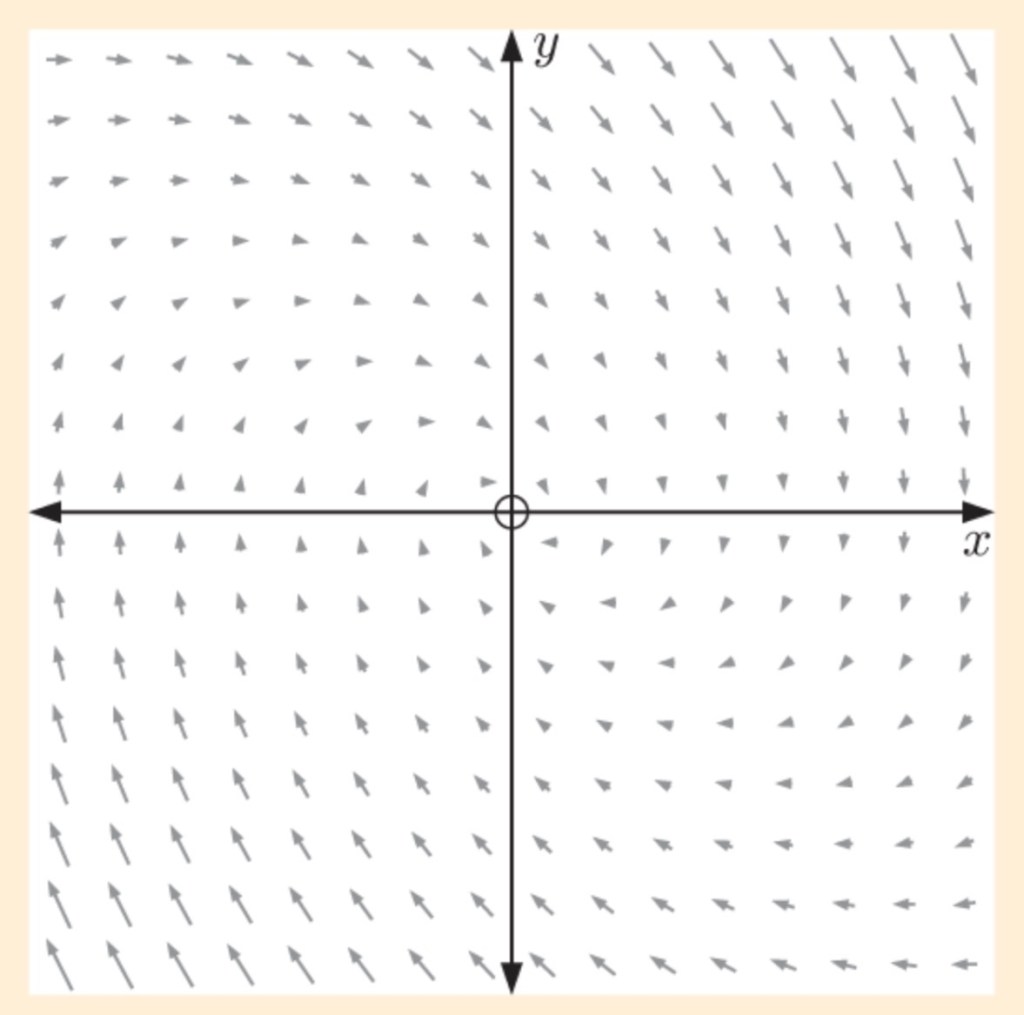
- a.) Write the system in the matrix form
.
- b.) Describe the equilibrium point of the system.
- c.) Show that the matrix A has complex eigenvalues.
- d.) Are there any trajectories that are straight lines?
General Solution to Coupled Linear Differential Equations
We know that x(t) = x0ekt is a solution of the one variable exponential growth equation 
So 


We can summarise the above by stating that 

The general solution for 


For the system of coupled linear differential equations 
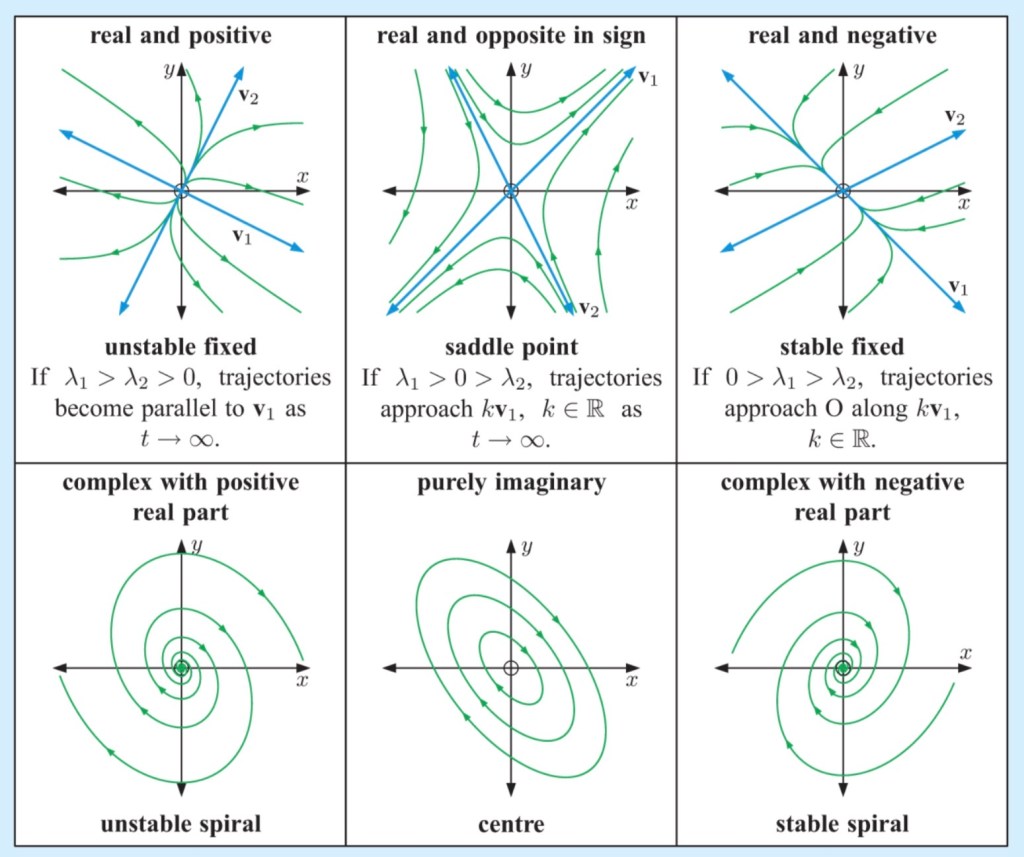
In this course we only consider cases with distinct eigenvalues. For both real and complex eigenvalues you should be able to sketch a phase portrait and trajectories and describe the behaviour of the system. If the eigenvalues are real you should be able to calculate the corresponding eigenvectors, write down the general solution to the system and find the particular solution for a given starting point.
Worked Example 1
The following system:


can be written in the form 


a.) Given the initial point (1,2), find: (i) 
b.) Sketch the phase portrait, including the particular solution.
c.) Discuss the behaviour of the system in the long term.
Worked Example 2
For each system 
a.) 


b.) 


Exercise
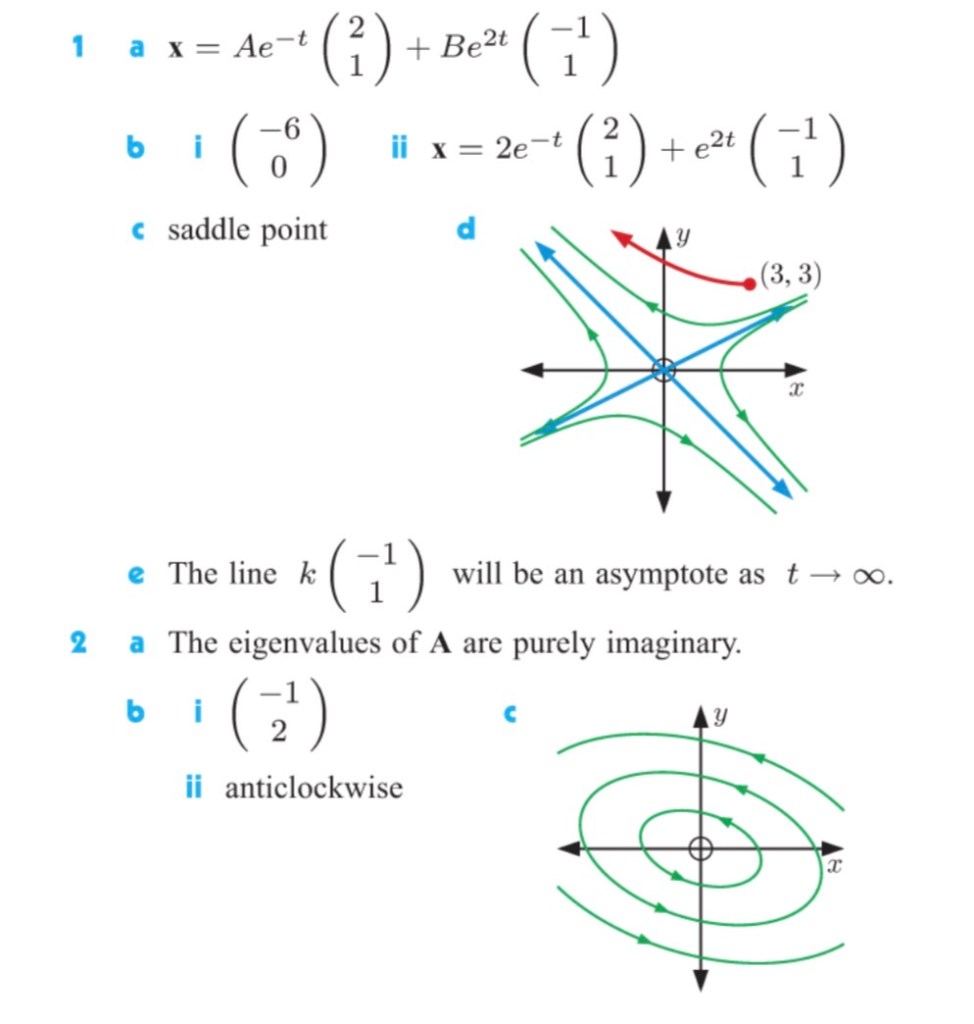
1.) The system 


- a.) Find the general solution to the system.
- b.) Given the initial point (3,3), find: (i)
, (ii) The particular solution to the system.
- c.) Describe the equilibrium point at (0,0).
- d.) Sketch the phase portrait, including the particular solution.
- e.) Discuss the behaviour of the system in the long term.
2.) The system:


can be written in the matrix form 

a.) Explain why the equilibrium point of the system is a centre.
b.) (i) Find the trajectory at the point (1,0)
(ii) Hence determine whether the trajectories rotate clockwise or anticlockwise
c.) Sketch the phase portrait for the system.
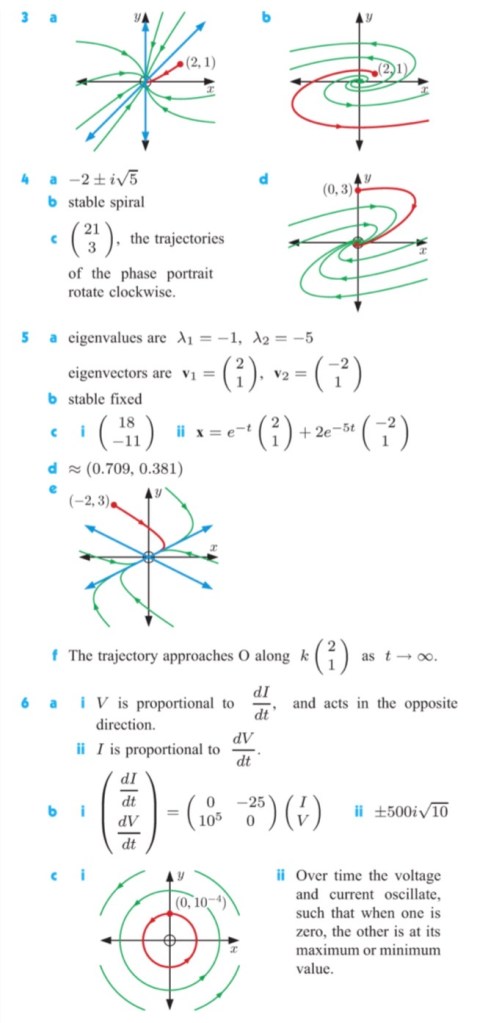
3.) For each system
- a.)
, where
has eigenvalues -3, -2 with corresponding eigenvectors
- b.)
where
has eigenvalue


4.) Consider the following system with initial point (0,3):


- a.) Find the eigenvalues of
- b.) Hence describe the equilibrium point of the system.
- c.) Find the trajectory when t=0, and explain what this tells you about the phase portrait.
- d.) Sketch the phase portrait including the trajectory from the initial point (0,3)

5.) Consider the system 

- a.) Find the eigenvalues and corresponding eigenvectors of
.
- b.) Describe the equilibrium point of the system.
- c.) Given the initial point (-2,3), find:
- (i)
- (ii) The particular solution to the system.
- (i)
- d.) Find the position of the particular solution when t=1. Round your answer to 3 decimal places.
- e.) Sketch the phase portraits, including the particular solution.
- f.) Discuss the behaviour of the system in the long term.
6.) An inductance-capacitance (LC) circuit is a simple electrical circuit used for producing radio signals.
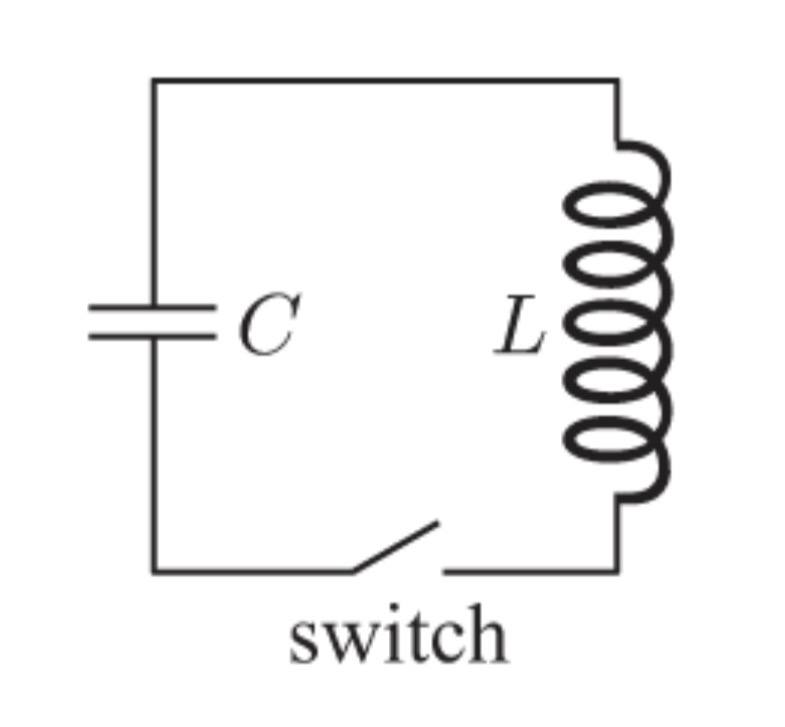
A simple LC circuit may be described as a combination of two interacting elements:
- A time-varying current I flows through a coil, inducing a voltage V against the flow and proportional to the rate of change of current.
- The current is produced by discharge from a capacitor, and is proportional to the rate of change of voltage across the capacitor.
a.) Explain why:
- (i)
for some “inductance” L.
- (ii)
for some “capacitance” C.
b.) A particular LC circuit has inductance L = 4 x 10⁻² H and capacitance C = 10-5F.
- (i) Write a system of coupled linear differential equations for the circuit in the form
- (ii) Find the eigenvalues of A.

c.) At time zero, the capacitor is fully “charged” with voltage 10-4 V across it. The switch is turned on so current will be able to flow.
- (i) Sketch a phase portraits for the system, including the trajectory from the initial conditions.
- (ii) Describe what happens over time.
Answers
 Maths with David