IBDP. AA. HL. Limits at Infinity

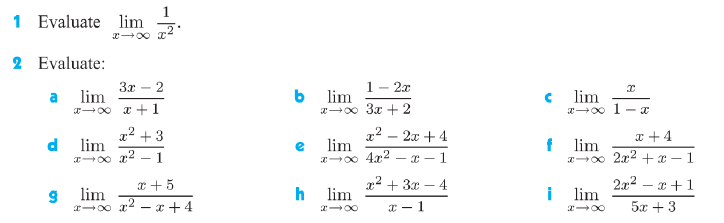
We can use the idea of limits to describe the behaviour of functions for extreme values of x. We write x \to \infty to mean “x tends to (positive) infinity and x \to - \infty to mean “x tends to (minus) infinity.

For instance, 1/x becomes increasingly small as x gets increasingly large, as does \frac{1}{x^n} for an n>0. So lim{x \to \infty } \frac{1}{x^n} = 0

Worked Example 1

Evaluate:

  • lim_{x \to \infty} \frac{2x+3}{x-4}
  • lim_{x \to \infty} \frac{x^2 - 3x + 2}{1 - x^2 }
  • lim_{x \to \infty} \frac{x^2 + x + 1}{x - 2 }

Worked Example 2

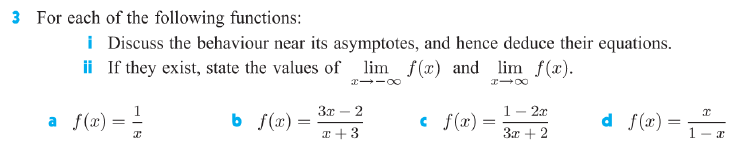
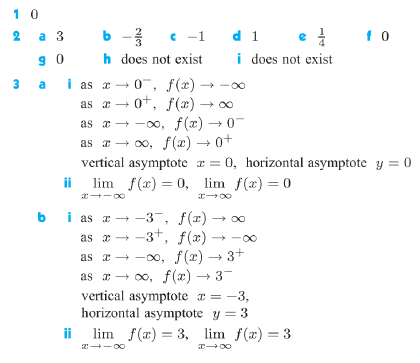
(a.) Discuss the behaviour of f(x) = \frac{ 2-x }{ 1+x } near its asymptotes and hence deduce their equations.

(b.) If they exists, state the values of lim_{x \to - \infty} f(x) and lim_{x \to  \infty} f(x)

Worked Example 3

Find, if possible

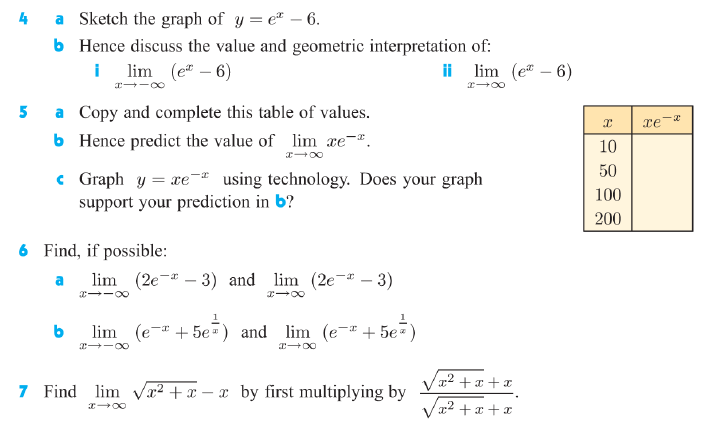
  • lim_{x \to - \infty} (3 - e^{-x} )
  • lim_{x \to \infty} (3 - e^{-x} )

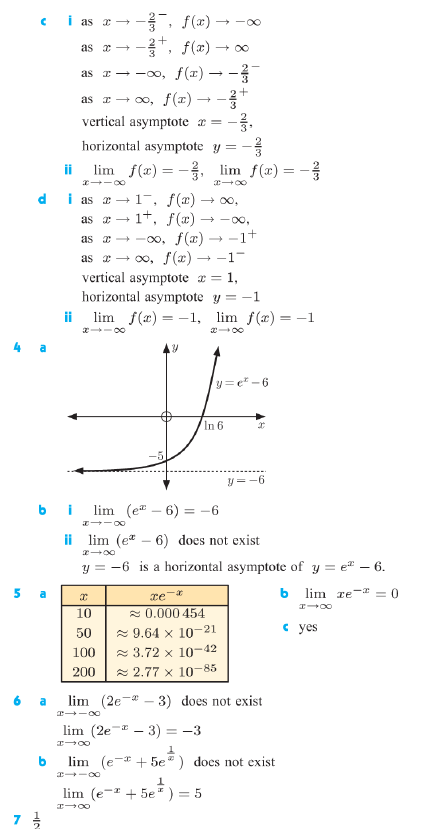
Exercise

Answers