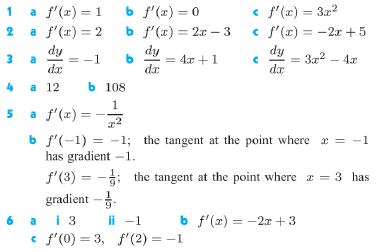
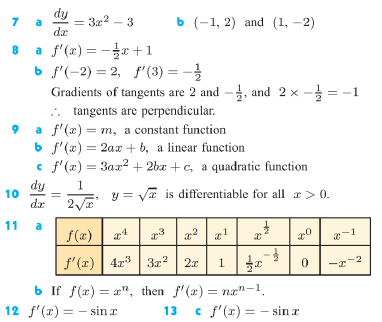
Combining what we’ve already cosidered, we know that
If a limit exists, then 
This definition lets us find the gradient of the tangent to a curve at a general point (x, f(x)) and hence find its derivative function.
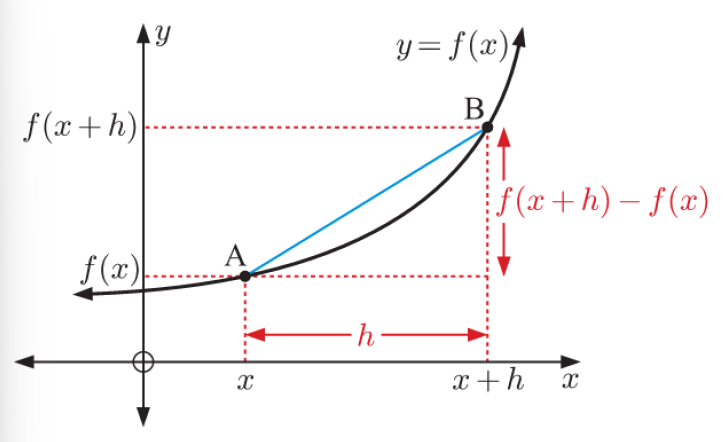
As per the diagram, the chord AB has gradient 

The derivative function (the “derivative”) of f(x) is defined as 
When we use this strict limit definition to find a derivative function, we say that we are differentiating from first principles.
Worked Example 1
Use first principles to find the gradient function f'(x) of f(x) = x4 and then find f'(-1) and interpret your answer.
Worked Example 2
Prove that 
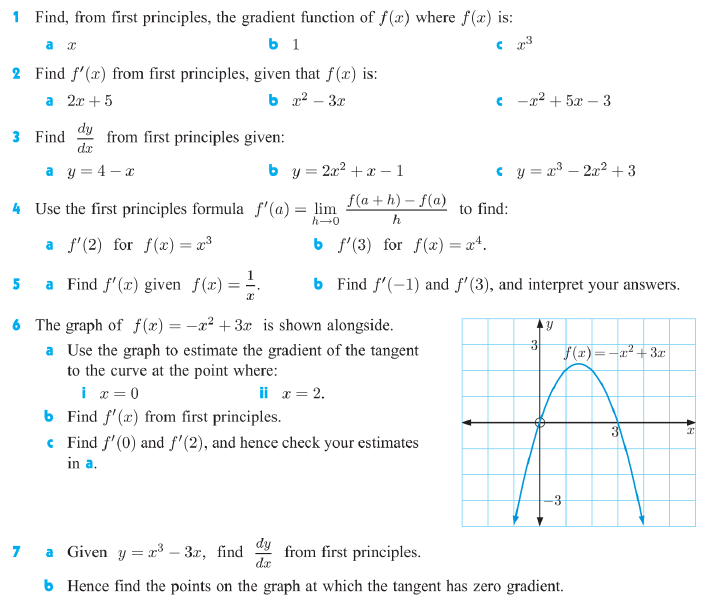
Exercise
Answers