IBDP. AA. HL. Differentiation. Existence of Limits

We can distinguish between when a function approaches a limit from below and from above using one sided limits: \lim_{ x \to a^- } and \lim_{ x \to a^+ }

Convergence: We say that the limit \lim_{ x \to a } f(x) exists and is equal to the finite value A if \lim_{ x \to a^- } = \lim_{ x \to a^+ } = A . We say that f(x) converges to A as x approaches a.

Of course, a limit does not always exist, i.e. there are many cases where f(x) diverges as x approaches a.

Consider the case where f(x) = 4 for x<1 and f(x) = 2 for x \geq 1 . Here there is a discontinuity at x= 1. \lim_{ x \to 1^- } f(x) = 4 and \lim_{ x \to 1^+ } f(x) = 2 . Hence \lim_{ x \to 1 } f(x) does not exist.

Worked Example

Find, if possible (a) \lim_{x \to 1} \frac{1}{x} , and (b) \lim_{x \to 0} \frac{1}{x}

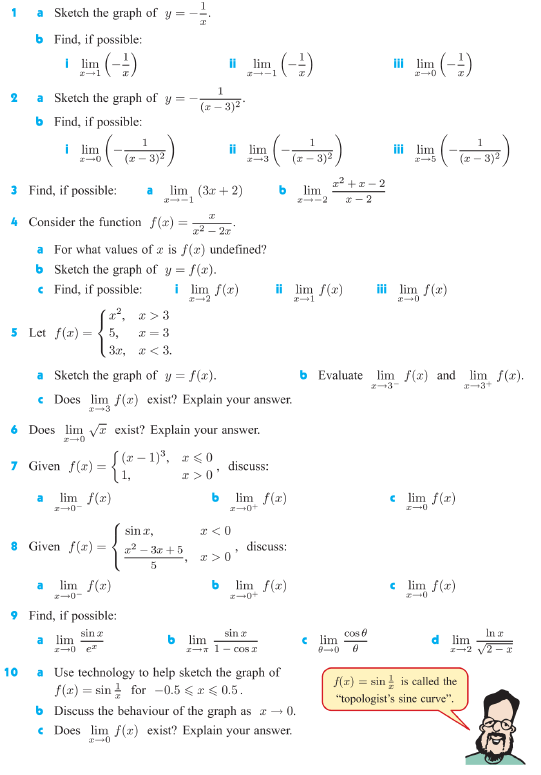
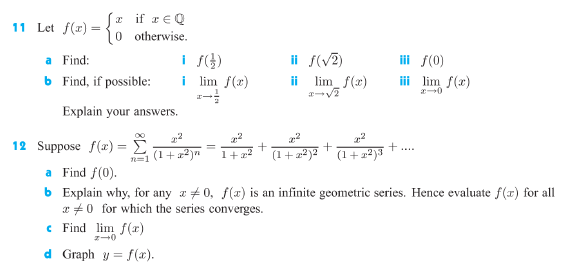
Exercise

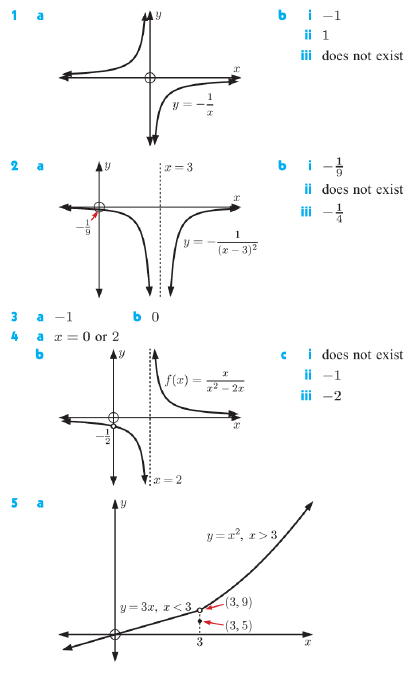
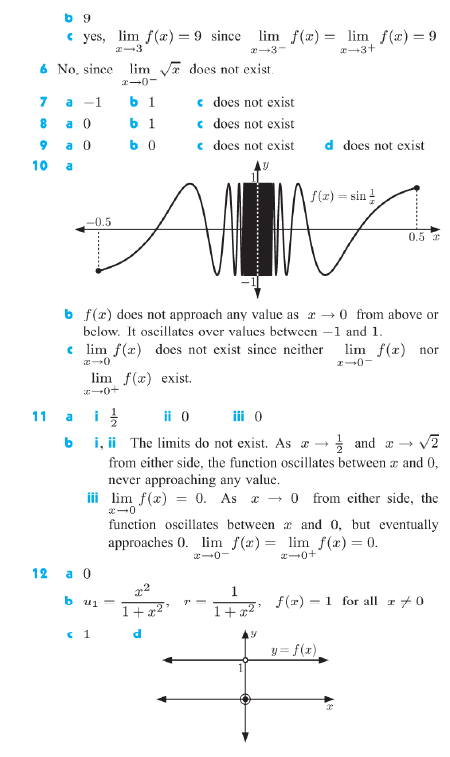
Answers