Definition of “Continuous”
A function, f, is continuous at x = a if f(a) and 
- Alternatively, we can say that f is continuous at x=a if at least one of the following is true:
- a is the left endpoint of an interval on which f is defined and f(a) and
exist and are equal;
- a is the right endpoint of an interval on which f is defined and f(a) and
exist and are equal.
- a is the left endpoint of an interval on which f is defined and f(a) and
If f is not continuous at x=a, we say either that f is discontinous at x = a, or that f has a discontinuity at x = a.
Regarding discontinuities, we can distinguish between a hole, a jump and a break.
A hole refers to a single undefined point in a continuous graph. A jump is similar, but involves the right hand side and left hand side of the jump not being connected. A break occurs when the function to the left of the break differs from the function to the right of the break. These subtle distinctions are demonstrated in the diagram below.
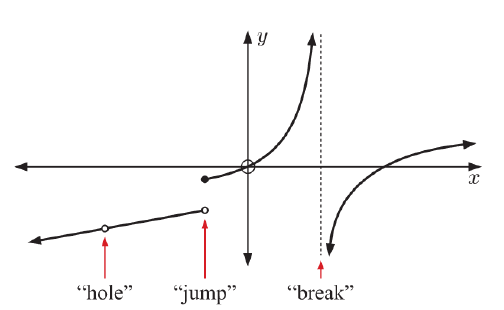
A hole is a removable discontinuity, which can be removed by defining a new function f whose value at x=a is defined as
Worked Example
Discuss the continuity of the following functions. If there is a removable discontinuity, describe how it could be removed:
- (a)
- (b) f(x) = 1 for
and f(x) = -1 for
- (c) f(x) = x2 for
and f(x) = 6 for x = 2.


Exercise
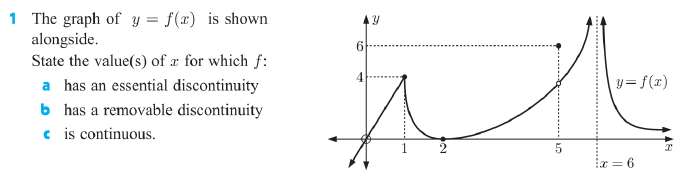
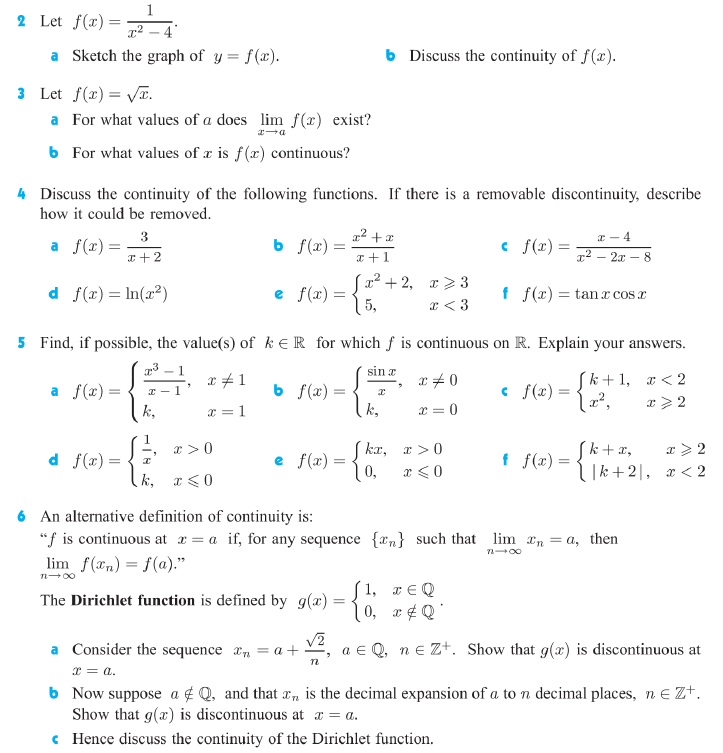
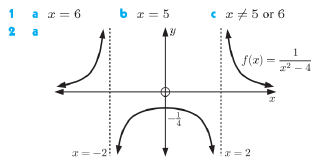
Answers

 Maths with David