As the world economy has become much more integrated, domestic firms have the opportunity to sell goods and services internationally and domestic customers have access to a wider range of goods and services. This also leads to greater risks due to global shocks that can start in one country and impact other countries. Also, many countries seek to interfere with freedom of trade and protect their domestic markets.
International trade allows specialisation. By the law of comparative advantage, if all firms specialise on producing the good in which they has a comparative advantage, overall output can be increased. We distinguish comparative advantage (the ability to produce a good relatively more efficiently, i.e. at a lower opportunity cost) from absolute advantage (the ability to produce a good more efficiently, e.g. with less labour).
The graph below this shows this in the trading possibilities curve (showing the consumption policies under conditions of free trade) for two countries, “Overthere” and “Elsewhere”, showing how trade can be mutually beneficial (i.e. “Elsewhere” will specialise in producing agricultural goods and “Overthere” will specialise in manufacturing):
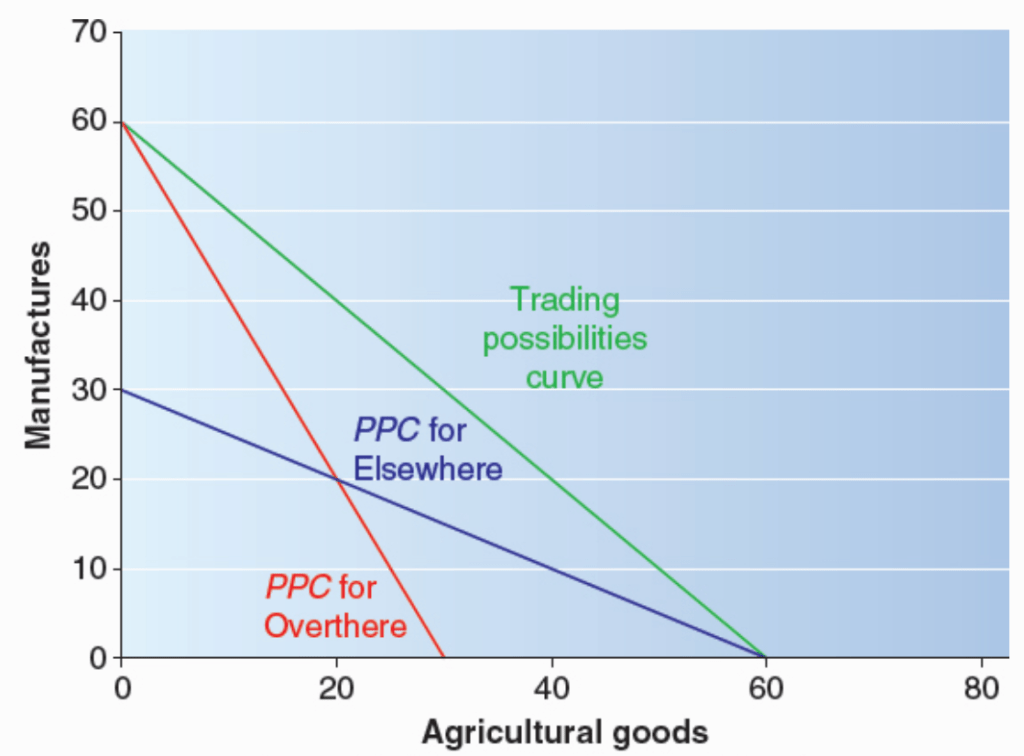
The above graphs assumes that the goods are exchanged on a one-to-on basis, although of course in reality exchange would take place at different prices for the goods, and this would determine which country gained most from the trade occurring.
Terms of Trade
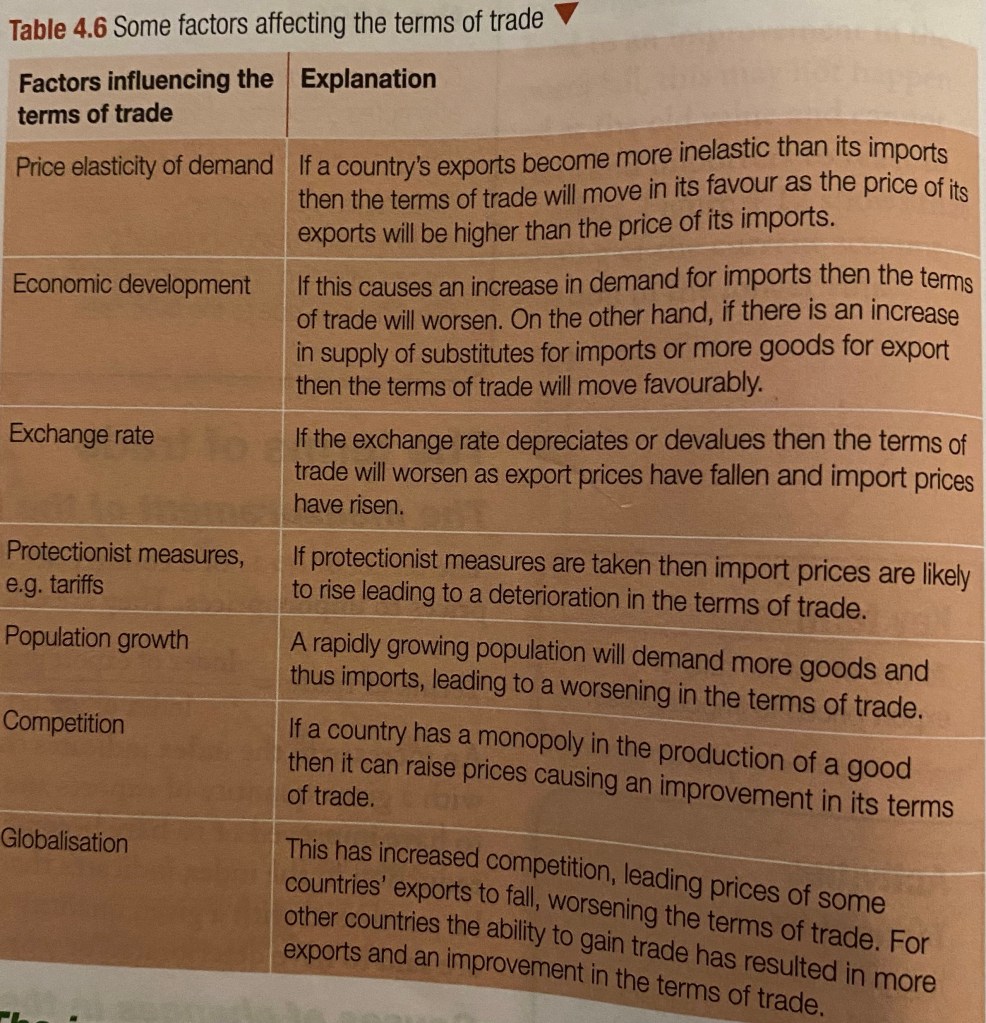
The ratio of a country’s export prices to import prices is called the terms of trade. Smaller countries with less market power can be affected by the need to accept the prices set in world commodity markets which may not work in their favour.

A danger in specialising is that it means a country may let some sectors disappear. If this applied to agriculture, for instance, in the event of war this could seriously hamper a country. Also the area specialised in could later be uncompetitive if a substitute product were developed (a situation that Malaysia has faced as a country that specialises in production of rubber). In general, according to the Prebisch-Singer hypothesis, terms of trade tend to become more unfavourable over time for countries producing primary goods (e.g. commodities), as demand increases more rapidly for manufactured goods and services as incomes increase.
Note that a favourable change in terms of trade is not always beneficial. If it is due to export prices rising because of increased demand then it is positive, but if they have risen due to increased production costs, the demand for these exports will fall and export revenue may decline. Also, an unfavourable change in terms of trade may reduce a deficit on the current account of the balance of payments (if the Marshal-Lerner condition is met).
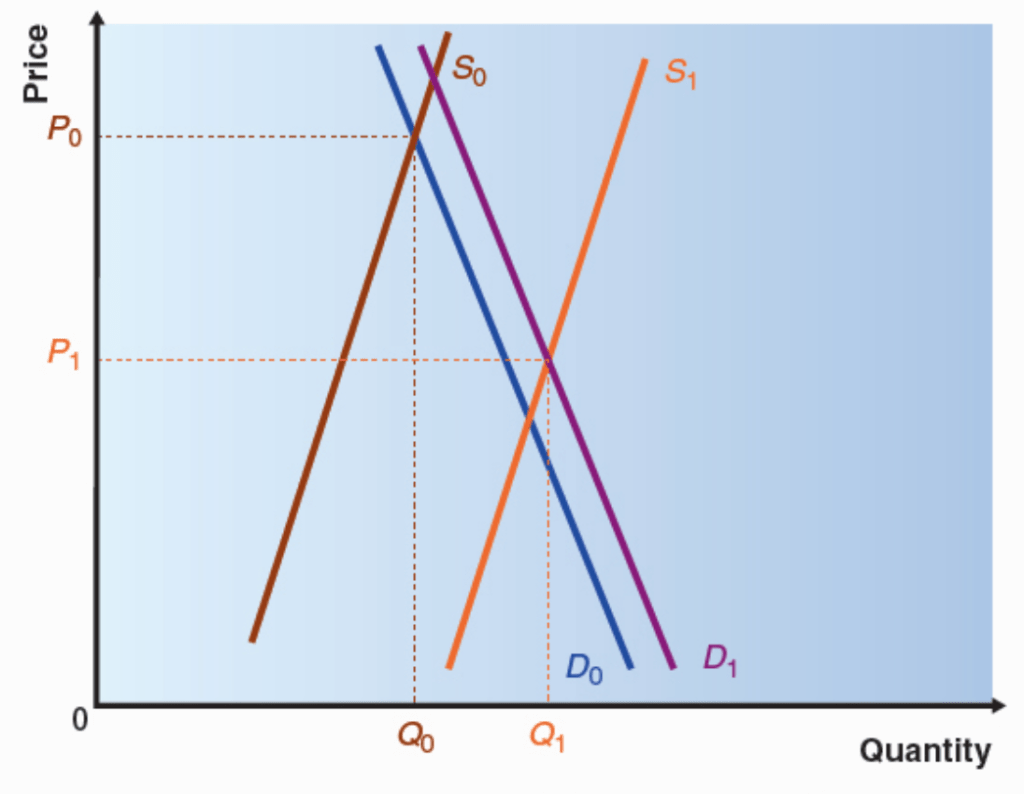
Supply of agricultural goods can be volatile, due to climatic conditions, whereas demand is fairly stable. By contrast, supply of commodities tends to be stable, whereas demand can fluctuate considerably. For a country producing goods any kind of volatility can create problems. In the long run technology can also impact significantly on the demand for commodities.
As incomes rise in developing countries, demand for agricultural goods typically rises slowly, whereas demand for luxury goods rises rapidly,
As less developed countries increase output over time this shifts the supply curve to the right. The graph below illustrates how this combine with a gradual increase in demand causes the price of the commodity to deteriorate in the long run:
All countries engage in international trade, depending on what goods they are able to produce. The graph below illustrates the extent to which countries engage in trade. Malaysia and Thailand rank highly as their governments have followed policies promoting exports and the USA rank low, as they have a large and diverse economy with a wealth of natural resources and so do not depend heavily on trade:
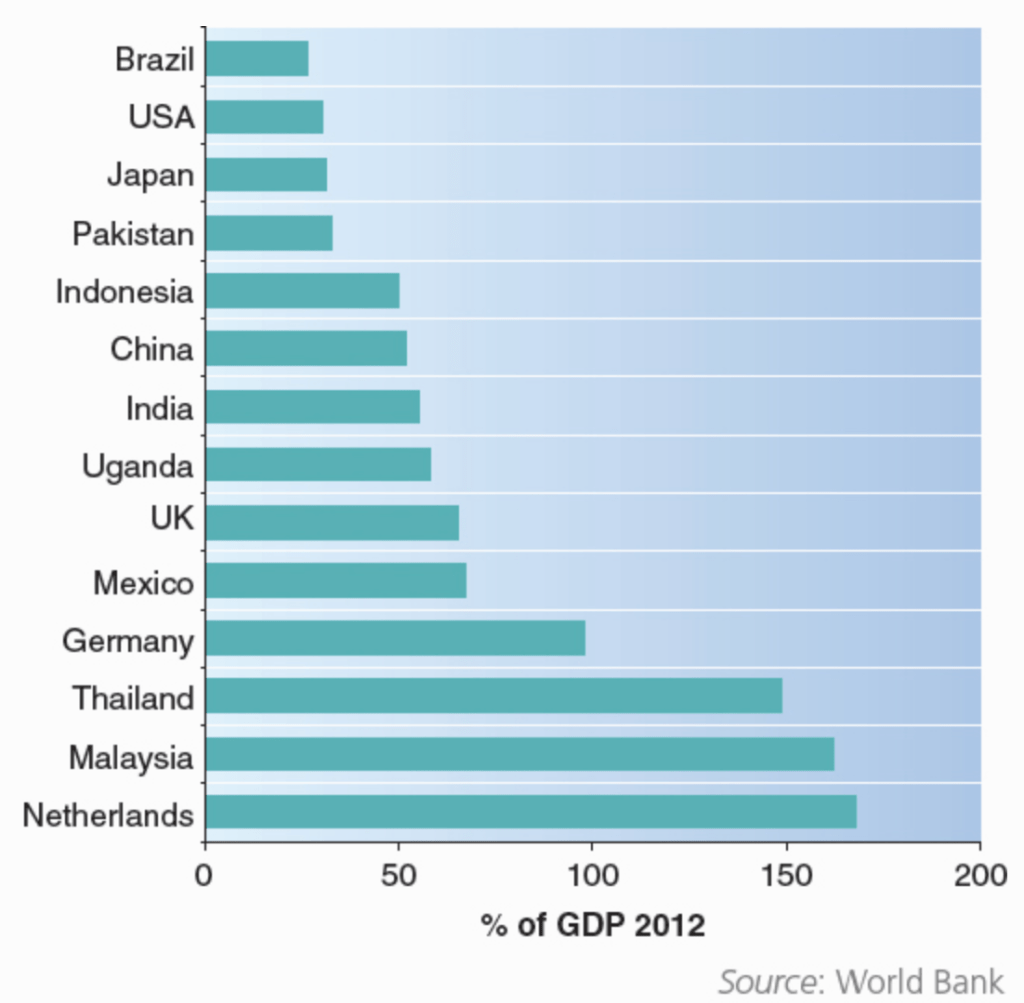
Countries level of trade depend on their ability to produce goods and on the policy stance of their governments regarding trade (India in the past has been reluctant to engage heavily in trade and introduced policies that restrict it).
Comparative Advantage
Most international trade is due to comparative advantage, a slightly counterintuitive concept which it is very important to distinguish from absolute advantage. The table and graph below illustrate comparative advantage:

Heckscher and Ohlin argue that a company’s comparative advantage depends heavily on their relative endowments of factors of production, as some commodities are most efficiently produced using labour-intensive techniques, whereas others are more efficiently produced using capital-intensive techniques. In general less developed countries specialise in labour- or land- intensive activities such as agriculture and mineral extraction and more developed countries specialise in capital- intensive activities such as manufacturing or financial services. However, the growth of the Asian Tigers in the second half of the twentieth century has shown that this process is not static.
Task 1 – Absolute and Comparative Advantage

Task 2 – Comparative Advantage

Task 3 – Comparative Advantage
Using the same quantities of resources to produce rice an cloth, China can produce 5kg of rice or 4m of cloth in a period and Pakistan can produce 3kg of rice or 3m of cloth.
- Draw PPC curves for Pakistan and China on the same diagram.
- Which country has an absolute advantage in each product?
- Which country has a comparative advantage in each product?
- Demonstrate how trade could benefit both countries and what would be an appropriate rate to exchange 1kg of rice for 1m of cotton.
Trade liberalisation vs Protectionism
Globalisation is a process whereby the world’s economies are becoming more closely integrated. This is in large part due to rapid advances in the technology of transportation and communications. This has led to firms spreading their production process across countries to take advantage of varying cost conditions, such as placing labour-intensive parts of a production process in areas where labour is relatively plentiful and cheap.
Improvements in communication technology has also made it easier for firms to compete in global markets. The growth of multinational corporations (MNCs) has been such that by turnover some firms are now larger than the countries in which they operate (measured by GDP). e.g. General Motors is larger by this measure than Hong Kong or Norway.
Globalisation has also been enabled by reduction in trade barriers, such as the General Agreement of Tariffs and Trade (GATT) set up after WWII and later replaced by the World Trade Organisation (WTO).
Free trade areas such as the European Union (EU) and Association of South East Asian Nations (ASEAN) have also increased international trade and integration.
Gradual deregulation of financial markets allowing financial capital to move more freely between countries has also helped fund this process.
Protectionism
Some countries see themselves as vulnerable to international trade and seek to protect their domestic producers. Some of the arguments in favour of protectionism are:
- The infant industry argument that a new industry cannot compete against mature competitors with economies of scale and so needs protection in the early stages of their development.
- To protect declining (“sunset”) industries which have lost their competitive advantage;
- To protect strategic industries;
- To prevent “dumping” (foreign companies importing goods at below their cost price to try and drive out domestic companies);
- To improve terms of trade;
- To improve balance of payments;
- To provide protection from cheap labour.
Excessive protectionism can, of course, prevent domestic firms from becoming competitive.
One way to implement protectionism is by imposing tariffs, a form of import tax, on imported goods. The graph below shows how tariffs are expected to operate:

Curve D represents the domestic demand for a commodity and curve Sdom shows the domestic supply. PW is the price at which the good can be imported from world markets, which would lead to demand D0, with S0 supplied domestically and D0-S0 imported. Imposing a tariff raises prices to PW+T, which reduces demand to D1 and increases domestic supply to S1. Imports are reduced from to D0-S0 to D1-S1. In some ways this has achieved its objective as domestic supply has increased and imports have been reduced, however domestic consumers are worse off as they now have to pay a higher price. Effectively, the government is subsidising inefficient local producers and forcing domestic consumers to pay a price that is above that of similar goods imported from abroad.
In the longer term such protectionism may delay necessary, although painful, structural change and prevent an economy remaining competitive. It can also encourage inefficiency. Other countries may respond to tariffs with their own tariffs, damaging overall trade and specialisation.
Another protectionist alternative is to limit imports of a commodity based on a fixed quota. A voluntary export restraint (VER) is an agreement by a country to limit its exports to a given quantity. The impact is demonstrated below:
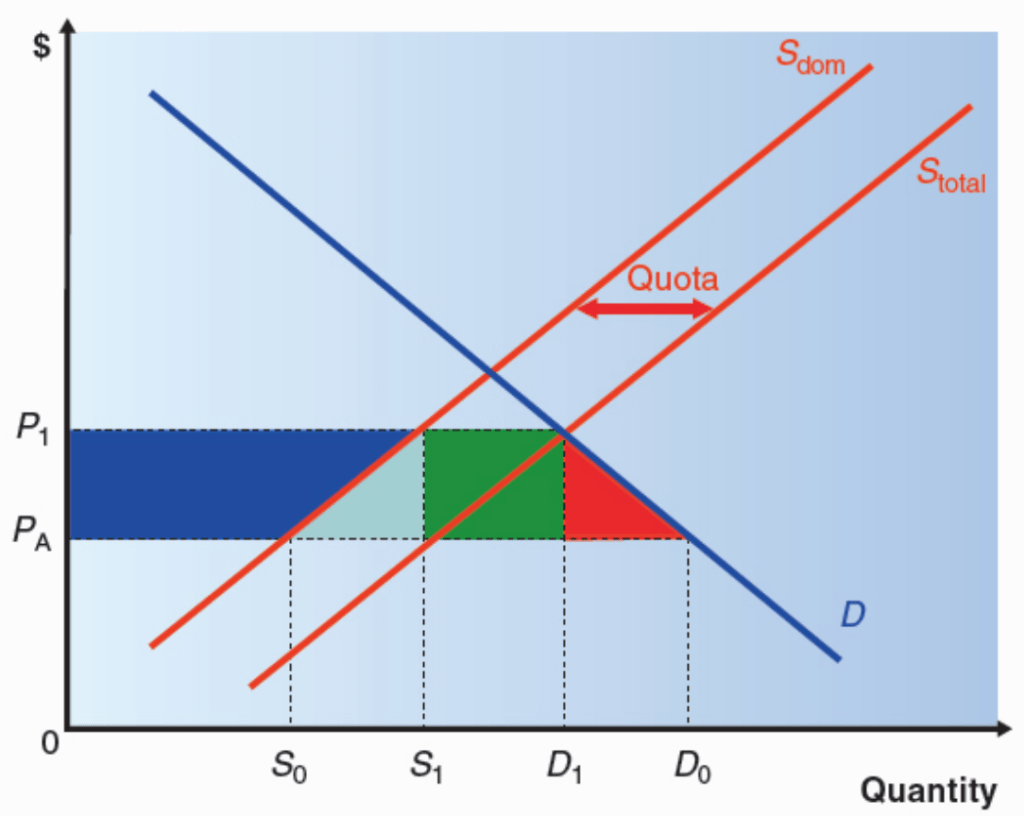
As can be seen, this increases the market equilibrium price of the good and decreases the demand whilst increasing the level of domestic supply (to S1). Effectively foreign producers are being subsidised by being able to charge a higher price than they would have accepted. As previously the triangles represent losses as a result of this policy and the consumers are made to suffer in order to support the producers. And as before this and lead to more inefficient production. China and the US have a history of using quotas in their trade relationship.
- Other protectionist measures include:
- non-tariff barriers, such as quality standards imposed on imported products, which can restrict foreign countries’ ability to enter markets. Sometimes these are for environmental or safety reasons, but they have also been used deliberately to give local producers a competitive advantage.
- subsidies, either for exporters or to domestic producers that compete with importers. This can benefit domestic producers but its impact is felt by foreign producers and domestic taxpayers. Consumers often benefit in the short run from cheaper goods and lose out in the one run as foreign competition is driven away and subsidised foreign firms raise their prices.
- embargoes, banning imports of a particular product or trade with a particular country;
- red tape, excessive bureaucratic requirement can discourage imports;
- maintaining FX rate below market value.
Reasons for protectionism can be political as well as economic, particularly if the sectors affected enjoy political influence in a country.
Economic Integration
One important aspect of globalisation has been regional trade agreements. These are designed to allow greater specialisation and reduce barriers to trade for countries whose proximity lends itself to the potential for stronger relationships. When membership of a trade bloc causes members to replace high cost domestic production with more efficiently produced imports, then trade creation has taken place.

The lower price (due to no tariff) increases consumer surplus by a, b, c and d amount. producer surplus falls by a amount and tariff revenue by c amount, giving a net gain of b and d amount.
The process of regional trade integration follows the following four stages:
- Free trade area – Countries agree to remove tariffs, quotas and other restrictions between member countries. Examples are ASEAN (in 1993 Brunei, Indonesia, Malaysia, Philippines, Singapore and Thailand and later also Cambodia, Laos, Myanmar and Vietnam) and NAFTA (US, Canada and Mexico)
- Customs union – Countries agree to remove restrictions on trade between members and set a common set of restrictions (including tariffs) against non-member states;
- Common market – A set of trading agreements in which a group of counties remove barriers to trade amongst themselves, adopt a common set of barriers against external trade, establish common tax rates and laws regulating economic activity, allow free movement of factors of production between members and have common public sector procurement policies; and
- Economic and monetary union – A set of trading agreements as for a common market, but with the addition of fixed exchange rates between the member countries and a common monetary policy.
One risk of a free trade area is that the lack of a common external tariff wall will lead to outside countries importing into whichever member country has the lowest tariff, who will then resell to the other countries in the free trade area, distorting the pattern of trade and causing unnecessary transaction costs.
One risk of a customs union is trade diversion whereby a member state imports goods from other members instead of from more efficient producers elsewhere in the world.


There can also be significant transaction costs in administering the union and political issues if certain member states have close ties with non-member states. It could also lead to growing inequality between regions within the union as firms choose to concentrate in certain geographical areas towards the centre of the union to minimise transportation costs. Such a union can however give smaller countries economies of scale that would not be available if they were confined to selling in their domestic markets. It could also lead to efficiency gains due to competition within the union leading to better and more efficient firms.
Risks involved with economic and monetary union are that by agreeing to fixed exchange rates governments can no longer use monetary policy for their internal domestic purposes, which is a particular problem if their business cycle is poorly synchronised with the other countries in the union.
Example Trade Blocs

Task – Trade Blocs

 Maths with David