What is differentiation?
Calculation of rate of change of a function, which is geometrically represented by the gradient of the function.
We will calculate gradient functions that show us the gradient at any point on a graph.
How do we find a gradient function?
The method works by taking one point on a curve and taking a second point close to it.
We measure the gradient of the secant line joining these two points.
We then consider what happens to this gradient as the two points become progressively closer together.

So, using this formula, how would we find the gradient of y=x2 at the point x=x1?
Differentiation of polynomials
Using this approach (known as differentiation from first principles), we can derive the following formula, which must be memorised and is used extensively: If n is any real number, then (xn)’ = nxn-1
This formula, combined with the following straightforward rules for multiplication and addition, allows us to differentiate any polynomial.
- (f(x) ± g(x))’ = f'(x) ± g'(x);
- (c.f(x))’ = c.f'(x).
Alternative notations
- Leibniz;
- Newton;
- Lagrange.
Worked Examples
- Differentiate:
- f(x) = 3x5 + 4x4 – 7x2 + 3x + 6;
- f(x) = 3/2x;
;
- f(x) = 0.2√x;
- f(x) = 3x2 + 5x – 1;
- For each of the above results, find f’(x) when x=1


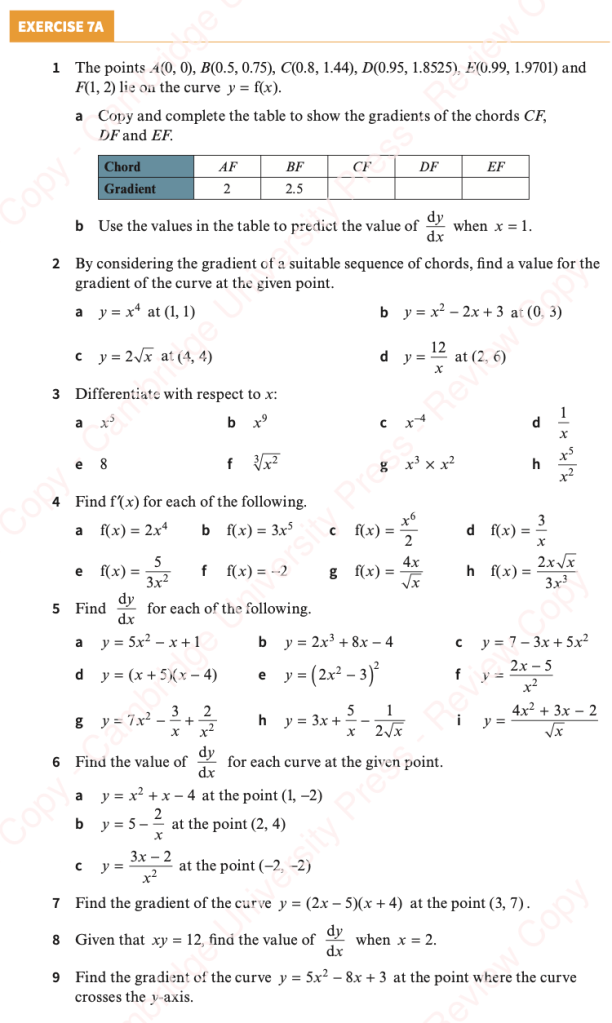
Exercise 1

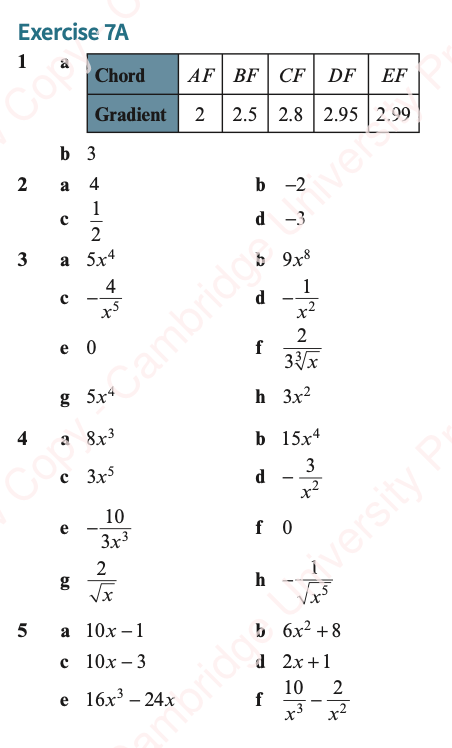
Answers

Chain Rule
[(f(x))n]’ =n(f(x))n-1.f'(x)
Worked Example
- Differentiate the function:
- f(x) = (2x3 + x2 – 15)-1/3
- f(x) = ((x+1)-2/3 + 5x)-3
- For each of the above functions, find the gradient of the function when x=2.


Exercise 2

Answers


Worked Solutions to Exercise 2
Equations of tangents and normals
To find the tangent to a curve or the normal to a curve, we differentiate to find the gradient, then use this gradient in the equation of a straight line.
Worked Example
Find the equation of the tangent to the curve y = x3 – 3x2 + 2x – 1 at the point (3,5)
Find the equation of the normal to the curve with equation y = 8 – 3√x at the point where x=4
A curve has equation 
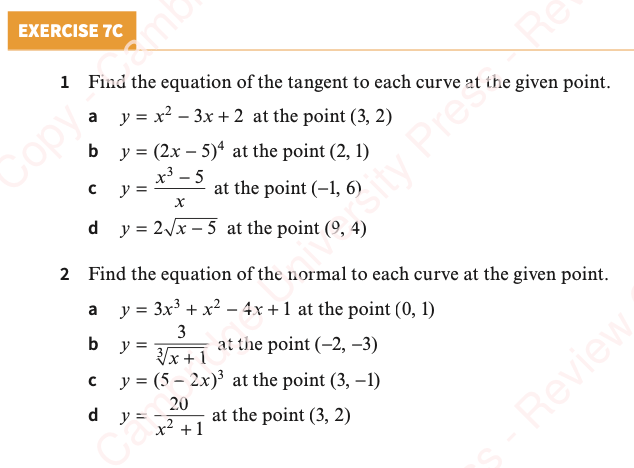
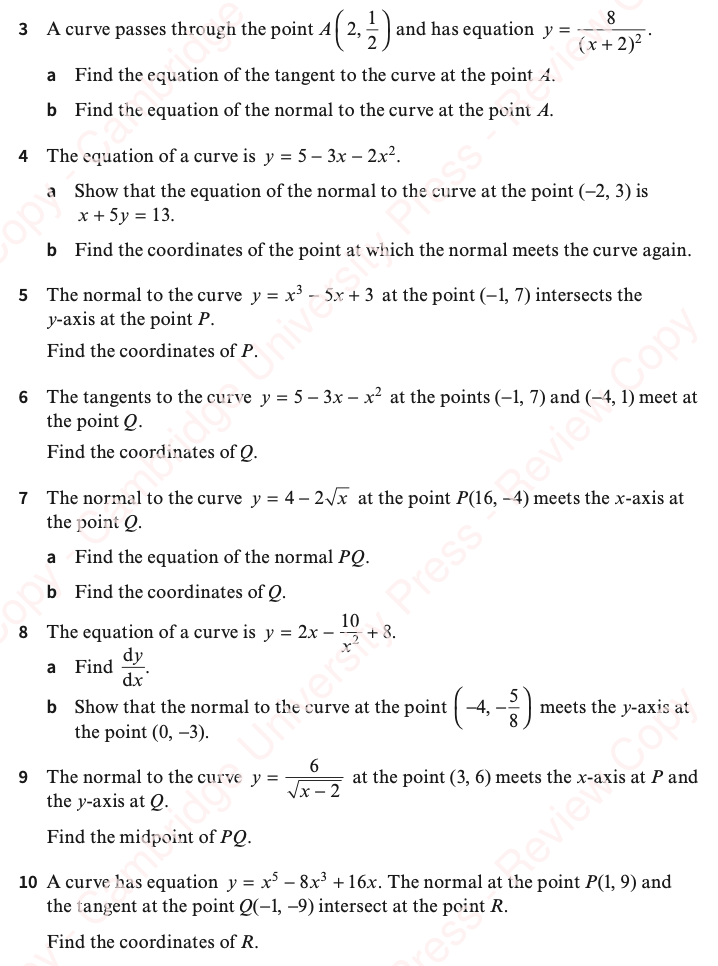
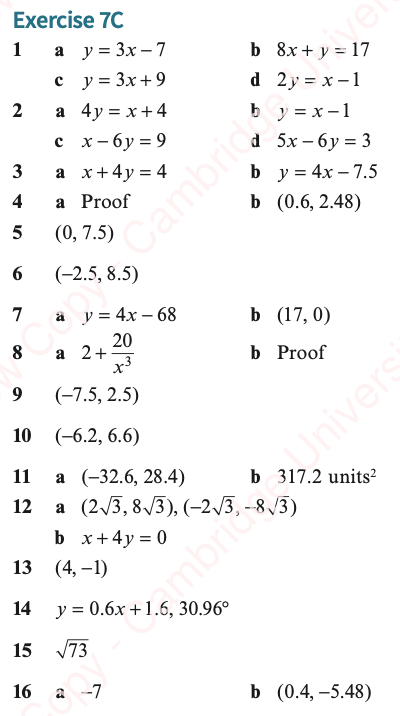
Exercise 3


Answers
Worked Solutions to Exercise 3
Second Derivatives
We can take the derivative of the gradient function to find its gradient. We will look later when we look at applications of differentiation at why this is useful to us.
Worked Examples
You are given that f(x) =4x2 + 1/x. Find f'(x) and f”(x)
- For each of the following functions find
- y=x3
- y=x5
- y=4x2
- y=x-2
- y=x3/2
- y=x4 – 2/x3

Exercise 4 and Mixed Exercise

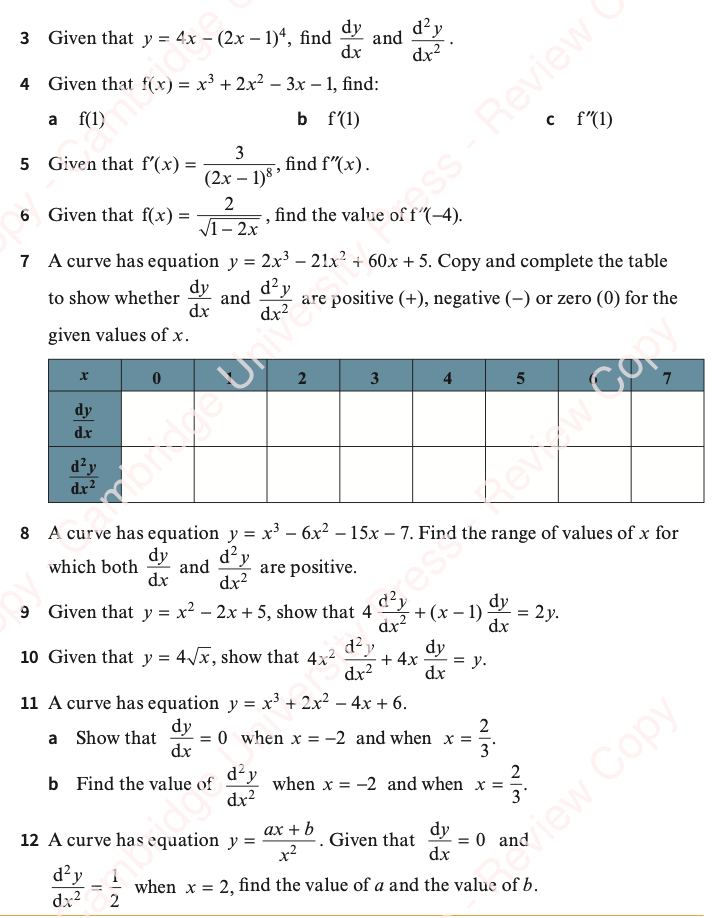

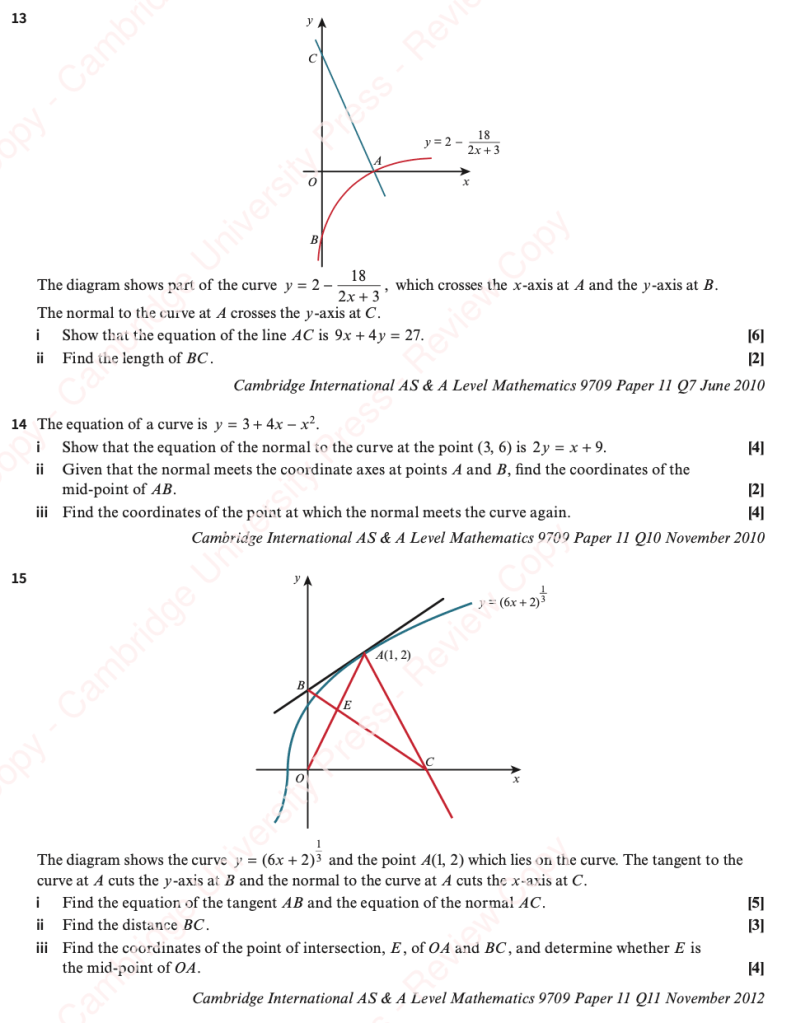
Answers
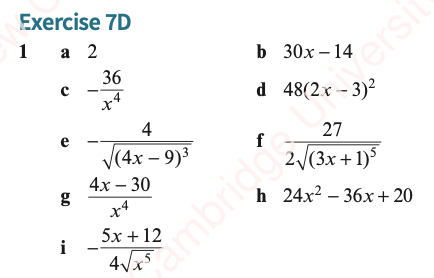
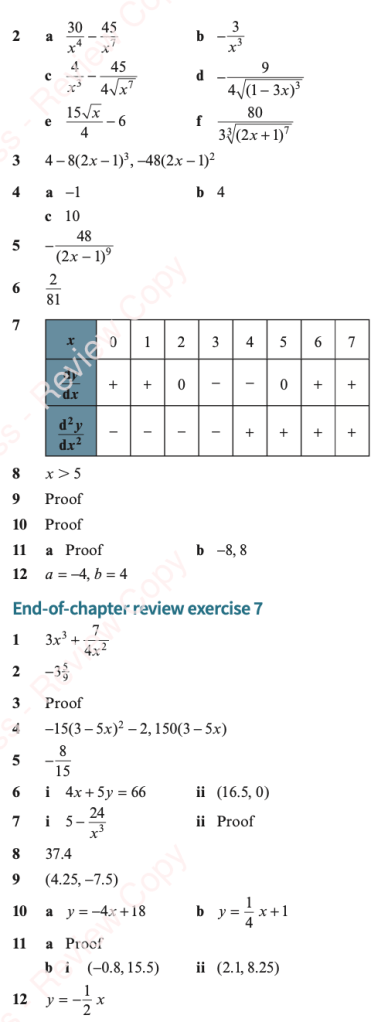
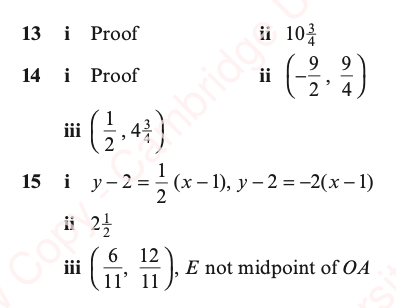
Worked Solutions to Exercise 4 and Mixed Exercise
 Maths with David