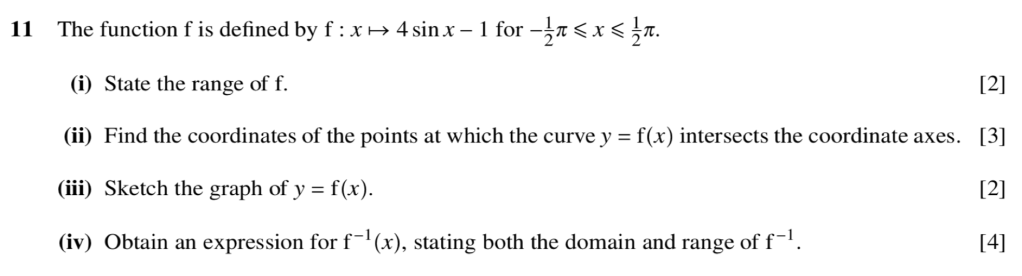
Exam Starter (from summer 2016 paper 11)
Mark Scheme

Measuring angles in circles
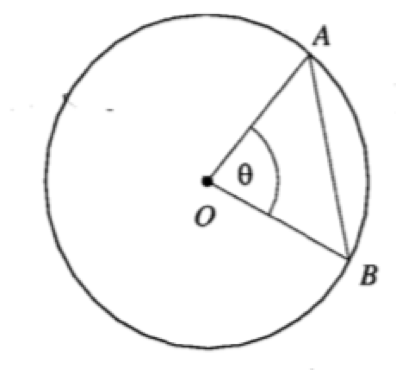
An arc is part of a circle (i.e. a curved part of its circumference), we call its length the arc length.
When we measure an angle in radians, the arc length is equal to the angle times by the radius of the circle.
So a distance of r around the arc covers an angle of 1 at the centre. And a complete turn is an angle of 2π radians (consistent with the circumference being 2πr).
Converting between degrees and radians
A complete turn can be measured as 360 degrees or 2π radians. These are equal.
So, the following conversions apply, which we must memorise:
Degrees
180º
90º
60º
45º
30º
Radians
π
π/2
π/3
π/4
π/6
The above key values must be memorised. For other values we can convert between degrees and radians by multiplying or dividing by the conversion factor: π/180
Worked Example


Exercise 1


Answers


Arc Length
- Clearly, the arc length of an arc subtending an angle of 𝜽 is r𝜽. So if we know any two of the following three values, we can work out the other one:
- (a) radius,
- (b) arc length,
- (c) angle subtending arc.
In the problems we tackle we will also need to use the sine rule and the cosine rule that we have previously studies in iGCSE. Do you remember them?

We also need to know the meaning of the following words: perimeter, circumference, chord, sector, segment.
Worked Examples


Exercise 2


Answers

Sector Area
To find the area of a sector, we simply take the area of the relevant circle, i.e. πr2, and multiply it by the proportion of the circle that the sector represents, i.e. 𝜽/2π, where 𝜽 is the sector angle.
This product gives us the formula for the area of a sector: 
Sometimes we will want to calculate the area of a segment (which we do by subtracting the area of a triangle from the area of a sector. We will use from iGCSE the following formula for the area of a triangle:

Worked Example

Exercise 3 and Mixed Exercises


Answers
 Maths with David