Polynomials
Do we remember what a polynomial is? (And isn’t?)
How to accurately define a general polynomial algebraically?
Some important terms: polynomial, degree, term, coefficient, leading coefficient, constant term, zero polynomial.
Types of polynomial: constant, linear, quadratic, cubic, quartic.
Descending order / ascending order
We can do with polynomials many of the things that we can do with numbers:
- Addition / subtraction -> Straightforward. Some terms may cancel;
- Multiplication -> A little more complicated, but we just need to be systematic and multiply every term by every term;
- m-degree polynomial x n-degree polynomial = m+n-degree polynomial.
Polynomial Division
We can use long division (below we will practice this), but we should also know the technique of equating coefficients.
If a(x) is divided by b(x), then we define the quotient, q(x) and the remainder r(x), by a(x)=b(x)q(x) + r(x), where deg(r)<deg(b) and if deg(b) < deg(a), then deg(q)=deg(a)-deg(b).
If we are dividing by a linear polynomial, the remainder will be a constant.
Worked Examples – polynomial division
1.) Divide x3 + 2x2 – 11x + 6 by x-2;
2.) Find the remainder when 2x3– 5x + 52 is divided by x+3.
Worked Examples – comparing coefficients
One factor of 3x2-5x-2 is x-2. Find the other factor. (although we can do this by inspection, let’s do it by multiplying the x-2 by ax+b to see this equating coefficients method, which is going to be of great help to us in the future)
If 4x3+2x2+3=(x-2)(ax2+bx+c)+r, find a, b, c and r.
In the following exercise, once you have practiced one method a few times (I.e. polynomial division) and gained confidence in it, then use a different method (I.e. comparing coefficients) for some of the questions. Mastering multiple methods is the best way as mathematicians for us to be able to tackle challenging problems.
Exercise
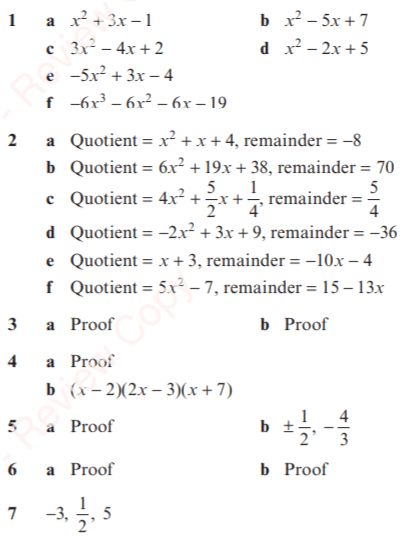
1.) Simplify each of the following:
1a.)

1b.)

1c.)

1d.)

1e.)

1f.)

2.) Find the quotient and remainder for each of the following:
2a.)

2b.)

2c.)

2d.)

2e.)

2f.)

3.) Use algebraic division to show that these two important factorisations are true:
3a.)

3b.)

4a.) Use algebraic division to show that x-2 is a factor of
4b.) Hence factorise 
5a.) Use algebraic division to show that 2x+1 is a factor of 
5b.) Hence solve the equation

6a.) Use algebraic division to show that x+1 is a factor of

6b.) Hence show that there is only one real root for the equation

7.) The general formula for solving the quadratic equation 


Answers
 Maths with David