Always acts in the direction opposite to motion or possible motion.
Friction has a limit which it cannot exceed. This is called limiting friction and is proportional to the normal contact force acting on a object.
The limiting friction depends on the object and the surface it is on and is governed by the equation F=μR, where μ is the coefficient of friction for the specific combination of object and surface.
If object is on the point of moving we say it is in limiting equilibrium.
μ is typically between 0.3 and 0.9, however it can be greater than 1 (it is an experimentally observed approximation and does not represent a mathematical law like Newton’s laws).
| Surfaces in contact |  |
| Wood sliding on wood | 0.2 – 0.6 |
| Metal sliding on metal | 0.15 – 0.3 |
| Normal tyres on dry road | 0.8 |
| Racing tyres on dry road | 1.0 |
| Sandpaper on sandpaper | 2.0 |
| Skis on snow | 0.02 |
Worked Examples


Exercise (skip questions 3 and 4 which are about total contact force. Total contact force is the resultant of the friction and the reaction force, which we haven’t talked about (and won’t;))
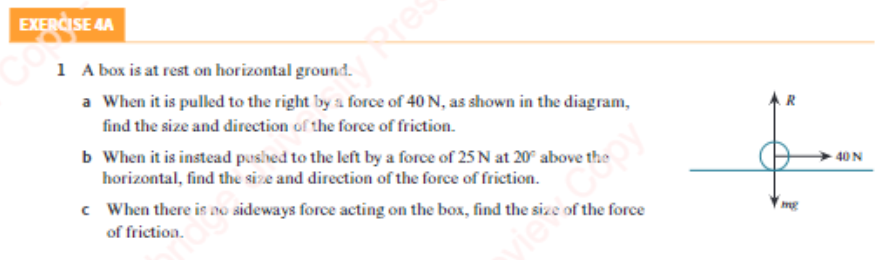


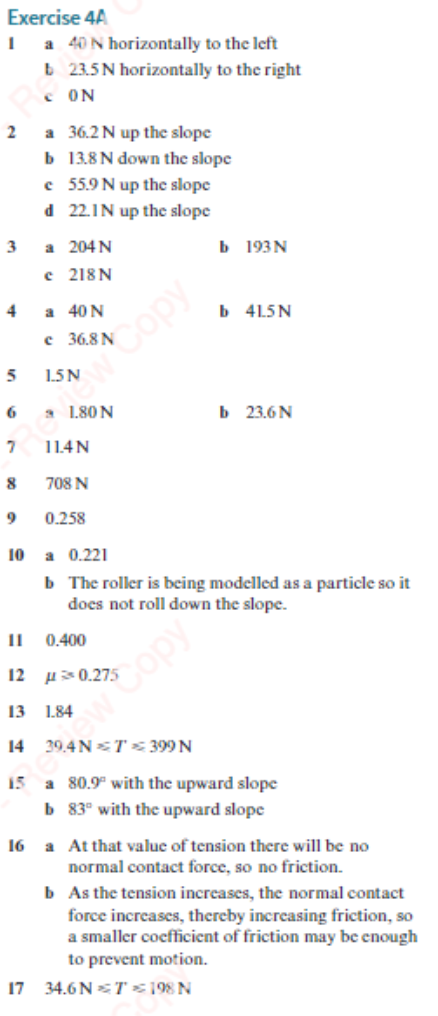
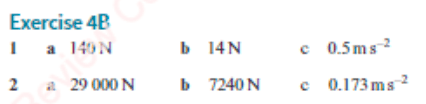
Answers
Limiting Equilibrium
F ≤ μR
It is only when an object is at the point of moving (in limiting equilibrium), that F = μR.
Worked Examples


Exercise

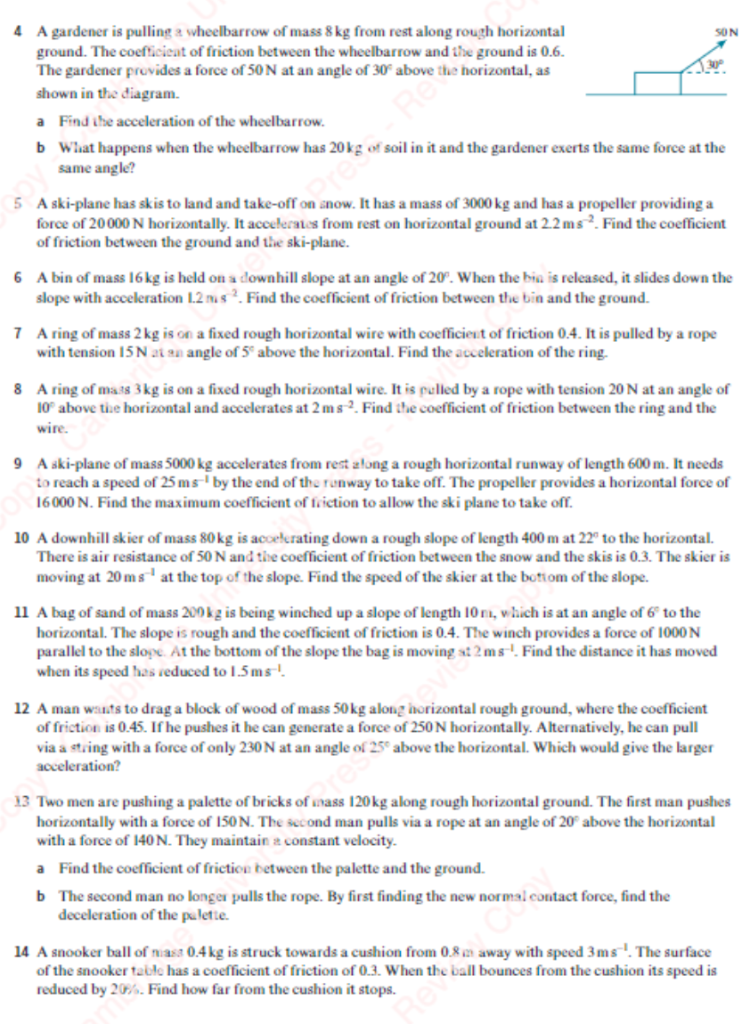
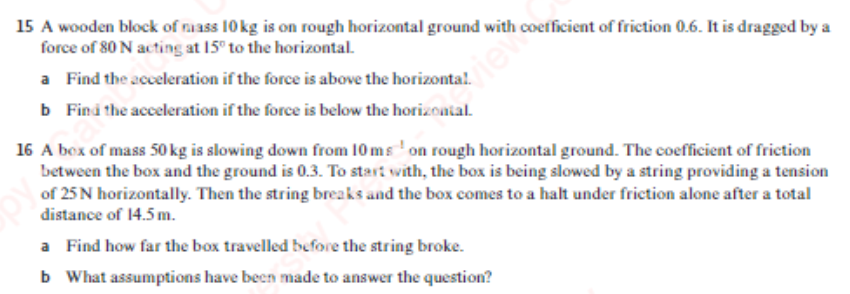
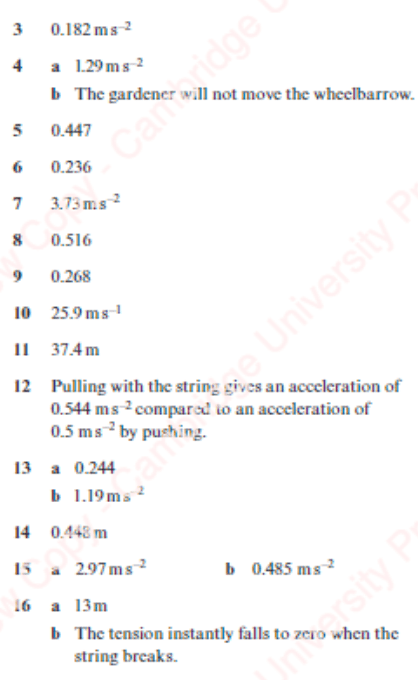
Answers
More Advanced Friction Questions
Worked Example

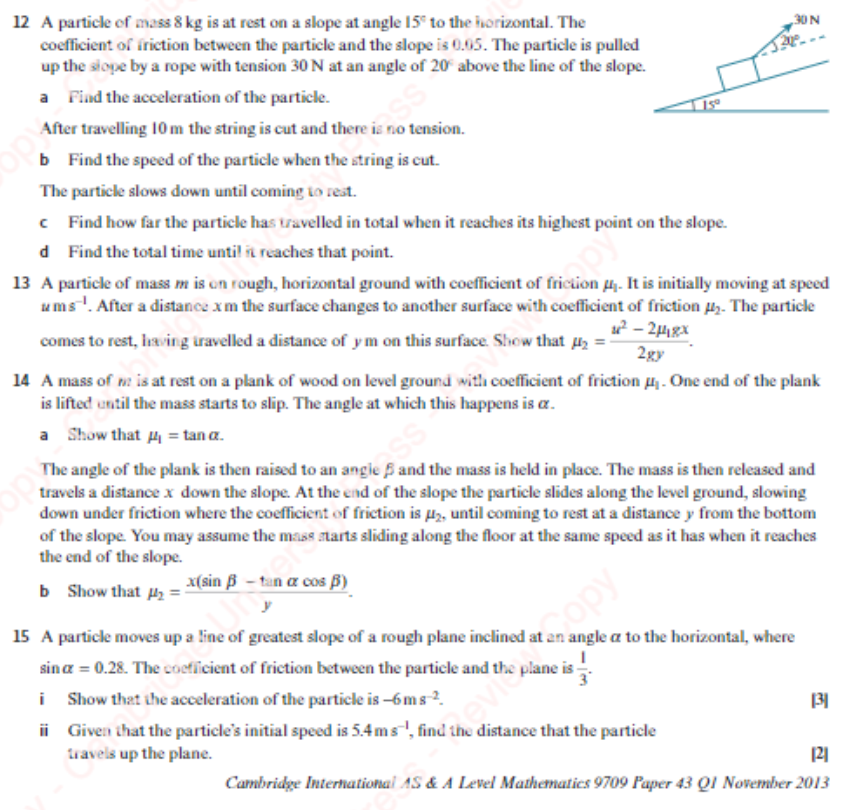
Exercise (and General Exercises)



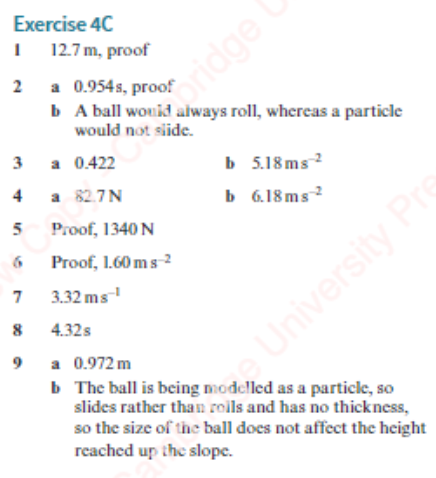
Answers


 Maths with David