So far we have looked at conditions of constant acceleration. Of course, this is a modelling assumption and in reality moving particles typically experience change in acceleration (although falling particles under gravity are subject to constant acceleration if we ignore air resistance.
As with velocity, we can think of acceleration as a function of time, which helps us to relate the three vector quantities: displacement, velocity and acceleration.
As velocity is the change in displacement over time, we can think of instantaneous velocity in terms of differential calculus, such that 

Worked Examples
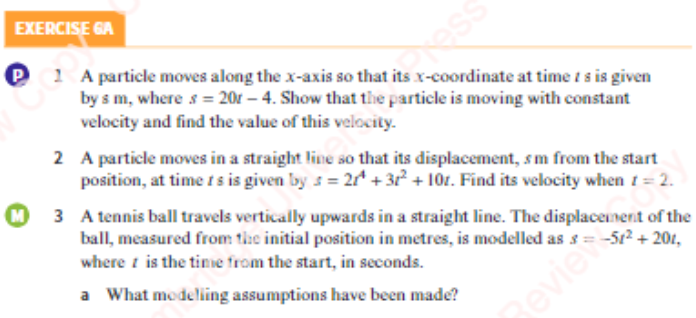
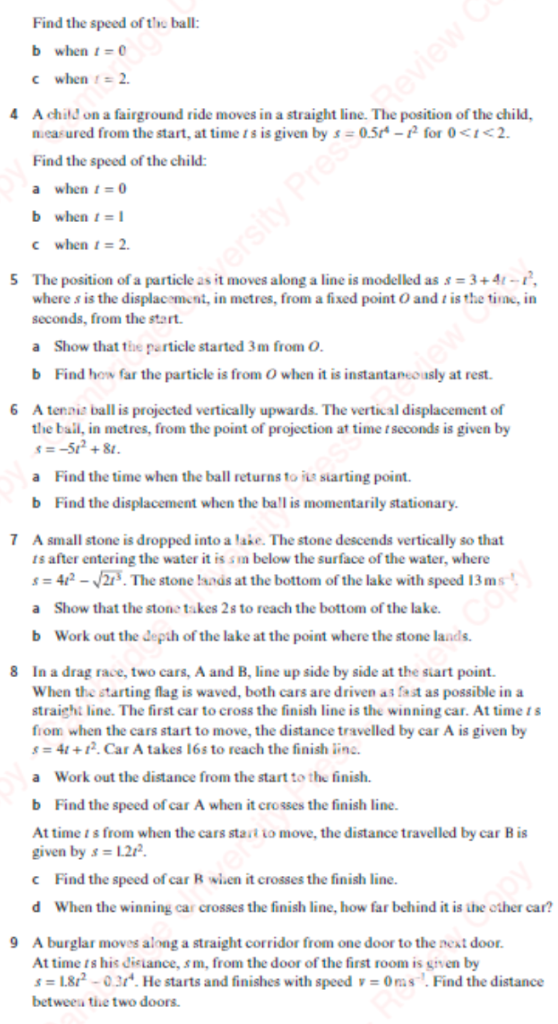
- A particle moves in a straight line so that its displacement s at time t is given by s = t3 – 14t. Find an expression for its velocity at time t;
- A ball moves in a straight line so that its displacement s at time t is given by s = 2t3 – 10t2. Find its speed when t=2;
- A particle moves forwards and backwards along a straight line so that its displacement, s metres from the initial position, at time t seconds is given by s=2t3-12t2+18t. Find the distance that it travels in the first 5 seconds.
Exercise

Answers

Acceleration, velocity and displacement – Differentiation
Because acceleration is change in velocity over time and velocity is change in displacement over time, we can write them in the following way: 
Worked Examples
- A particle moves in a straight line so that its velocity, v ms-1, at time t s is given by v=t2-4t. Find an expression for its acceleration at time t;
- A motorcycle moves in a straight line so that its velocity, v ms-1, at time t s is given by v= 5t2-t3, for 0 < t < 4. Find its acceleration when t = 2;
- A particle moves in a straight line so that its displacement, s m, at time t s (0≤t≤10) is given by
- Sketch the shape of the velocity-time graph for the particle;
- Hence, find the maximum speed of the particle.

Exercise


Answers


Velocity and displacement – Integration
Of course, as v = s'(t), so s = 
Worked Examples
- A particle moves in a straight line so that its velocity, v ms-1, at time t s is given by v = t3 – 4t. Find an expression for its displacement from the initial position at time t.
- A particle moves in a straight line so that its velocity, v ms-1, at time t seconds after it starts to move is given by v = u + at, where u and a are constants. Find the displacement after t seconds.
Exercise


Answers


Acceleration and Velocity – Integration
The same relationship as between velocity and displacement applied between acceleration and velocity. As a = v'(t), so v = 
Worked Examples
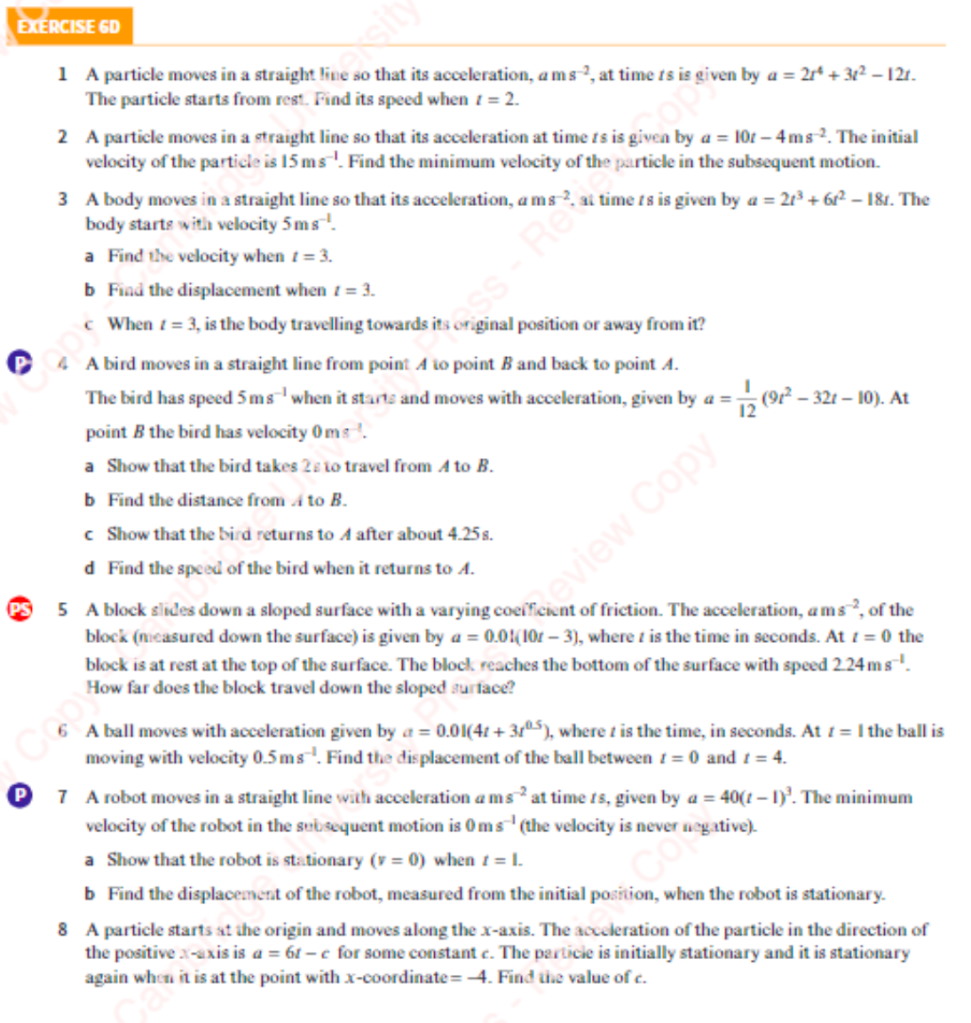
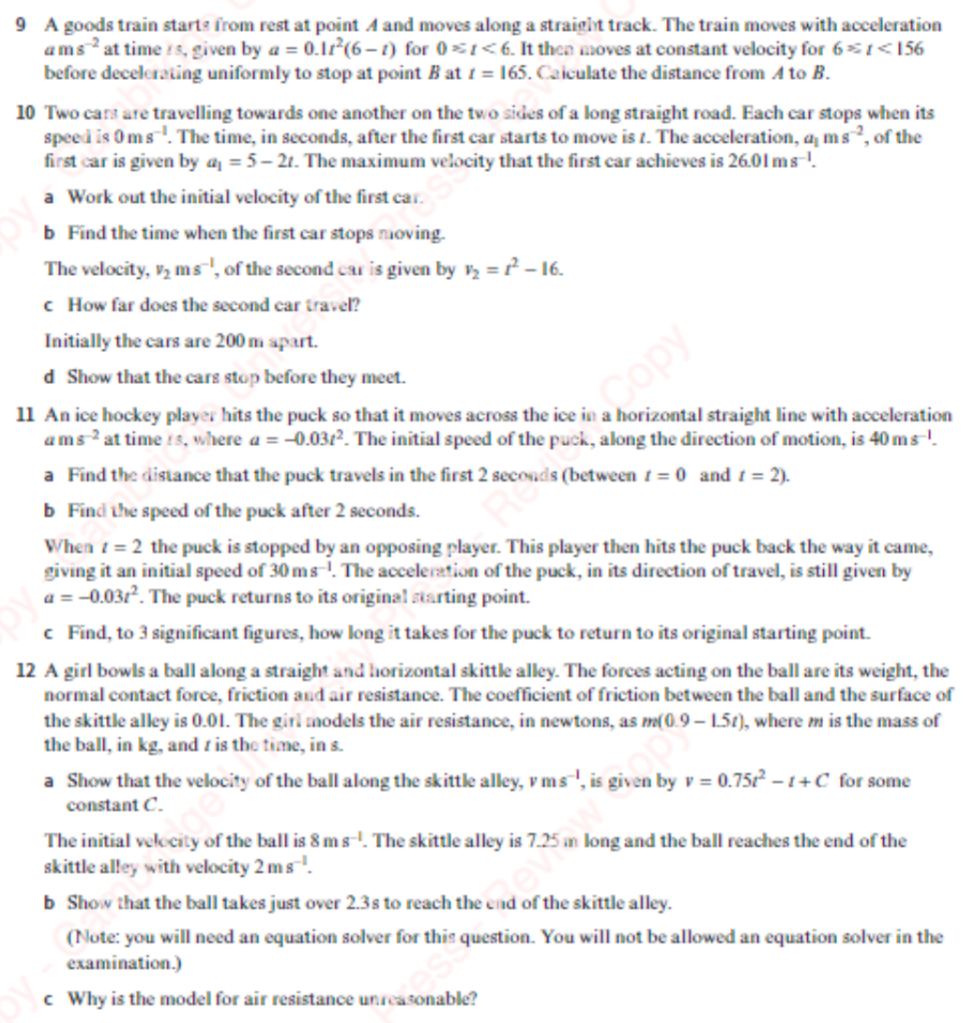
- A particle moves in a straight line so that its acceleration, a ms-2, at time t s is given by a = 8 – 4t. It starts with velocity 2 ms-1. Find an expression for its velocity at time t.
- A particle moves in a straight line so that its acceleration, a ms-2, at time t s is given by a = 12 – 45t – 0.6t2. The particle comes to rest after 5 seconds.
- Find the initial velocity of the particle;
- Find the displacement after 2 seconds.
Exercise & General Exercise
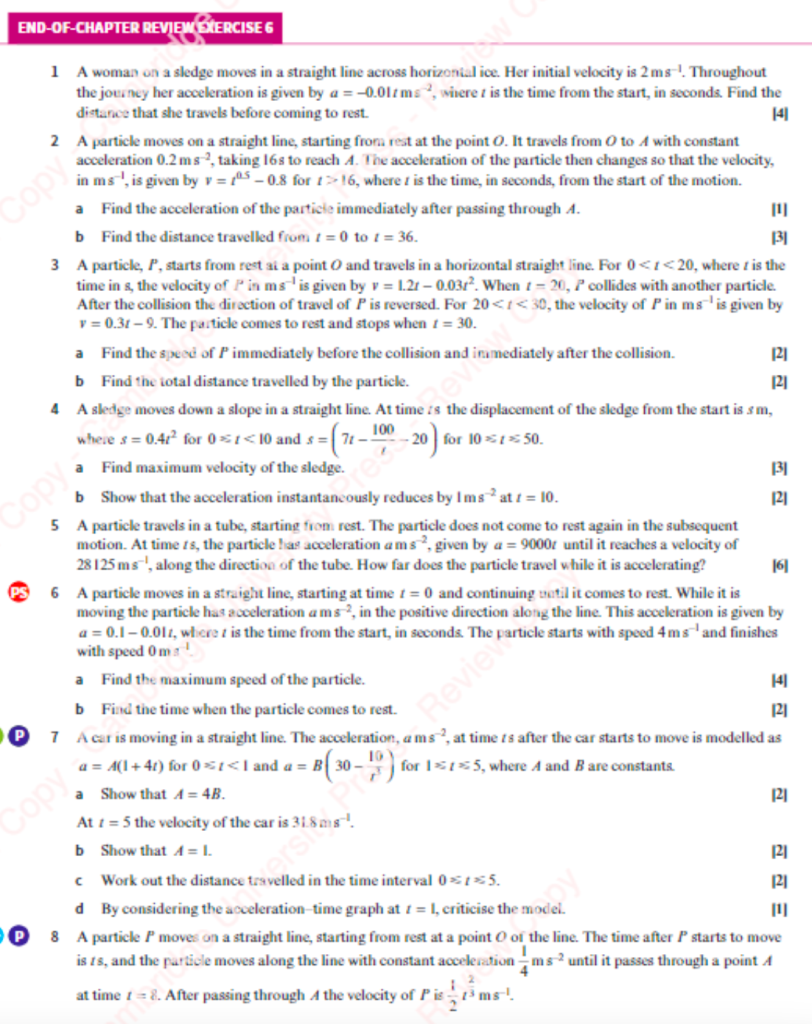
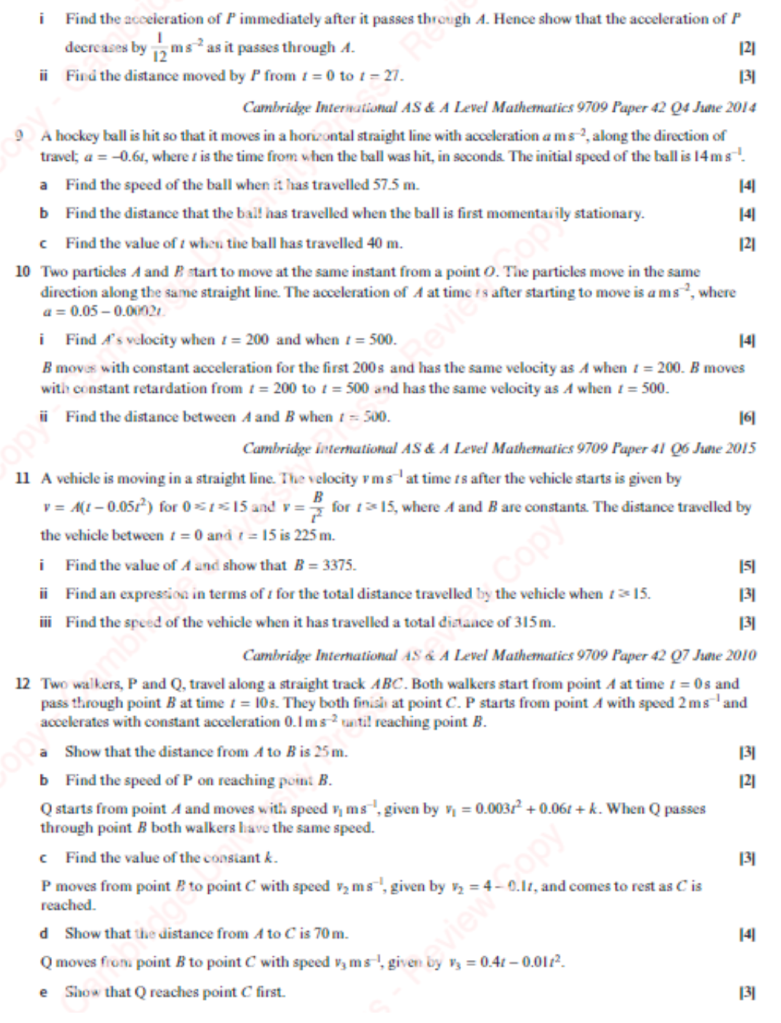
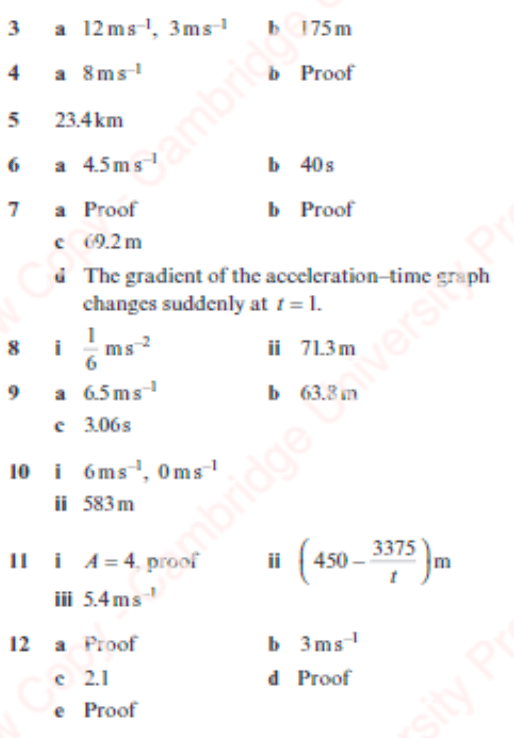
Answers

 Maths with David