1. The diagram shows a firm in imperfect competition. It changed its aim from profit maximising to
sales revenue maximising.
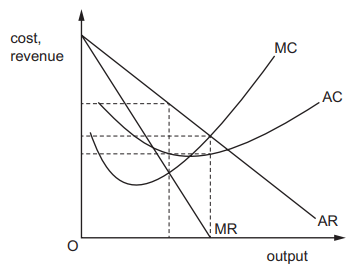
Which type of profit was it making in each case?
| Profit maximising | Sales revenue maximising | |
| A | Normal profit | Supernormal profit |
| B | Subnormal profit | Normal profit |
| C | Supernormal profit | Normal profit |
| D | Supernormal profit | Supernormal profit |
2. An airline sells seats at $100 each three months before a flight, at $150 each one month before
the flight and at $200 each the day before the flight.
What describes this type of market behaviour by the firm?
A limit pricing to deter entry in an imperfect market
B price discrimination by a monopoly supplier
C price leadership by an oligopolist
D pricing where price equals average cost under perfect competition
3. What would not be an indication of a divergence between the interests of the managers and the
shareholders of a company?
A an emphasis on sales maximisation
B management salaries which are linked to the long-run growth of the company’s share price
C the acceptance of ‘X’ inefficiency in the company’s production process
D the purchase of artwork for a company’s headquarters
4. The total cost to a school of employing ten cleaners is $60 per hour.
The school estimates that the hourly marginal cost of employing an eleventh cleaner would be
$11.50.
By how much would the hourly wage have to increase to employ an additional cleaner?
A $0.50 B $0.65 C $2.25 D $11.50
5. What would cause a rise in the productivity of labour?
A an increase in indirect taxes
B an increase in the quality of capital
C a rise in consumer surplus
D a rise in the elasticity of supply of labour
 Maths with David