1. A medical team in a refugee camp provides vaccinations for children to prevent an outbreak of an infectious disease.
Why would this be described as a positive externality?
A Additional benefit might be gained as the disease no longer spreads.
B Any kind of medical help will improve the condition of the children.
C No action would be taken unless the medical team intervened.
D The social benefits of vaccination are less than the social costs.
2. The diagram shows the average cost curves for a firm.
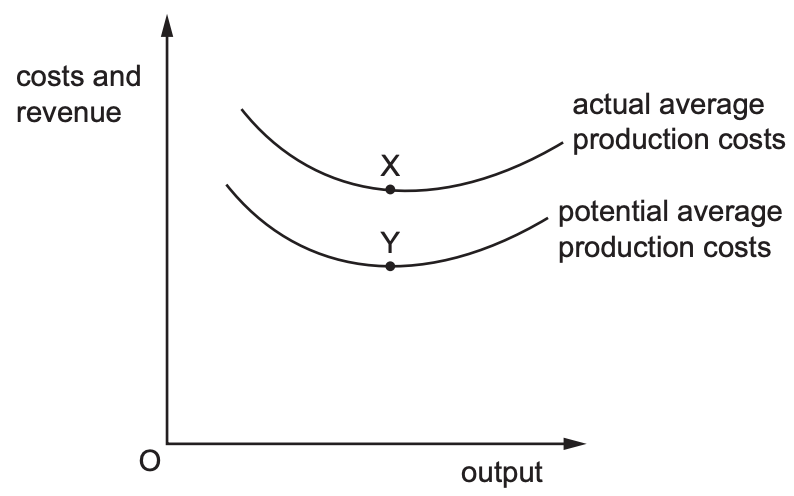
If a firm moved from point X to Y, what is most likely to happen to the productive efficiency and x-inefficiency of this firm?
| Productive efficiency | X-inefficiency | |
| A | Decreases | Decreases |
| B | Decreases | Increases |
| C | Increases | Decreases |
| D | Increases | Increases |
3. An economist undertakes a cost-benefit analysis of the pollution resulting from a manufacturing process.
Which judgement is most likely to guide any recommendation about the appropriate level of
manufacturing output?
A that the marginal social cost of manufacturing equals the marginal social benefit
B that the marginal cost of pollution is zero
C that the total revenue of manufacturing equals the total cost
D that the total benefit of pollution is maximised
4. An individual consumes goods X and Y. The marginal utility of good X is positive and falling. The consumer is at the point where the ratio of the marginal utility of the two goods is equal to the ratio of their prices.
What can be concluded from this information?
A the consumer will continue to consume additional units of X until marginal utility is zero
B the consumer will purchase more of X if the price of Y rises
C total utility will be negative on the additional unit of X consumed
D total utility will be rising at an increasing rate on the additional unit of X consumed
5. To analyse a consumer’s preferences, an indifference curve represents possible combinations of goods X and Y.
The diagram shows a consumer’s indifference curve for good X and good Y.
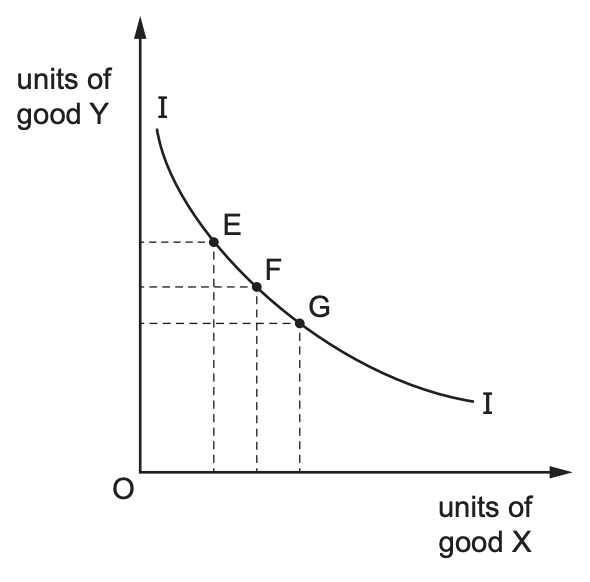
What can be concluded from the diagram?
A Point E is the most desirable combination.
B Point F is less desirable than point G.
C Point G is the least desirable combination.
D Points E, F and G are equally desirable combinations.
 Maths with David