1. A manufacturing company merged with two companies. One of these was company X that
produced a substitute product. The other was company Y that supplied its raw materials.
Which combination shows the types of merger that the manufacturing company has undertaken?
| Merger with company X | Merger with company Y | |
| A | Horizontal | Horizontal |
| B | Horizontal | Vertical |
| C | Vertical | Horizontal |
| D | Vertical | Vertical |
2. Which phrase best describes the market structure illustrated by the diagram if the firm produces
at output Q1?
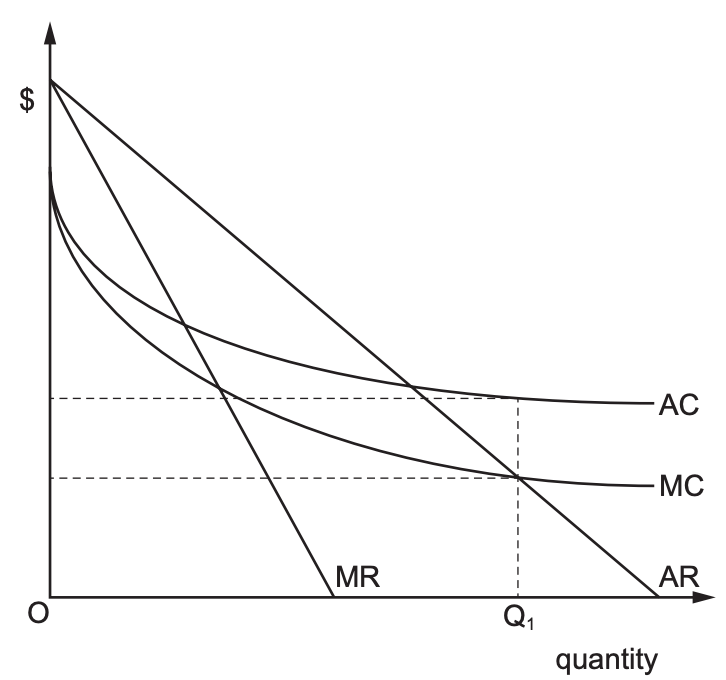
A a monopolistic firm in short-run equilibrium
B a monopoly making supernormal profits
C an oligopoly engaged in a price war
D a non-profit maximising state monopoly
3. The government wants to regulate the consumption of a demerit good in order to increase
society’s net welfare.
In which situation will society’s net welfare increase?
A The fall in the marginal social benefit is greater than the fall in the marginal social cost.
B The fall in the marginal external cost is greater than the fall in the marginal external benefit.
C The fall in the total social benefit is greater than the fall in the total social cost.
D The fall in the total social cost is greater than the fall in the total social benefit.
4. Governments often aim to reduce income inequalities. The diagram shows the effects of using
taxation and benefits to try to achieve this aim.

What can be concluded from the diagram about the effects of taxes and benefits?
A All income groups are better off except those originally earning more than $40 000 per year.
B Benefits paid to the lower income groups are not a burden because they are not paid out of
tax revenues.
C The average final income of the top 20% exceeds the combined final incomes of the other
groups.
D The progressive taxation system still favours the top 20% over the bottom 20% of
households.
5. Which policy is likely to be the least effective means of producing a more equal distribution of
income amongst households?
A the imposition of minimum wage levels below the levels produced by the market
B the introduction of progressive personal income taxes
C the payment of benefits to low income households
D the removal of sales taxes on food consumed by lower income households
 Maths with David