1. As firm X grows in size, it specialises in a narrower range of products.
Which economies of scale will the firm be less able to benefit from?
A financial
B marketing
C risk-bearing
D technical
2. What would economists agree should be the aim of any healthcare system?
A to meet all the healthcare demands of the population
B to provide every patient with the latest and best available treatment
C to provide free medical treatment
D to secure the maximum health gain from the resources available
3. A producer of a good causes pollution.
When will a specific tax on the production of the good be most effective in reducing output?
A when there is price elastic demand and price elastic supply
B when there is price elastic demand and price inelastic supply
C when there is price inelastic demand and price elastic supply
D when there is price inelastic demand and price inelastic supply
4. Governments often aim to reduce income inequalities. The diagram shows the effects of using
taxation and benefits to try to achieve this aim.
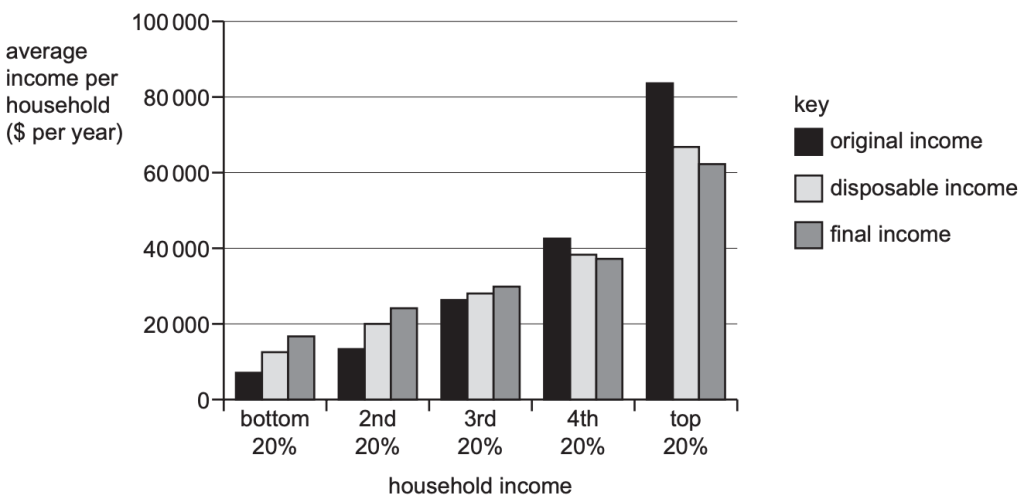
What can be concluded about the effects of taxes and benefits from the diagram?
A All income groups are better off except those earning more than 40 000 dollars per year.
B Benefits paid to the lower income groups are not a burden because they are not paid out of
tax revenues.
C The average final income of the top 20% exceeds the combined final incomes of the other
groups.
D The progressive taxation system still favours the top 20% over the bottom 20% of
households.
5. Which government policy would not be classified as regulation?
A bans on heroin and cocaine consumption
B compulsory wearing of seatbelts in cars and coaches
C licences for the extraction of water from lakes and rivers
D taxation of cigarettes and tobacco products
 Maths with David