1. Broken rice is an inferior good. What would be the resulting income and substitution effect on the quantity demanded of broken rice if its price falls?
| Quantity demanded due to income effect | Quantity demanded due to substitution effect | |
| A | Falls | Falls |
| B | Falls | Rises |
| C | Rises | Falls |
| D | Rises | Rises |
2. Firms in a market decide to collude over the price that they charge for their products. What is not likely to be a feature of the market?:
A Firms have similar cost structures.
B Products of the firms are close substitutes.
C There are high barriers to entry into the market.
D There is a large number of competing firms.
3. Firms often remain small even when growth could result in technical economies of scale.
What is not a likely reason for this?:
A Demand for the product tends to change often and rapidly.
B Individual entrepreneurs wish to keep a tight personal control over their own firm.
C The entrepreneurs who establish the firms tend to be ambitious risk-takers.
D The market in which they operate is very specialised in nature, often selling unique products.
4. This diagram shows the short-run equilibrium for a firm operating in a monopolistically competitive market:
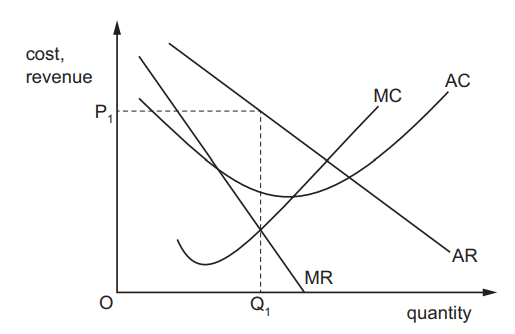
What is not likely to occur at the long-run equilibrium?
A The individual firm’s demand curve is more elastic.
B The individual firm’s demand curve has moved left.
C The profit-maximising price is greater than average cost.
D The profit-maximising price is greater than marginal cost.
5. The table shows a firm’s total costs corresponding to different levels of output:
| Units of output | 1 | 2 | 3 | 4 | 5 | 6 | 7 | 8 |
| Total cost ($) | 8 | 14 | 18 | 22 | 28 | 36 | 46 | 58 |
If the market price is $8, within which range of output would a profit-maximising firm in a perfectly
competitive industry produce in the short run?
A 1–2 units B 3–4 units C 5–6 units D 7–8 units
 Maths with David