1. What is likely to facilitate the growth of large firms in an economy?
A an industry structure which approximates to perfect competition
B dividend payments are a low proportion of company profits
C government regulations preventing takeovers
D the existence of managerial diseconomies of scale
2. A firm changes its objective from maximising profit to producing at the allocatively efficient output.
In which market structure must the firm operate for this to cause the least change in economic
welfare?
A monopolistic competition
B monopoly
C oligopoly
D perfect competition
3. Which government policy is intended to correct ‘market failure’?
A guaranteed minimum prices for farmers producing certain agricultural products
B imposition of taxes on factories releasing pollutants into rivers
C rent controls on housing occupied by low income individuals
D the provision of free books for children of poorer households
4. The chart shows changes in employment by sector for a country between 2010 and 2016.
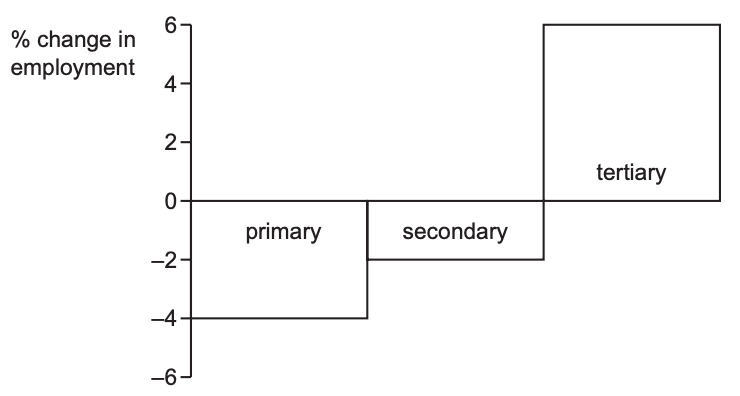
Which statement about the period 2010 to 2016 must be correct for this country?
A Employment in service industries increased.
B The primary sector lost more workers than the secondary sector.
C There was no change in the total working population.
D Unemployment stayed constant.
5. An engineer is paid $100 000 a year.
The next best paid job she could get is as a teacher at $60 000 a year.
What are her transfer earnings and her economic rent?
| Transfer earnings $ | Economic rent $ | |
| A | 60,000 | Zero |
| B | 60,000 | 40,000 |
| C | 100,000 | Zero |
| D | 100,000 | 40,000 |
 Maths with David