1. What is marginal cost?
A the difference between the total cost of producing n units and n – 1 units of output
B the difference between the average variable cost of producing n units and n – 1 units of
output
C the difference between the average total cost of producing n units and n – 1 units of output
D the average fixed cost of producing one more unit of output
2. The table shows the production and total cost of a firm.
| Production (tonnes) | Total cost ($) |
| 0 | 20 |
| 1 | 30 |
| 2 | 35 |
| 3 | 40 |
| 4 | 45 |
| 5 | 50 |
What is the average variable cost of producing 5 tonnes of output?
A $4 B $5 C $6 D $10
3. The diagram shows the long-run total cost (LRTC) curve of a firm.
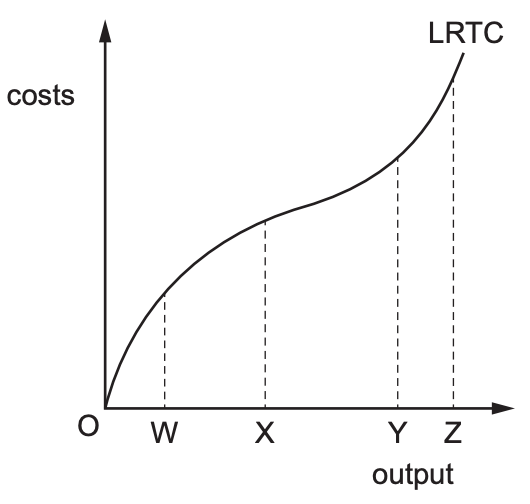
At which output is the long-run average total cost at its minimum?
A OW B OX C OY D OZ
4. Which combination of statements about small firms and large firms is correct?
| Small firms | Large firms | |
| A | Are more common in manufacturing than in services | Face high barriers to exit |
| B | Are more numerous than large ones | Do not experience diseconomies of scale |
| C | Can do well when each item produced must be different | May arise from internal growth or mergers |
| D | Cannot have any monopoly power | Cannot earn supernormal profits |
5. Why might the long-run equilibrium of a profit-maximising firm in a monopolistically competitive
market differ from its short-run equilibrium?
A Advertising expenditure is possible.
B There are low barriers to entry.
C Firms experience diminishing returns.
D Innovation reduces the monopoly power of firms.
 Maths with David