1. The diagrams show different budget lines and consumer equilibrium choices. The consumer is in
equilibrium at Q1XQ1Y.
Which diagram shows the effect of a successful advertising campaign of good Y?

2. What is a characteristic of a highly contestable industry?
A a reduction in abnormal profits
B a substantial volume of advertising by existing firms
C relatively few firms in the industry
D significant sunk costs incurred by new entrants to the industry
3. The diagram shows cost and revenue curves for a firm.
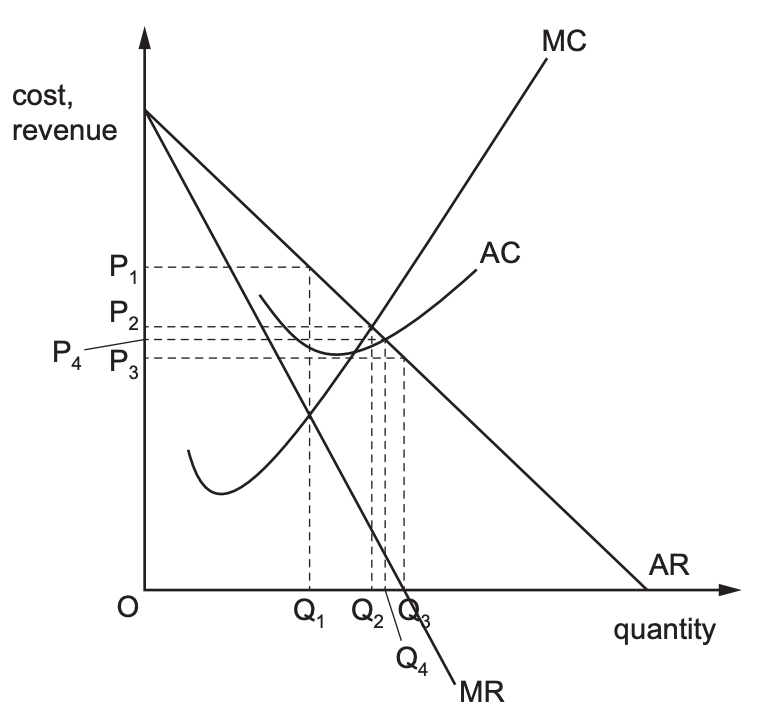
The firm may seek to either maximise profit or maximise revenue.
What is the correct price and quantity combination for each?
| Maximise profit | Maximise revenue | |
| A | Q1P1 | Q3P3 |
| B | Q1P1 | Q4P4 |
| C | Q2P2 | Q3P3 |
| D | Q2P2 | Q4P4 |
4. The list provides characteristics of the market in which firm X operates.
● Firms in the market spend a lot of money on advertising.
● Firms in the market experience a high level of uncertainty.
● Start-up costs for new firms entering the market are relatively high.
● The largest five firms in the market control 85% of total sales.
In which market structure is firm X operating?
A monopoly
B monopolistic competition
C oligopoly
D perfect competition
5. Which statement about the ‘kinked demand curve’ model of oligopoly is incorrect?
A The kink in the demand curve of each firm is based on expectations about other firms’
responses to changes in its price.
B The marginal revenue curve of the firm has a vertical segment at the market price.
C The model explains how the equilibrium market price is determined.
D The model suggests price stickiness within a certain range of marginal costs.
 Maths with David