1. In which situation are there definitely positive externalities?
A Private benefits exceed private costs.
B Private benefits exceed social benefits.
C Social benefits exceed private benefits.
D Social benefits exceed private costs.
2. A cost-benefit analysis is carried out on the construction of a hydroelectric power station.
Which combination of circumstances would be most likely to lead to the scheme being approved?
A Private benefits are greater than private costs.
B Social benefits are greater than social costs.
C Social benefits are greater than total costs.
D Total costs are greater than total revenue.
3. What does not pose a threat to the achievement of allocative efficiency?
A imperfect information on the part of consumers
B income inequalities
C the existence of externalities
D the presence of monopolistic elements
4. The diagram shows budget lines and an indifference curve. The consumer’s initial position is T.
The price of good X then falls.
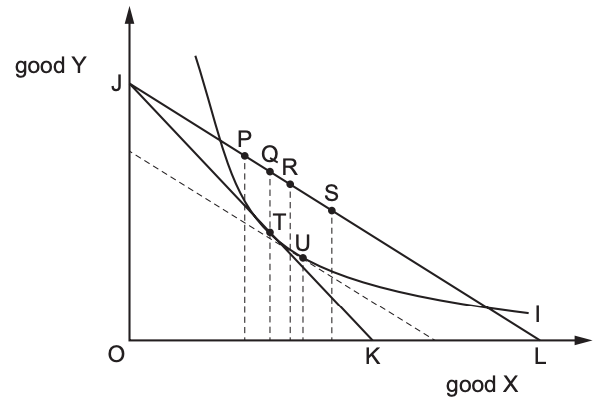
Which combination of statements about the movements in this diagram is correct?
A T to Q represents perfect elasticity; T to P represents a Giffen good
B T to R represents an income effect; R to S represents a substitution effect
C T to U represents a substitution effect; T to Q represents a normal good
D T to U represents a substitution effect; U to P represents an income effect
5. The diagram shows various combinations of apples and rice which are potentially available to a
consumer.
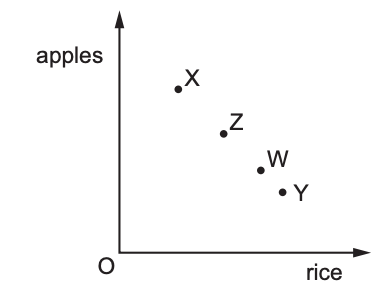
If standard indifference curves were added to the diagram they would show that the consumer is
indifferent between combination X and combination W. What can be concluded?
A The consumer is indifferent between combination Y and combination Z.
B The consumer is indifferent between combination Z and combination W.
C The consumer prefers combination Y to combination X.
D The consumer prefers combination Z to combination W.
 Maths with David