1. Which statement about a monopoly is correct?
A Profit maximisation occurs when average cost equals average revenue.
B Sales maximisation occurs when marginal cost equals marginal revenue.
C Sales revenue maximisation occurs when marginal revenue is equal to zero.
D Satisficing occurs when marginal cost is equal to zero.
2. A satellite communications company is bought by an investment bank.
Which outcome has resulted from this purchase?
A a cartel
B diversification
C lateral integration
D vertical integration
3. The diagram shows the long-run average cost (LRAC) curve for a firm, and three short-run
average cost (SRAC) curves.
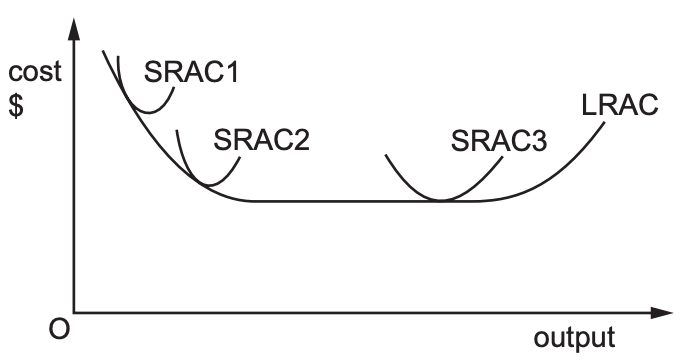
Which statement is correct?
A When the minimum point of SRAC3 is lower than the minimum point of SRAC2 it reflects the
law of variable proportions.
B The law of diminishing returns explains why each of the SRAC curves is U-shaped.
C The position of SRAC2 shows the minimum efficient scale of production.
D The rising section of SRAC1 indicates the existence of diseconomies of scale.
4. What is the most likely reason that barriers to entry might lead to x-inefficiency?
A The firm does not account for any external benefits.
B The firm has no incentive to cut its costs of production.
C The firm’s price is set higher than its average costs.
D The firm’s price is set higher than its marginal costs.
5. The diagram shows the long-run cost and revenue curves for a public sector monopoly.
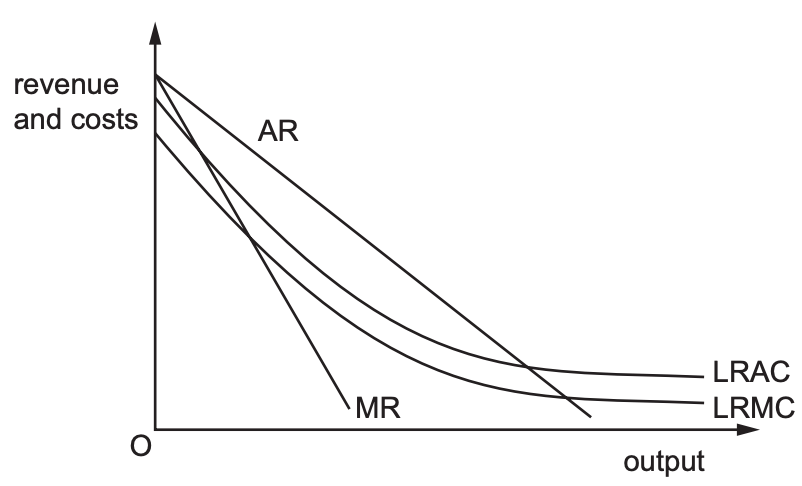
The government decides to set a price that maximises social welfare.
What will be the consequence of this decision?
A The firm will experience diseconomies of scale.
B The firm will make a loss.
C The firm will maximise profits.
D The firm will maximise total revenue.
 Maths with David