1. A government is worried about the increasing monopsony power of employers in the wage
bargaining process.
Which policy combination is most likely to improve the wages and employment prospects of
workers?
| Trade union powers | Immigration controls | National minimum wage | |
| A | Strengthen | Relax | Cut |
| B | Strengthen | Strengthen | Raise |
| C | Weaken | Relax | Cut |
| D | Weaken | Strengthen | Raise |
2. The diagram shows the labour market for fruit pickers in country X.
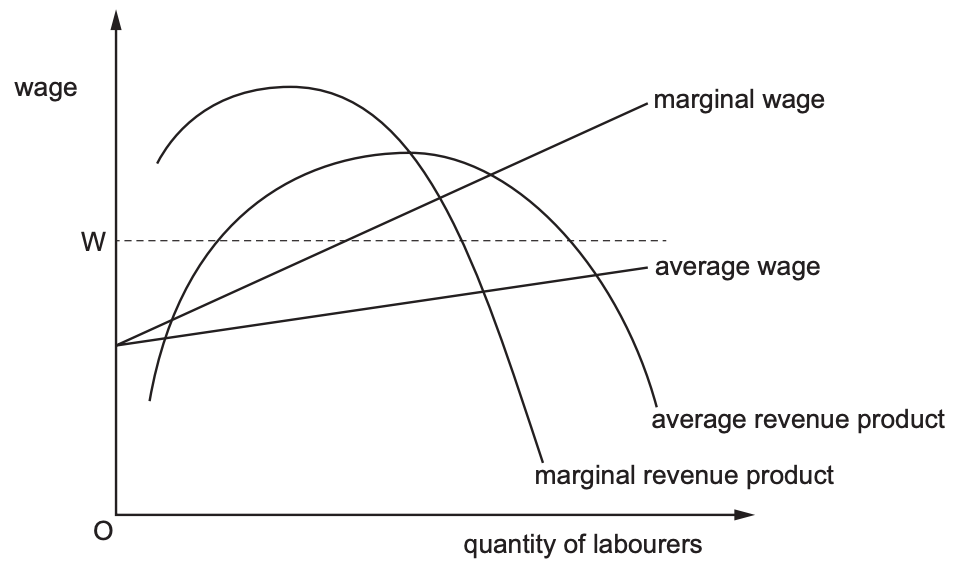
If the market was originally in equilibrium, what would happen to wages and employment if a
minimum wage of W were imposed?
| Wages | Employment | |
| A | Fall | Fall |
| B | Fall | Rise |
| C | Rise | Fall |
| D | Rise | Rise |
3. What would not be regarded as an example of a possible negative impact of rapid economic
growth?
A Greater production could result in greater atmospheric pollution.
B A higher level of income could cause a higher balance of trade deficit.
C Increased AD could cause domestic inflation to increase.
D Increased GDP could generate greater tax receipts.
4. How can GDP at market prices be calculated if GDP at factor cost is known?
A add taxes, add subsidies
B add taxes, subtract subsidies
C subtract taxes, add subsidies
D subtract taxes, subtract subsidies
5. Which combination indicates that GDP per capita is likely to be an accurate indicator of living
standards in a country over time?
| Income distribution | Hidden economy as % of GDP | Quality of goods and services produced | |
| A | Equal | Large | Constant |
| B | Unequal | Large | Improving |
| C | Equal | Small | Improving |
| D | Unequal | Small | Constant |
 Maths with David