1. When a firm increases all its inputs fourfold, its output increases threefold.
What does this illustrate?
A decreasing marginal costs
B decreasing returns to scale
C economies of scale
D the law of diminishing returns
2. What represents the transfer earnings of the factor enterprise?
A excess profit
B normal profit
C return on capital
D start-up costs
3. A country has a negative income tax.
The curve NT in the diagram shows the country’s initial tax schedule.

A change in the tax rate causes the schedule to shift to NT1.
How will this affect work incentives and the after-tax distribution of income?
| Work incentives | Distribution of income | |
| A | Strengthen | More equal |
| B | Strenghten | Less equal |
| C | Weaken | Less equal |
| D | Weaken | More equal |
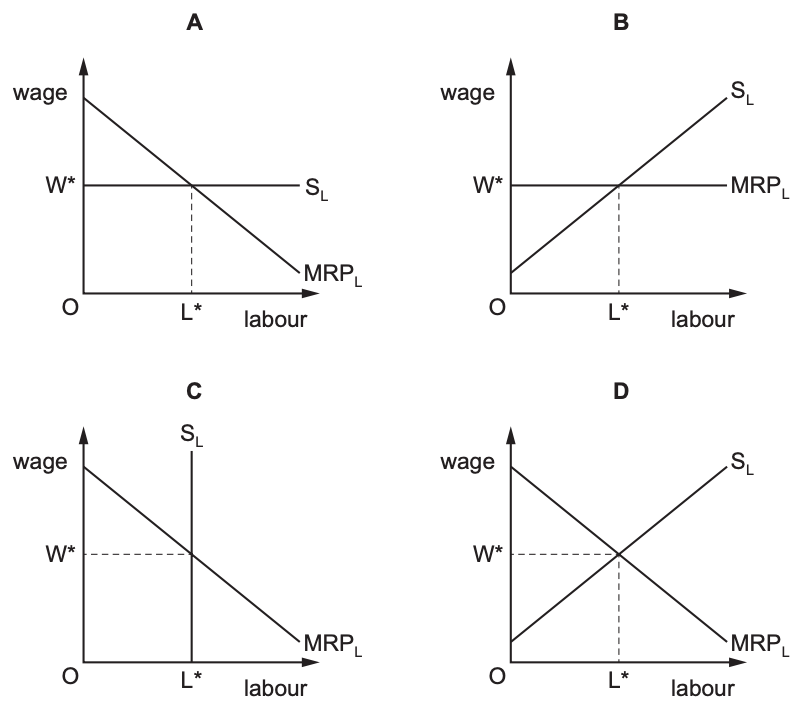
4. In which labour market diagram is the economic rent of workers greatest?
5. Which statement about government intervention is correct?
A Government failure may result from policies that have unintended side effects.
B Governments cannot identify the existence of inefficiency.
C Inefficient government policies mean that the market system will be better at resource
allocation.
D Market failure means that government action will necessarily improve the situation.
 Maths with David