There is an inherent conflict between policy options, as, for instance, seeking to reduce demand-pull inflation using deflationary fiscal and monetary policy may reduce economic growth and increase unemployment. Supply side policies can be used that could mitigate these effects in the long run.
There is also an inherent conflict between achieving low inflation and reducing a current account deficit, particularly when a bank raises the interest rate to reduce inflation, which can worsen the balance of payments position and lead to an appreciation in the exchange rate, which could lead to hot money inflows.
There can also be conflicts between stimulating economic growth and developing greater income equality. More progressive tax rates and greater benefits to low income groups can discourage foreign direct investment (FDI) (although in the long run, increasing the living standards of the poor may lead to greater productivity).
Tinbergen’s Rule suggests that for each policy objective there should be a separate policy measure (e.g. to reduce unemployment the government cuts income tax, whilst to improve the current account position the government devalues the currency). When we consider the effectiveness of a specific policy measure in meeting a policy objective, we should always consider its possible impact on other policy objectives.
Governement macroecnomic policy failure
Sometimes government intervention can worsen economic performance. For instance, by understating the national income multiplier a government may increase spending by more than intended, replacing the problem of a negative output gap with the problem of a positive output gap.
Time lags can also create problems. There may be a recognition lag before a government identifies that inflationary pressure has built up, followed by an implementation lag as the formulate and introduce a policy measure such as increasing income tax. There is also then the behavioural lag, which is the time it takes for households and firms to respond to this new measure. By the time all these lags have taken place, the level of economic activity may have changed, and policy measures may end up reinforcing a trade cycle, instead of being countercyclical as intended.
As well as delays, sometimes households and firms may respond to policy measures in unanticipated ways. For instance, if consumers are optimistic about the future, then even after a rise in interest rates intended to increase saving and decrease borrowing, they may continue to borrow and spend.
In democracies, there is also a risk of governors introducing popular policy measures when elections are approaching, which are not in the long term interest of the economy. Pressure groups and corruption may also influence their decisions.
Task

Laffer Curve
The Laffer curve is a curve that shows an increasing tax rate initially leading to an increase in tax revenue and then beyond a certain rate leading to a fall in tax revenue.
The curve was designed by Reagan’s economist Arthur Laffer in the 1970s to support his view that cutting tax rates could actually increase tax revenue by stimulating economic activity (due to greater incentives).
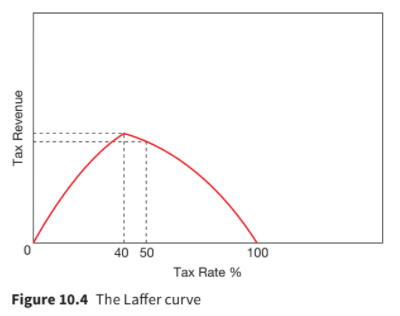
Many economists dispute the usefulness and the validity of the Laffer curve, arguing that there is little certainty over the precise shape of the curve and that it will vary over time and between countries. When Reagan applied tax cuts based on the curve, it actually led to a decrease in tax revenue.
Task
 Maths with David