Initial Task

Relationship between internal and external value of money
Inflation causes the internal value of money to fall. If a country’s internal value of money falls due to an inflation rate higher than that of rival countries, demand for its products will fall. This will lead to demand for the country’s currency to fall as foreigners buy fewer of the country’s exports. There will also be an increase in supply of the currency on the FX market, as more imports are purchased. The reduced demand and increased supply of the currency will cause it to depreciate, as shown in the graph below:
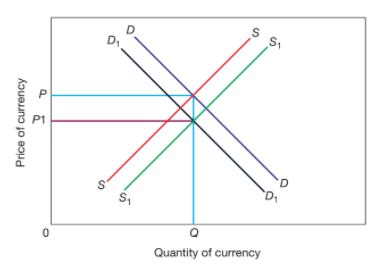
A depreciation in the external value of the currency, the exchange rate, will impact the internal purchasing power of the country’s money, and will increase the price of the country’s imports.
So the internal and external value of a country’s money are normally directly related, with a fall in the internal value leading to a fall in the external value and vice versa. However, as indicated above, a fall in the internal value will not always lead to a fall in external value, for instance if a country experiences inflation but other countries experience greater inflation, or if the two countries have a fixed exchange rate.
Relationship between balance of payments and inflation
An increase in inflation above that of competitors will cause a decrease in price competitiveness, leading to a drop in export revenue and an increase in import expenditure, thus worsening the current account balance.
An increase in the current account surplus can cause inflation, as net exports make an increasing contribution to aggregate demand, so more money is flowing into the country than leaving it. This upward pressure on the domestic price level and downward pressure on the internal value of the currency can be short term, as an increasing current account surplus can cause an increase in the exchange rate, which may reduce the surplus and reduce the inflation rate, as the price of imports drops and domestic firms are under pressure to keep their prices low.
Relationship between economic growth and inflation
High inflation can reduce a country’s economic growth rate by leading to a reduction in net exports.
The impact of economic growth on inflation is more complicated. It may lead to increased cost-push or demand-pull inflation, as the greater level of production leads to competition for resources (including labour) causing their price to increase, and the higher output increasing income and therefore aggregate demand.
However, it can also reduce inflation by reducing the costs of production (e.g. through technological advances). This can increase aggregate demand without pushing up the price level.
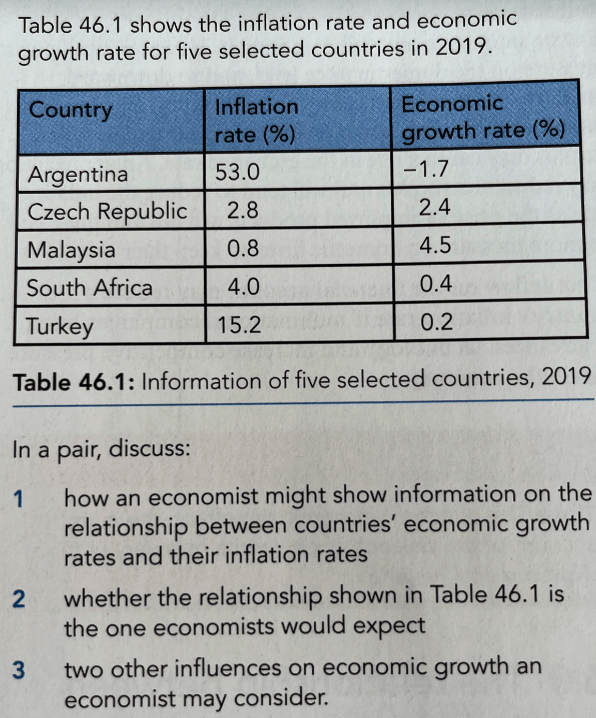
Task – Economic Growth and Inflation
Relationship between unemployment and inflation
New Zealand economics Bill Phillips analysed unemployment and wage rate (taken as an indicator of inflation) between 1861 and 1957 and identified an inverse relation, as illustrated below.

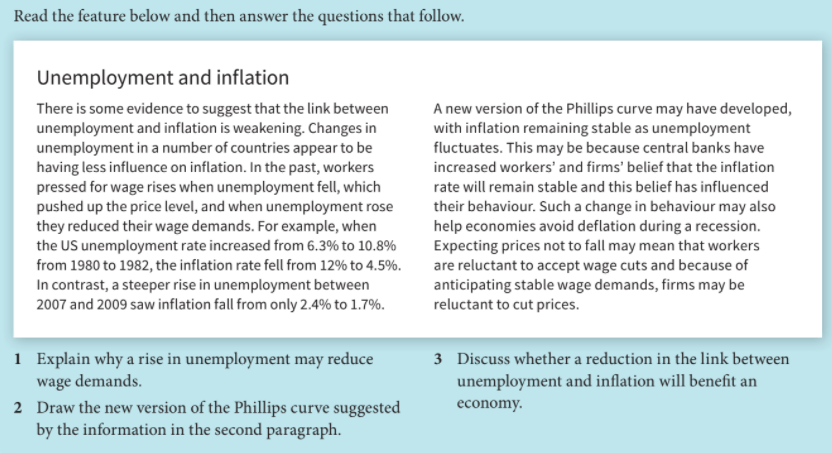
A drop in unemployment can cause higher inflation due to increased aggregate demand and potential upward pressure on wages. Hence a government can set policies to try and achieve their preferred balance between unemployment and inflation in the economy.
Monetarists, however, question this Keynesian view. They suggest that this “trade off” only applies in the short run, and in the long run, government measures to increase aggregate demand will have no impact on unemployment and will only raise the inflation rate. Monetarist Milton Friedman developed the Expectations-Augmented Phillips Curve, as indicated by the vertical line in the diagram below, which is determined by the natural rate of unemployment:

An increase in aggregate demand reduces unemployment from 8% to 4% but creates inflation of 5% and moves the economy onto a higher short-run Phillips curve. Firms expand their output and more people are attracted into the labour force as a result of the higher wages. Firms then realise that their costs have risen and reduce output and some workers, realising that real wages have not risen will leave the work force. Unemployment thus returns to 8%, but the 5% inflation has now been built into the system.
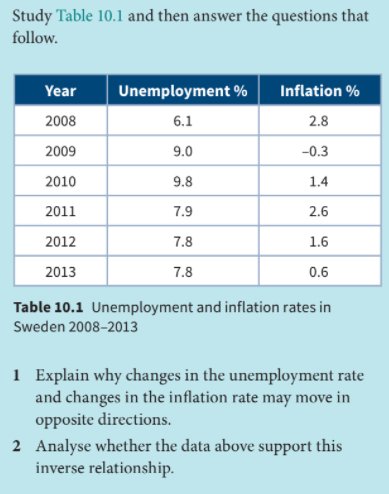
Task 1
Task 2
Project
In pairs, analyse the relationship between Georgia’s unemployment rate and inflation rate during the last twenty years. Produce a report indicating the relationship identified and giving an analysis of the reasons for this relationship.
 Maths with David