1. The diagram shows the cost and revenue curves of a monopolist:
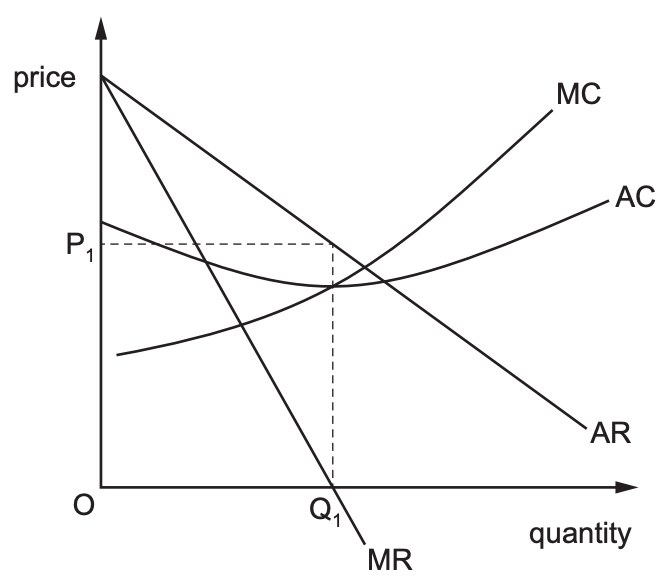
What would be the aim of the firm if it chose to produce at Q1P1?
A revenue maximisation
B profit maximisation
C sales maximisation
D growth maximisation
2. What does the ‘kinked demand curve’ model suggest about the equilibrium price in an oligopoly market?
A It will be stable because there is little incentive for firms to change prices.
B It will be stable because there is a lot of competition.
C It will change frequently because there is a lot of competition.
D It will change frequently because price is determined by demand and supply.
3. What is the essential feature of nudge theory?
A the aim of satisficing
B the establishing of a legal requirement
C the existence of a contestable market
D the idea of persuasion
4. What indicates that a more equal distribution of income has been achieved?
A a faster rate of economic growth
B a higher Human Development Index
C a lower Gini coefficient
D a lower tax /GDP ratio
5. Which combination of policies is most likely to reduce the number of low-paid workers caught in the poverty trap?
| Individual’s tax-free allowance for income tax | National minimum wage in real terms | |
| A | Decrease | Increase |
| B | Decrease | Unchanged |
| C | Increase | Increase |
| D | Increase | Unchanged |
 Maths with David