We should be familiar with the following index rules:
am x an = am+n
am ÷ an = am-n
(am)n = amn
a0 = 1
a-1 = $\frac {1}{a} $
| Worked Example 1 a.) Write  as a fraction. as a fraction. |
Fractional Indices
If instead of writing 

In general, ![3^{\frac{1}{n}} = \sqrt[n]{3}](https://s0.wp.com/latex.php?latex=3%5E%7B%5Cfrac%7B1%7D%7Bn%7D%7D+%3D+%5Csqrt%5Bn%5D%7B3%7D+&bg=ffffff&fg=000&s=0&c=20201002)
We can combine this with what we already know to give the more general
![a^{ \frac{m}{n}} = \sqrt[n]{a^m} = (\sqrt[n]{a})^m](https://s0.wp.com/latex.php?latex=a%5E%7B+%5Cfrac%7Bm%7D%7Bn%7D%7D+%3D+%5Csqrt%5Bn%5D%7Ba%5Em%7D+%3D+%28%5Csqrt%5Bn%5D%7Ba%7D%29%5Em&bg=ffffff&fg=000&s=0&c=20201002)
| Worked Example 2 Calculate  |
| Worked Example 3 Simplify the following, leaving your answers in standard form: a.) (5 x 105) x (4 x 102) b.) (8 x 105) x (4 x 102) |
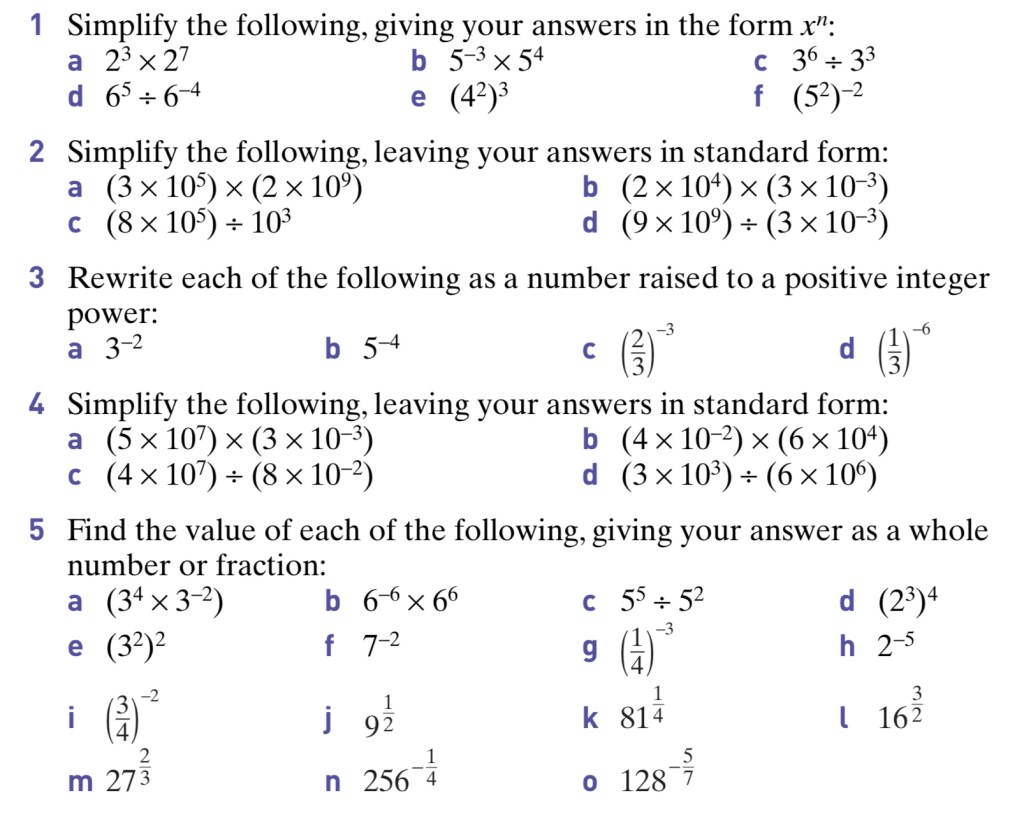
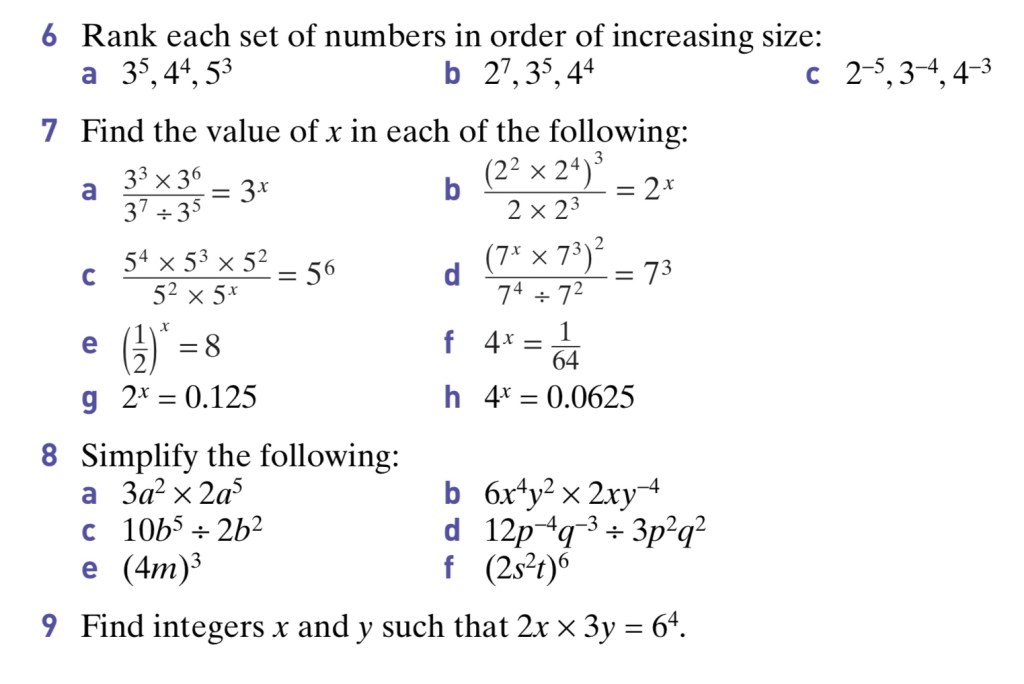
Exercise 1
Surds
Surds are irrational numbers such as 

To simplify a surd, we must check for any square numbers within the root and write them outside of the root, as in the next example:
| Worked Example 4 Simplify  |
| Worked Example 5 Simplify  |
We add and subtract surds by treating them as like terms.
Expanding brackets involving surds follows the same principles as expanding brackets in general.
| Worked Example 6 Simplify  |
| Worked Example 7 Simplify  |
| Worked Example 8 Simplify  |
| Worked Example 9 Simplify  |
Rationalising the Deonominator
It is better to present fractions within surds on the numerator and not the denominator. If we wish to remove them from the denominator, we simply need to multiply the fraction through by the surd.
| Worked Example 10 Simplify  |
| Worked Example 11 Simplify  |
| Worked Example 12 A right angled triangle has shorter sides of lengths (  )cm and ( )cm and (  )cm. Work out the length of the hypotenuse. )cm. Work out the length of the hypotenuse. |
| Worked Example 13 A ladder of length 6m is placed 2m from a vertical wall at the side of a house. How far up the wall does the ladder reach? (Leave your answer as a surd) |
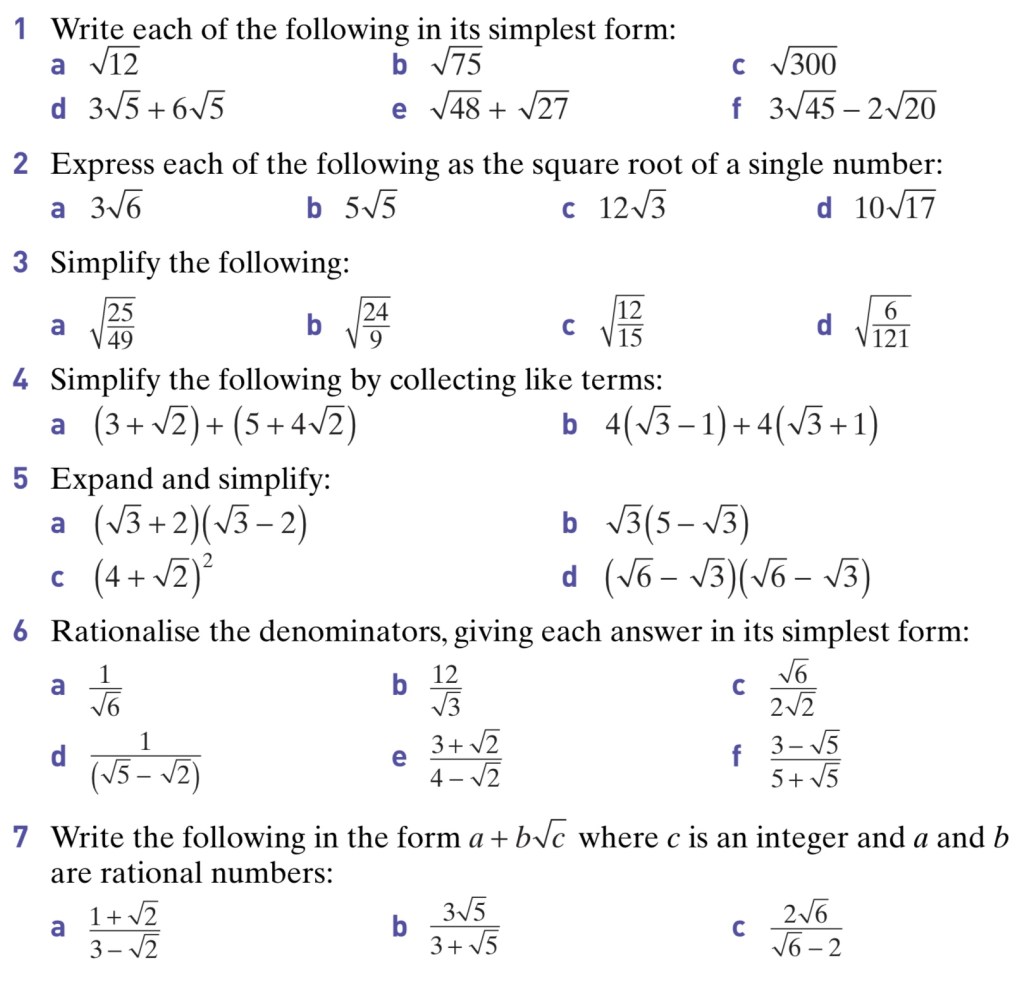
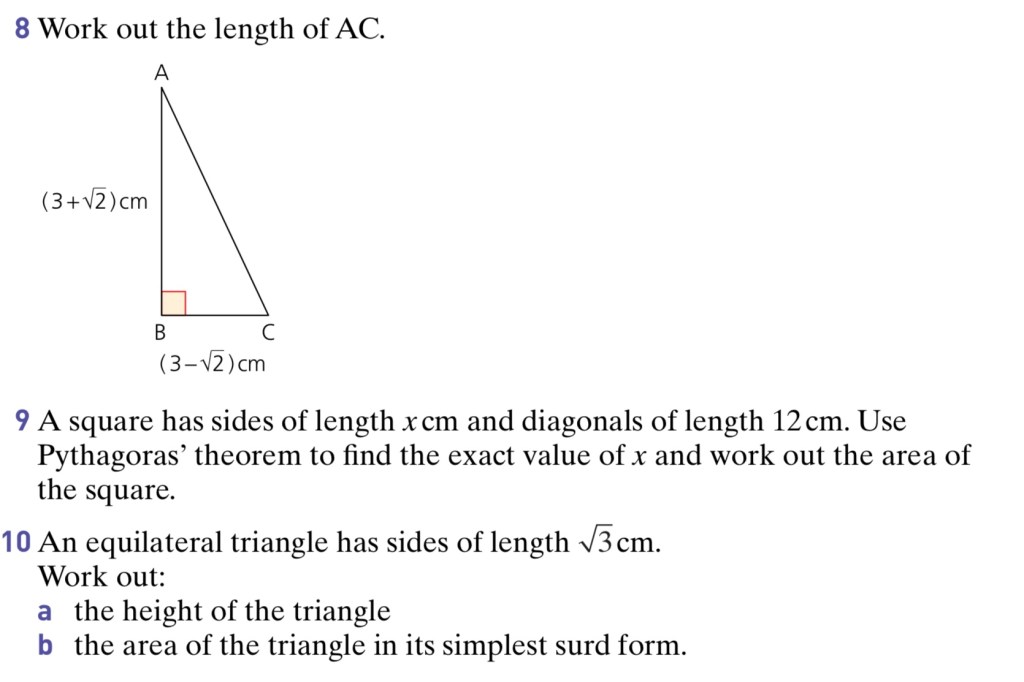
Exercise 2
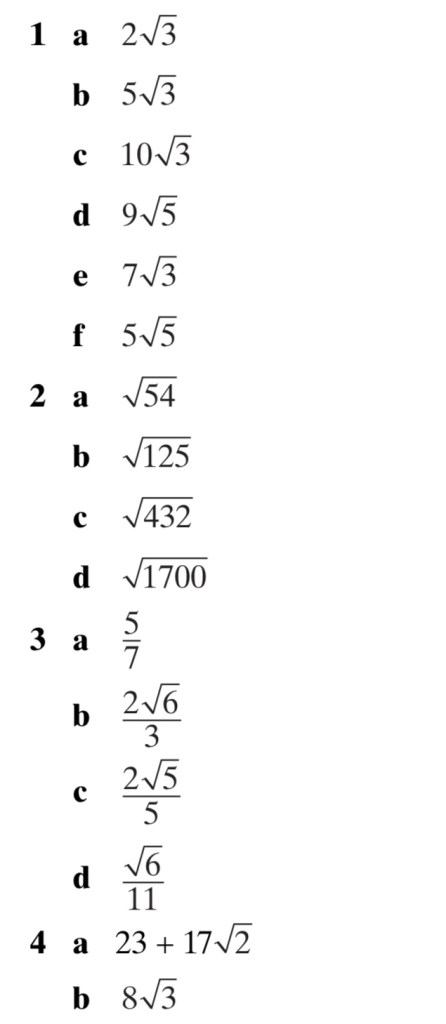
Exercise 2 Answers

 Maths with David