Any diameter of a circle is a line of symmetry (i.e. it has infinitely many).
A circle has rotational symmetry around its centre.
Due to these two facts we can deduce the following:
- The perpendicular bisector of any chord passes through the centre of the circle;
- Equal length chords are an equal perpendicular distance from the centre (the converse is also true);
- Two tangents drawn to a circle from the same point outside the circle are equal in length.
Worked Example 1
Chord AB is drawn in a circle with a radius of 7cm. If the chord is 3cm from the centre of the circle, then find the length of the chord correct to 2 decimal places.
Worked Example 2

O is the centre of a circle with radius 11cm. AB and CD are chords, with AB = 14cm. If OX = OY, then find the length of OY correct two 2 decimal places.
Worked Example 3
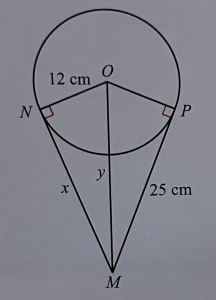
Find the lengths of x and y in this diagram correct to 2 decimal places.
Worked Example 4

Find the sizes of angles x and y in the diagram above.
Exercise
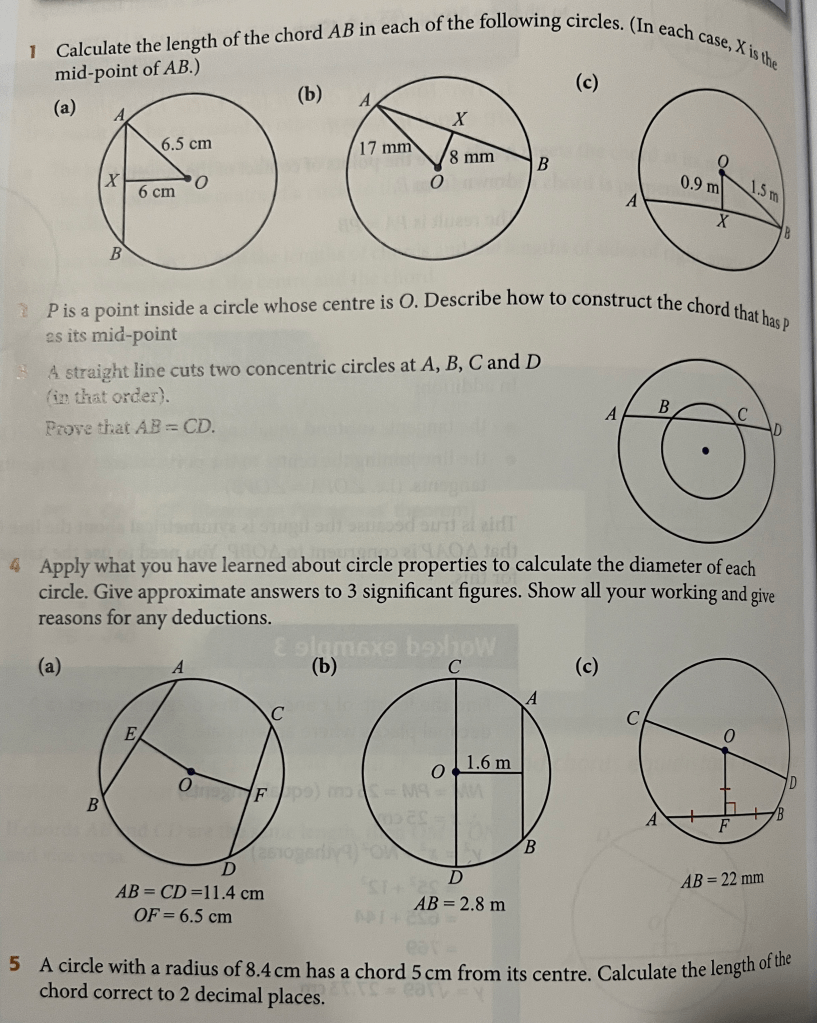
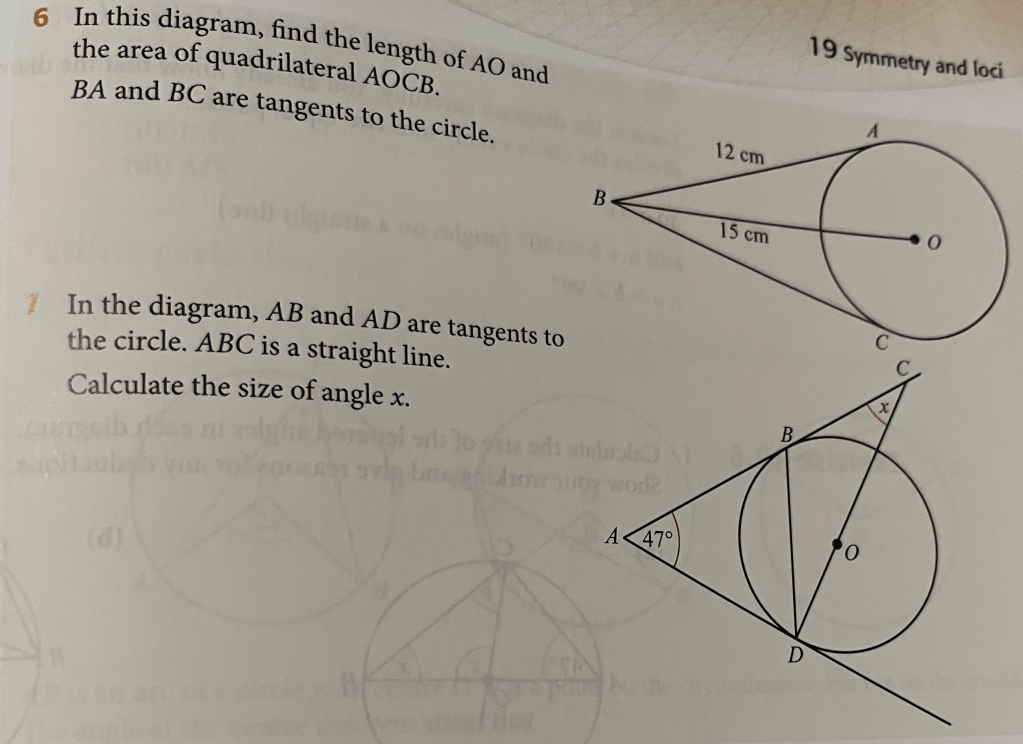
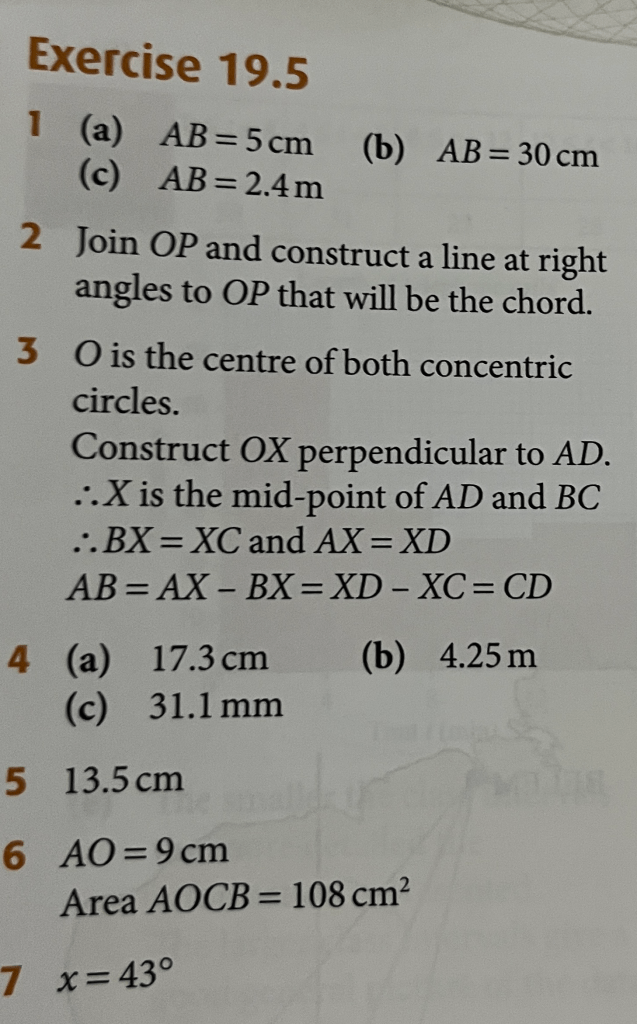
Answers
 Maths with David